

What is a release clause in soccer and how does it work?
By Mariano David Pérez Co-founder

A release clause is a fixed amount, written into a footballer’s contract, that must be paid to the club for the player to end that contract early and leave as a free agent. If someone puts up the money, the club cannot refuse: there is no negotiation, because the price was agreed in advance. Spain has one in every contract, Brazil requires one by law, and almost everywhere else it is optional.
Why does every contract in Spain have a release clause?
In Spain the clause comes from employment law, not from a soccer rulebook. Royal Decree 1006/1985, which governs the employment of professional athletes, says in Article 16 that an athlete may terminate the contract of their own will and that the club is entitled to compensation. Then comes the detail that explains everything: “in the absence of an agreement”, that compensation is set by a labour court.
The decree does not force anyone to write down a figure, but no club wants a court to price its best player, so all of them agree the number up front. The same Article 16 adds that if the player signs for another club within a year, that club is secondarily liable for the payment.
How is a release clause paid?
The usual procedure has three steps: the club that wants the player advances him the money, the player or someone he authorises deposits the amount at LaLiga’s headquarters, and LaLiga passes it on to the old club and releases the player.
It is not the only route. In August 2017 Neymar’s lawyers went to LaLiga with the EUR 222 million of his clause; LaLiga declined the deposit, and the payment was made the same day directly at Barcelona’s offices, according to the club’s statement.
How does a release clause work in other countries?
- England. Not mandatory. A release clause, often called a buy-out clause, is a private term between club and player, usually confidential, and many contracts have none. Without it, the only way out is for the two clubs to negotiate a transfer fee.
- Brazil. Mandatory by law. The General Sports Law (Law 14,597 of 2023, Article 86) requires every contract to include a cláusula indenizatória esportiva, the “multa rescisória” of the Brazilian press. The parties set it freely, capped at 2,000 times the average contractual salary for transfers within Brazil and with no cap for transfers abroad. The player and the new club are jointly and severally liable for it.
- Argentina. Optional. In June 2025 the Argentine FA and the players’ union, Futbolistas Argentinos Agremiados, agreed a model “simplified contract termination clause” that the parties may include: the player notifies the club, the FA and the union, pays the agreed amount and is free to go. With no official text published online, the detail comes from an analysis in the Argentine legal journal abogados.com.ar, in Spanish.
- FIFA. It does not require one. Article 17 of its Regulations on the Status and Transfer of Players deals with compensation for terminating a contract without just cause; agreeing the amount in advance keeps that calculation out of a tribunal’s hands.
How do a release clause, an exit clause and an option to buy differ?
They are used interchangeably, but they are three different things: what changes is who holds the right and when it can be used.
| Who holds the right | When it can be used | What happens | |
|---|---|---|---|
| Release clause | The player | At any point in the contract | The amount is paid and the player is free |
| Exit clause | The player | Only if a condition is met: relegation, missing out on European soccer, an offer from a certain kind of club, a specific window | The club must let him go for the agreed amount, usually a lower one |
| Option to buy | The club taking him on loan | Within the period set in the loan agreement | The loan becomes a permanent transfer at the agreed price |
An option to buy is not even in the player’s contract: it is an agreement between two clubs, and the player still has to accept his new contract separately. In everyday English usage, “release clause” often covers the first two rows, so always ask which one is meant.
Who pays the release clause: the player or the club?
Formally the player pays, because he is the one ending his employment contract. In practice the money comes from the club signing him, which is why the law ties that club to the debt: secondarily liable in Spain, jointly liable in Brazil.
That structure has tax consequences: if the money passes through the player, the question is whether the tax authority treats it as his income. Spain’s tax directorate examined the issue in a binding ruling in 2016 (V3375-16), in Spanish. Paying a clause is not taxed like a transfer agreed between two clubs, so it is a job for a tax adviser in each country.
It matters to agents too: under the FIFA Football Agent Regulations, compensation for breach of contract is left out of the base for the fee of an agent acting for the selling club, although that rule is part of the fee caps that circular 1873 suspended. We cover it in how much soccer agents earn, and it is worth addressing in the representation agreement.
How to record the clause in The Scout Arena
In The Scout Arena each playing contract is stored with its club, its term, its amount and a summary of its clauses, with the signed PDF attached, and is visible from the player’s profile. That is where the release clause goes: amount, currency and conditions, for instance “EUR 4,000,000; drops to 2,500,000 if the club is relegated”.
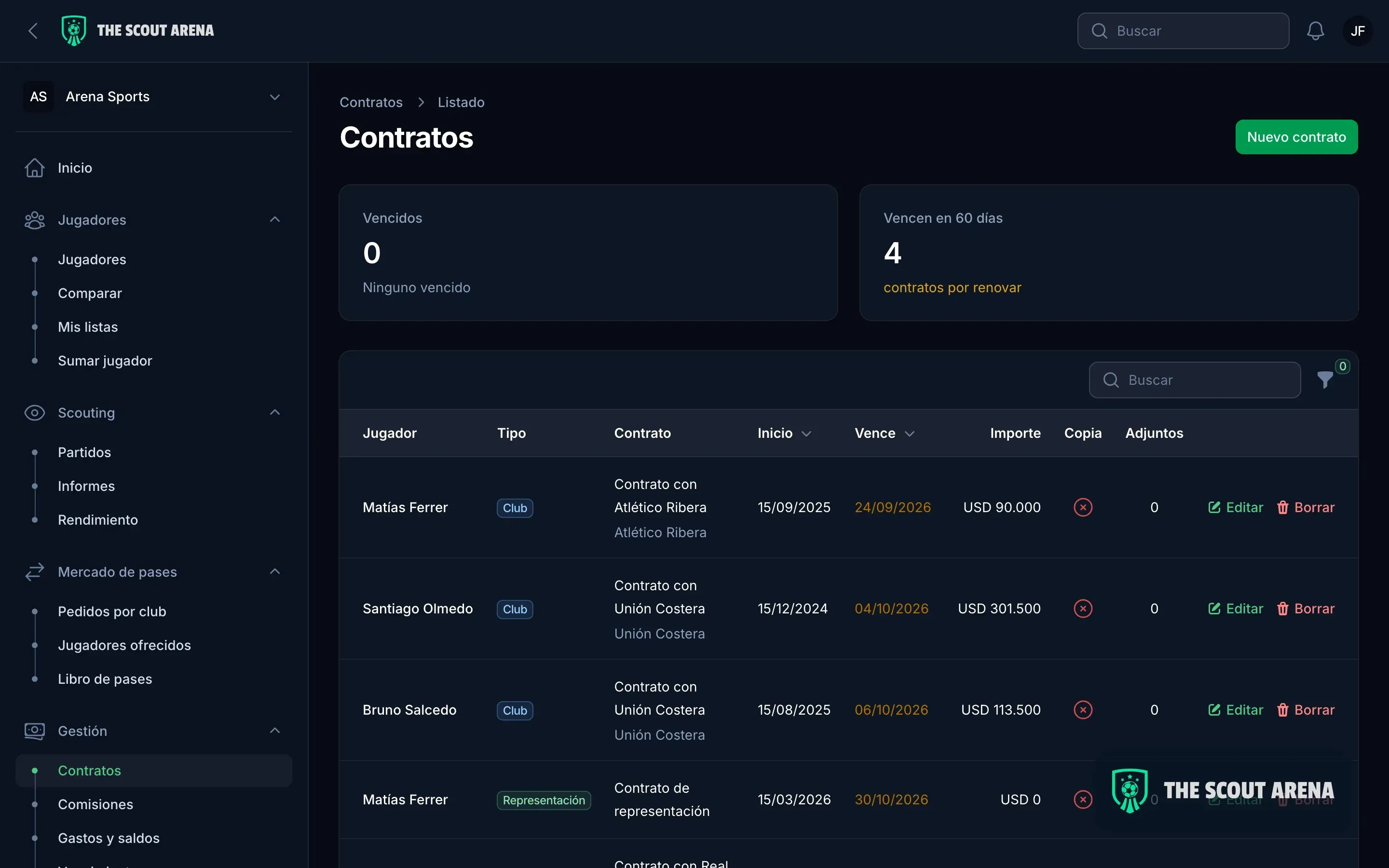
Since many clauses change value over time, it pays to read them alongside the contract expiry alerts: once a contract enters its final six months, the clause becomes almost irrelevant.
In short
A release clause is the pre-agreed price for a footballer to end his contract and walk free. In Spain every contract has one because of Royal Decree 1006/1985, normally paid by deposit at LaLiga; in Brazil the law requires it; in England and Argentina it is optional. It is not an exit clause or an option to buy, and formally the player pays it, with the buying club’s money.
Sources
- Spain’s Royal Decree 1006/1985 on the employment of professional athletes, in the BOE (Article 16, in Spanish).
- Brazil’s Law 14,597/2023, the General Sports Law (Article 86, in Portuguese).
- FIFA Regulations on the Status and Transfer of Players (Article 17).
- FIFA Football Agent Regulations.
- Binding ruling V3375-16 of Spain’s Directorate General for Taxation (in Spanish).
- FC Barcelona statement on the payment of Neymar’s clause, 3 August 2017.
- The June 2025 agreement between the Argentine FA and Futbolistas Argentinos Agremiados, as summarised by abogados.com.ar (specialist press in Spanish, not an official text).
This article is for information only and is not legal or tax advice. Updated to September 2026.