

Roles in a soccer agency: who does what and who sees what
By Mariano David Pérez Co-founder

Roles in a soccer agency come down to three questions: who does each task, who decides on it and who is allowed to see the information involved. The answer usually gives four functions — the licensed agent who leads, whoever runs day-to-day admin, whoever handles the money and whoever watches matches — even if, in a small agency, one person covers two or three of them. What doesn’t change with size is that only a licensed agent can represent a client, and that nobody needs to see everything.
Updated on 21 October 2026. The regulatory points come from the FIFA Football Agent Regulations, edition in force since 1 January 2025. The data protection points come from the EU General Data Protection Regulation; outside Europe your own country’s law applies, and a lawyer should confirm it.
What roles does a soccer agency have?
An agency has no fixed org chart, but the work always splits into the same four functions. Naming them helps even if there are only two of you: when something gets dropped, you know whose it was.
| Role | What they do | What they decide |
|---|---|---|
| Licensed agent (lead) | Signs up players, signs representation agreements, negotiates with clubs, talks to families | Who joins the agency, what to accept in a negotiation, who joins the team |
| Day-to-day admin | Keeps player profiles, lists, documents and deadlines up to date; runs the diary | How information is organized, what to chase and when |
| Finance admin | Records contracts, commissions and expenses; prepares the month-end close | Nothing commercial: organises and flags, never negotiates |
| Scouting | Watches matches, files reports and follows both clients and targets | Which player is worth putting to the agent |
The table hides one rule: recording and deciding are not the same thing. The scout files a report but doesn’t decide to sign the player; the finance admin records a commission but doesn’t negotiate it. When that line is blurred, one of two things happens: either the agent ends up entering expenses at eleven at night, or someone on the team promises something that wasn’t theirs to promise.
How these functions fit into the week — what happens on Monday, what on Friday — is covered in a soccer agent’s daily tasks.
Which tasks can only the licensed agent do?
The representation itself. The FIFA regulations are explicit across three articles:
- The license is personal. It is granted to an individual and is “strictly personal and non-transferable” (art. 8.1). The agency holds no license; its agents do.
- Only an agent represents. “Only a Soccer Agent may perform Soccer Agent Services” (art. 11.1), and only an agent may approach a potential client or enter into a representation agreement with one (art. 12.2).
- The team doesn’t approach clients. Agency employees or contractors who are not soccer agents may not perform those services or approach a potential client to represent them, and the agent remains fully responsible for any breach by the agency and its people (art. 11.3).
In practice, the scout who likes a youth player doesn’t offer the family representation: they tell the agent, and the agent decides whether to call. And the regulations define an “approach” broadly: in person or through any electronic means, with the player or with a family member or friend. A message on Instagram to a youth player’s mother counts, so the whole team should know this from day one. If the player is a minor, the rules are stricter: see representing a minor.

Who should see what information in an agency?
Each person sees what they need for their job, and nothing more. It isn’t about mistrust: it means a mistake, a lost laptop or someone leaving doesn’t expose what never needed sharing. The GDPR calls this data minimisation: personal data must be “adequate, relevant and limited to what is necessary” for the purpose it is processed for (art. 5(1)(c)). It adds that anyone acting under the controller’s authority may only process the data on the controller’s instructions (art. 32(4)).
An agency handles three kinds of information with very different sensitivity:
| Information | Why it’s sensitive | Who needs it |
|---|---|---|
| Financial: commissions, contracts, expenses, balances | It’s the agency’s business and the player’s salary | The lead and finance admin |
| Sporting: reports, performance, lists | Written opinions about people, often minors | The lead, scouting and day-to-day admin |
| Personal and medical: documents, passports, injuries, test results | Health data is a special category under the GDPR (art. 9) | Only whoever handles or decides on that player |
The classic mess is the shared spreadsheet: one sheet with the contract, the commission, the scout’s report and the scanned passport, open to everyone because “there are only a few of us”. The day the scout also works for another agency, or someone forwards the file to a club, there’s no undoing it. Which documents to keep for each player, and where, is covered in soccer player documents.
How do you split roles in a small agency?
By combining functions, not skipping them. In a one-person agency the agent is all four, and what matters is not mixing the records: the report goes with the player, the expense with its player or as an overhead, the commission with its contract. That way, when someone else joins, you can hand over part of the work without unpicking everything.
The most common combinations by size:
- One person. The agent does everything, but still benefits from separate records and a fixed half-hour a week for admin.
- Two people. The agent leads and watches matches; the other person runs all the admin, financial and day-to-day.
- Three to five. Scouting becomes its own function, with one or two scouts who don’t see the finances, and admin can be split in two.
- More than five. Several licensed agents, each with their own clients, and shared admin. Here it matters that each agent sees the finances of their own clients and the lead sees everyone’s.
What should happen when someone joins or leaves the agency?
When someone joins, give them access to what their role needs, explain in one sentence what they decide and what they don’t, and walk them through article 11 if they aren’t an agent. When someone leaves, cut their access that same day, reassign their players, pending tasks and games to someone else, and check what they had downloaded.
The second half is the one people forget. A scout who left with the agency’s spreadsheet on their phone took the reports, the club contacts and sometimes a minor’s passport number with them. That’s why splitting roles works better in a system with individual user accounts than in shared files: permissions change in one place and there are no loose copies.

How roles work in The Scout Arena
The Scout Arena has the same four roles described above, with permissions that come from the application’s rules rather than a promise (the screens are from a demo agency with made-up data):
- Owner. Sees everything: finances, contracts, performance and team. Manages the agency, invites people and sets roles.
- Administrator. Runs the full day-to-day across players, contracts and reports, and can invite people, but doesn’t edit the agency’s details.
- Admin staff. Works on the financial side — contracts, commissions, expenses and deadlines — and doesn’t file game reports.
- Scout. Files game reports and follow-up notes, builds their lists and follows their players. Doesn’t see contracts, commissions or financial reports.
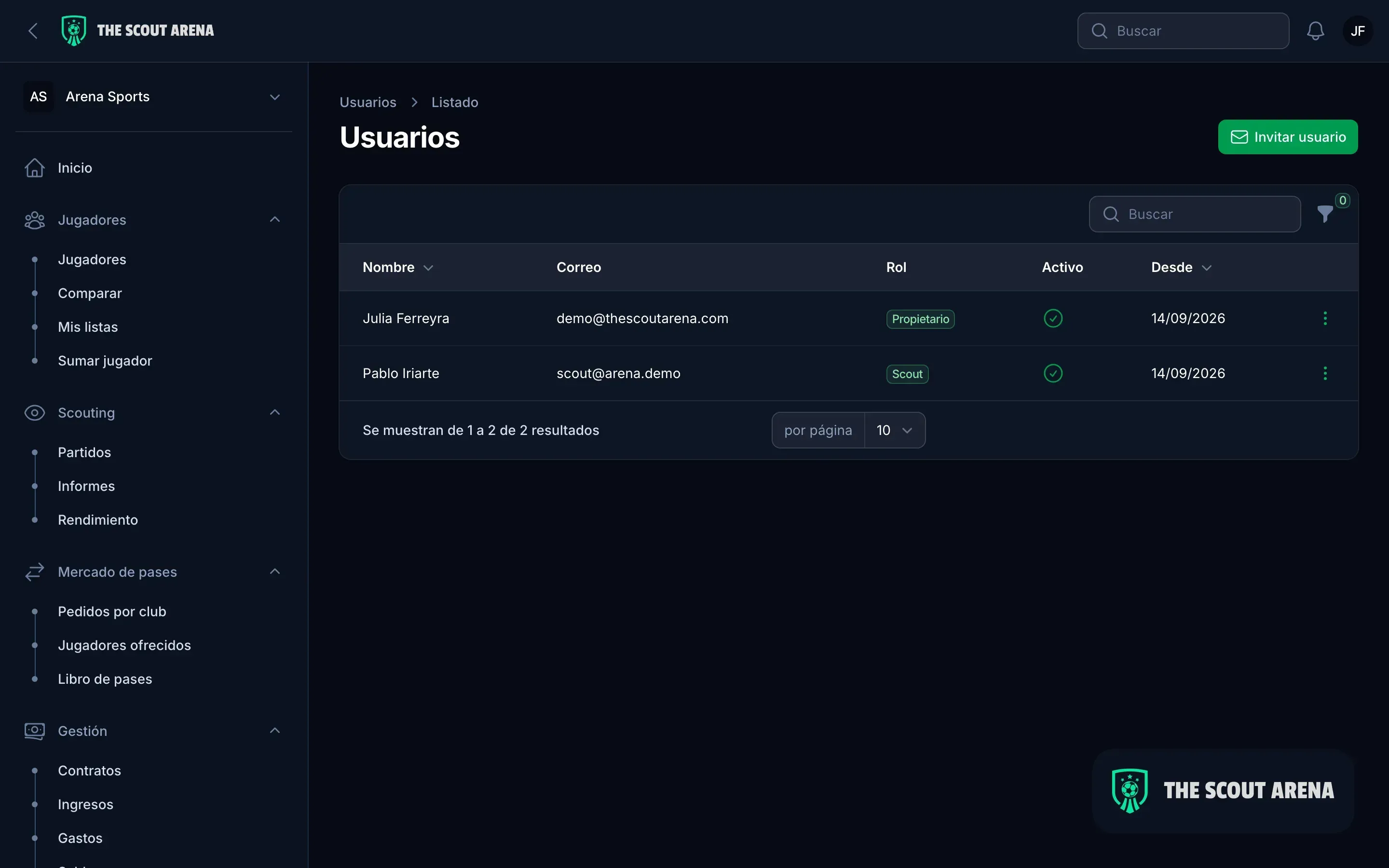
People join through an email invitation that already carries their role, and everyone works on the same player profile, each on their own part: the scout on reports and follow-up; admin on the contract and commissions, which the scout can’t see. The WhatsApp assistant follows the same table: a scout who asks it how much the agency earned doesn’t get an answer. The full table of what each role can reach is on the page for soccer agents.
This split is one of the pieces of how to organize a soccer agency; what else to ask of a system before paying for it is in the article on apps for soccer agents.
In short
Roles in a soccer agency are four functions — a licensed lead, day-to-day admin, finance and scouting — which in a small agency the same people share. What can’t be shared is representation: under FIFA’s regulations only the licensed agent approaches, signs and negotiates, and answers for what the team does. And each person sees what their job needs: the scout doesn’t see commissions, admin doesn’t read the reports, and medical data stays with whoever handles it.
This article is for information only and is not legal advice. The regulatory points were checked against the editions cited at the top, as of October 2026; each national association may have its own agent rules, and each country its own data protection law.
Sources
- FIFA Football Agent Regulations, in force since 1 January 2025 (PDF) — articles 8.1, 11.1, 11.3 and 12.2
- Regulation (EU) 2016/679, General Data Protection Regulation (EUR-Lex) — articles 5(1)(c), 9(1) and 32(4)