

App for soccer player agents, stage by stage
By Mariano David Pérez Co-founder

An app for soccer player agents has to follow each client through their career, not just store their details: when you may approach them if they are a minor, when your representation ends, how long is left on their club contract, which window they can move in, and when another agent or another club may step in. Every one of those stages has a deadline written into FIFA’s regulations, and the app earns its place if it warns you about each one before it arrives. This article walks through a player’s career stage by stage and sets out what the tool needs to record at each.
Updated November 2026. The regulatory points come from the FIFA Football Agent Regulations, in force since 1 January 2025, and the Regulations on the Status and Transfer of Players (RSTP), July 2025 edition. FIFA has already published a reformed RSTP that takes effect in January 2027; check the deadlines below again once it applies.
What makes an app for player agents different from a calendar or a spreadsheet?
The unit is the player and their career, not the task or the row. A calendar holds loose dates and a spreadsheet holds loose data; an app built for player agents knows that the end of your representation and the end of the club contract belong to the same player, that one depends on the other, and that each opens a different window.
That changes what you get back. A spreadsheet tells you a full-back’s contract ends in June. An app for player agents tells you that from January that full-back can sign for another club, that your representation ends before his contract does, and that his country’s window closes in two weeks. Agents rarely lose a client over information they didn’t have; they lose them over two pieces of information kept in different places.
What should it record at each stage of a player’s career?
It should record what the regulations require of you at each stage and the deadline that starts running from there. The table sums up the six stages almost every client goes through; the sections below explain each one.
| Stage | What the regulations say | What the app needs to keep |
|---|---|---|
| 1. Before you represent them (youth) | First contact with a minor or their guardian may happen no earlier than six months before the age at which they can sign their first professional contract, only once, and with the guardian’s written consent (art. 13.1) | Date of birth, the first-contract age in their country, the date from which contact is allowed, and the consent |
| 2. Signing the representation agreement | Two years at most, extendable only by a new agreement (art. 12.3); uploaded to the FIFA platform within 14 days (art. 16.2 j) | Signing date, expiry date, the signed PDF and proof of the upload |
| 3. The club contract | Five years at most; a player under 18 may not sign a professional contract longer than three (RSTP, art. 18.2) | Club, start, end, salary and clauses |
| 4. Fees | Paid in quarterly installments over the employment contract, and only on what the player actually receives (arts. 14.6 and 14.7) | Every installment, invoiced and collected |
| 5. A transfer | Registration only happens in one of each country’s two annual registration periods (RSTP, art. 6) | The destination country’s windows and the clubs that asked |
| 6. The end of each contract | In the last six months of the club contract, the player is free to sign for another club (RSTP, art. 18.3); in the last two months of your exclusive representation, another agent may approach and sign them (art. 16.1) | Two separate alerts, with margin before each deadline |
1. Before you represent them: the youth player you follow
The longest stage of many careers is the one before any contract exists. You follow a fifteen-year-old for two seasons, and the regulations set a date before which you cannot discuss representation with the family: six months before the first professional contract age in the country where they will play. To represent a minor you must also have completed the continuing professional development course on minors (art. 13.2), and the agreement is signed by both the minor and their guardian (art. 13.3).
The app should work that date out for you from the date of birth, and in the meantime keep what you have seen: matches, minutes, reports and follow-up notes. What FIFA allows with minors is covered in representing a minor.
2. Signing the representation agreement
A representation agreement with a player lasts two years at most, and any automatic renewal clause is void. Before signing, you must tell the player in writing that independent legal advice is advisable and get their written confirmation (art. 12.4). And you may only have one representation agreement in force with the same person.
For the app that means three things: the expiry date, which triggers every other alert; the signed PDF, ready for the FIFA platform upload; and the record of the legal-advice confirmation. What the agreement itself must say is in the soccer representation agreement, clause by clause.
3 and 4. The club contract and the fees
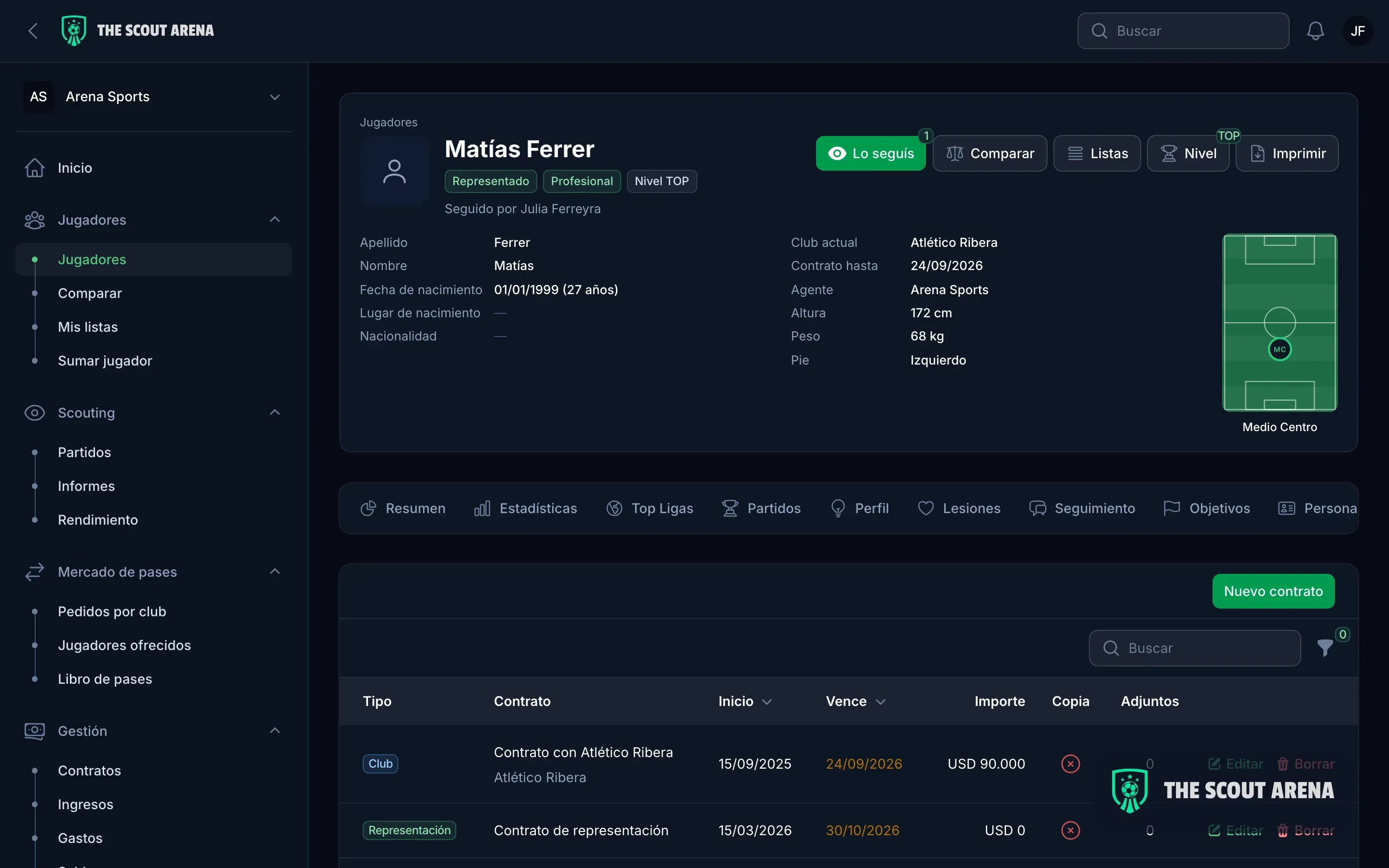
The player’s employment contract sets how much you earn and for how long: your fees are paid after the registration period closes, in quarterly installments across that whole contract. If the player moves to another club before it ends, the outstanding installments are lost (art. 14.12).
That is why the app should keep the club contract next to the representation agreement, not in another file: the agreed salary, the dates and the installments that follow from them. Tracking those installments and each player’s costs is covered in how to organize a soccer agency’s expenses.
5. A transfer
A player can only be registered with a new club during one of the two registration periods each association sets: the first lasts between eight and twelve weeks, the second between four and eight, and together they may not exceed sixteen (RSTP, art. 6.2). Dates vary by country, and a club asking about your player on the last day of its window is a club that won’t be able to sign him.
What the app needs to bring together here is two lists: which markets are open today and which clubs asked about which position. Each country’s dates are in transfer window dates by country.
6. The end of each contract
There are two endings, and the app should flag them separately. The club contract: in its last six months, your client may sign for another club without his current club’s permission. Your representation: in its last two months, another agent may approach and sign him. If your representation ends before his club contract does, the player reaches his most valuable moment with nobody representing him.
An alert that arrives on the expiry date is useless for either. A sensible margin is several months for the club contract and more than two for the representation; soccer contract expiry goes through the deadlines.
Does an agent working alone need an app?
They need one once they have more clients than dates they can hold in their head, and that happens sooner than it seems: ten players means at least twenty contracts with expiry dates, plus passports, plus quarterly installments. An independent agent doesn’t have the “who sees what” problem, but they do have the problem of not being able to fall ill for a week without something slipping.

What changes between working alone and working in an agency is what you ask of the tool. Alone, it’s enough that it warns you and that the information is written down. In an agency, each person also needs to see only what concerns them: that’s in roles in a soccer agency. Either way the tool comes after the routine, as how to organize a soccer agency explains.
What should you ask an app for player agents before choosing one?
Ask whether it understands the career, not just whether it stores contracts. What a soccer agent app solves, and what it doesn’t has the full test for installments, costs and permissions; these are the questions specific to following clients over time:
- Does it separate the representation agreement from the club contract? They are two dates that open different windows, and the app has to flag each one on its own.
- Does it follow a youth player who has no contract yet? Matches, minutes, reports and their age group, even with nothing signed.
- Does it keep documents with their expiry dates? A passport that needs renewing before a trial abroad expires just like a contract.
- Does it show which markets are open and who has asked? A transfer plays out between those two lists.
- Does it show the player’s history in one place? What happened with a client over the last three years shouldn’t depend on who remembers.
How The Scout Arena handles it
The Scout Arena is the software we built for player agencies, and it follows every stage in the table above from the player profile.
- One profile per client. Personal details, contracts, finances, performance, reports, follow-up, goals, contacts and documents, in the tabs of a single player profile.
- Youth players before the contract. Their age group’s matches, game reports and threaded follow-up notes, with performance by season.
- Both endings, separately. Contract expiry alerts bring together club contracts, representation, documents and passports, with the days left and an email every morning.
- Installments. Contracts and commissions tracks what was agreed, invoiced and collected, installment by installment and by currency.
- The market. Each club’s requests, with position, age and budget, to match against your clients, and the transfer window book showing which windows are open by country.
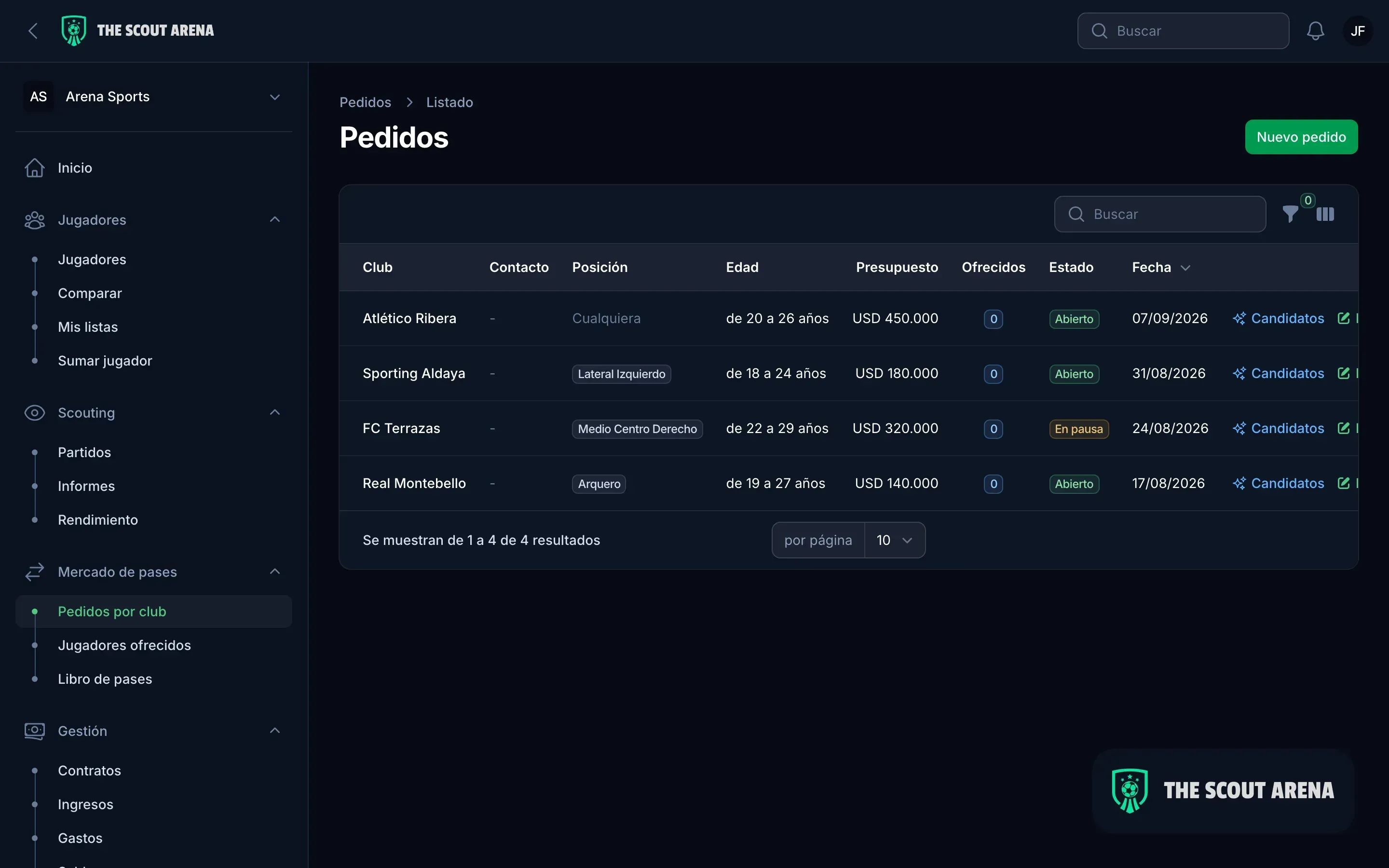
What it doesn’t do is file on the FIFA platform for you or talk to the family: it keeps the contract, the date and the deadline to hand. How each role in an agency works inside the panel is on the page for soccer agents; plans are on pricing, and you can book a demo to walk through the table with one of your own clients.
This article is for information only and is not legal advice. Deadlines were checked against the FIFA editions cited, as of November 2026; each national association may have its own rules on agents and on the age of a first professional contract.
Sources
Consulted in October 2026:
- FIFA Football Agent Regulations, in force since 1 January 2025 (PDF): articles 12.3, 12.4, 13.1 to 13.3, 14.6, 14.7, 14.12, 16.1 and 16.2 j).
- FIFA Regulations on the Status and Transfer of Players, July 2025 edition (PDF): articles 6.1, 6.2, 18.2 and 18.3.
- FIFA: 2026 edition of the Legal Handbook, with the reformed RSTP that takes effect in January 2027.