

How to write a soccer scouting report clubs will read
By Mariano David Pérez Co-founder
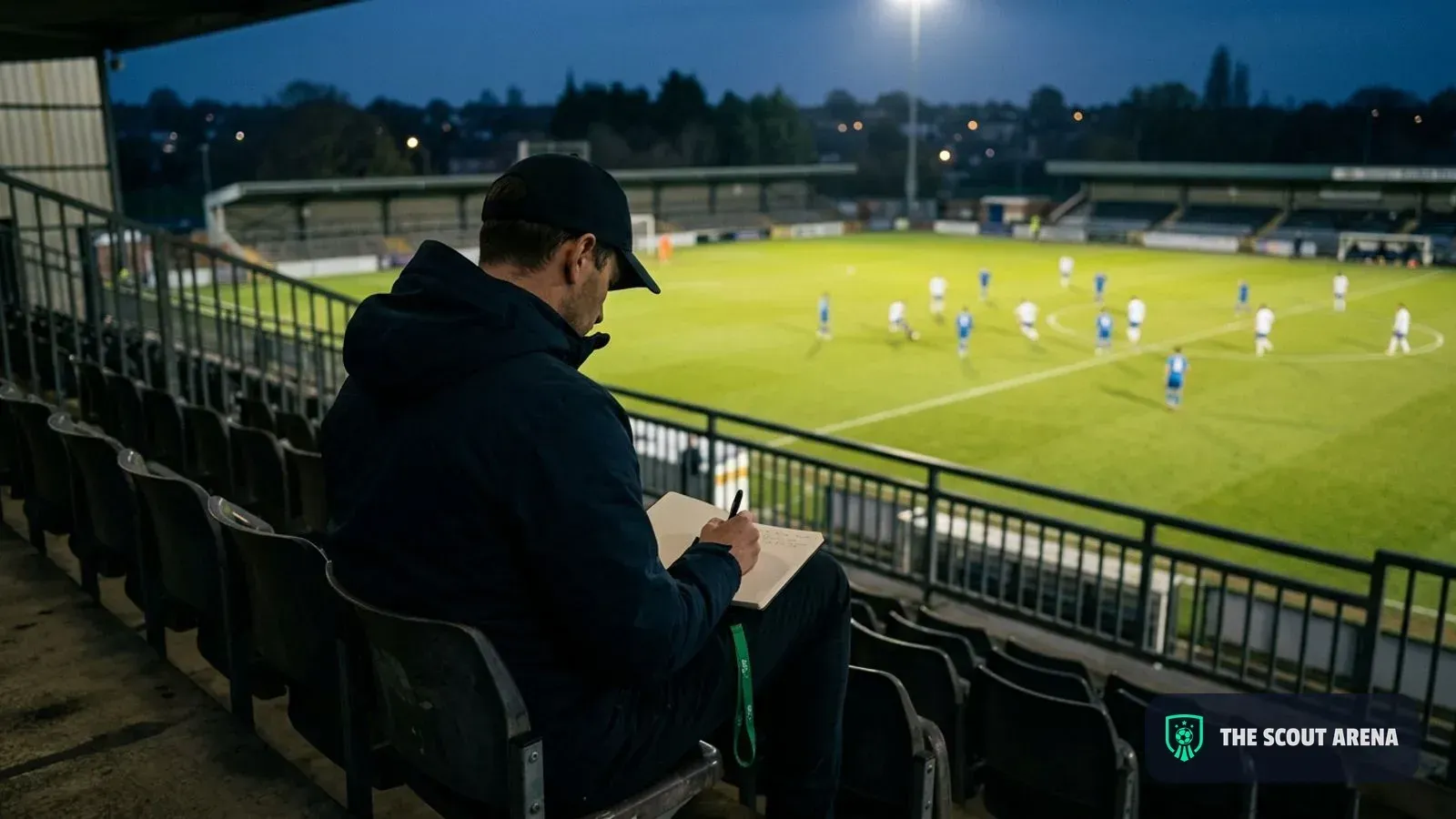
A soccer scouting report is the document in which a scout writes down what they saw from a player in a match and what they recommend doing about it: sign, keep watching or drop. It covers the game context, the player’s details, a technical, tactical, physical and mental assessment, and a conclusion with a recommendation. The reports that get read put the conclusion first, in one sentence, and use everything else to back it up.
What a scouting report is for, and who reads it
A report exists so that someone who did not watch the game can make a decision. That person is usually a sporting director, a head of recruitment or the owner of an agency, and there are twenty more reports in their inbox. They want to know whether this player deserves another trip, another phone call or another hour of video.
That gives you the three questions every report has to answer, in this order:
- What do we do with this player? Sign, monitor, watch again in a different setting, or discard.
- Why? Two or three things you observed, not impressions.
- How sure are you? One match on video is not the same as four from the stands.
If the reader has to reach the bottom of page two to find the first answer, the report has already lost.
The sections of a soccer scouting report
There is no official format: every club and every agency has its own. But almost every template that works shares the same six sections.
| Section | What goes in it |
|---|---|
| Match context | Date, competition, opponent, result, field conditions, live or video |
| Player details | Name, age, club, position played, preferred foot, minutes, goals, cards |
| Technical | First touch, passing, carrying, finishing, aerial play, depending on position |
| Tactical | Positioning, reading of the game, behavior in and out of possession, in each phase |
| Physical and mental | Pace, power, stamina; reaction to mistakes, leadership, concentration |
| Conclusion and recommendation | An overall grade, a one-sentence summary and the next step |
Match context
Context is what makes two reports comparable. A full-back who never overlapped may be a limited full-back, or a full-back whose team went down to ten men after twenty minutes. Note the opponent, the result, the team’s shape, the player’s role and anything that conditioned the game: heavy rain, a red card, a positional switch. A reader in another league needs to know what kind of match this was before trusting the grade.
Technical, tactical, physical and mental
The rule is to assess what the position demands, not a generic list. For a centre-back you look at duels, aerial play and build-up; for a winger, one-v-one play, crossing and the final decision.
The mental side is the hardest to observe and the one clubs ask about most. Write it with facts: “after his mistake for the goal he asked for the ball on the very next move” says more than “good character”.
How to write it so it is read in two minutes
A sporting director reads the conclusion, looks at the grade, and only scrolls down if something catches their eye. Build the report for that reading pattern:
- Conclusion at the top, not the bottom. The rest is evidence.
- Facts before adjectives. “Won seven of nine ground duels” rather than “very strong in the duel”. If you did not count, describe one specific action with its minute.
- Separate what you saw from what you think. “Intensity dropped in the last fifteen minutes” is an observation; “lacks stamina” is a hypothesis that needs another match.
- Say how much you have seen. One match, on video, with the player out of position, is a first impression and should be labelled as one.
- Write for a reader in another country. Avoid local slang for positions and roles; if the report may travel, plain terms travel better.
A simple test: cover everything except the first three lines. If they do not say what you recommend and why, rewrite them.
Which rating scale should you use?
The best scale is the one the whole team uses the same way. Three are common, and none of them is official:
| Scale | How it works | Strength | Watch out for |
|---|---|---|---|
| Numerical, 1 to 10 | One grade per attribute and one overall | Needs no explanation and can be averaged | Everything drifts to 6 or 7 unless each number is defined |
| Letters (A, B, C, D) | A: sign; B: monitor; C: not at the level today; D: discard | Forces a decision | No nuance within the same letter |
| Dual: current level and potential | Two grades per player | Essential for youth players | Needs a shared view of what “potential” means |
Whichever you choose, write down what each value means and tie it to a concrete level: “7: a starter in the division he plays in today; 8: could play one division higher”. Without that anchor, one scout’s 7 is another’s 5.
The most common mistakes
- Describing the game instead of assessing the player. The game report is already online.
- Adjectives with nothing behind them. “Interesting”, “tidy”, “dynamic”: nobody can challenge or compare them.
- Recommending nothing. A report without a next step forces someone else to decide with less information than you had.
- Drawing conclusions from one match. A performance is a data point, not a trend.
- Storing it where nobody will find it. A report in a notebook, a voice note or a chat thread stops existing within six months.
A short example of a soccer scouting report
The player, the clubs and the game are all invented.
Santiago Olmedo — left-back, 24, left-footed. Atlético Ribera Sur 1–1 Real Montebello, matchday 9, watched live. Played 90 minutes at left-back in a back four.
Conclusion: monitor. Overall 7 out of 10. Attacking full-back with a quality cross, ready to compete at this level; needs to be seen defending against a quick winger before we recommend him.
Technical. First touch almost always takes him forward. Six crosses, four into a shooting area; the one for the goal (62’) was first-time. Weak right foot: avoided it all three times he was forced inside.
Tactical. Picked his moments to go: never left space behind him while his team was ahead. Late to cover the far post; for the equaliser (78’) his man finished unmarked.
Physical and mental. Repeated high-intensity runs to the end, no drop after the 75th minute. After his error for the goal he asked for the ball in the next build-up and kept overlapping.
Next step. Watch him away from home against a side that attacks down his flank. First report: medium confidence.
That is about 150 words, and it answers all three questions: what to do, why, and how sure the scout is.
How match-by-game reports are logged in TheScoutArena
The report nobody can find is not fixed by better writing but by storing it where it belongs. In TheScoutArena a game report is logged from the game itself or from the player: you pick the player and the schedule, record how he featured (started, came on, unused substitute, not in the roster), minutes, goals and cards, and grade the attributes for his position from 1 to 10, grouped by phase of play. The conclusion holds an overall rating from 1 to 10, the comments, a “highlight” flag for what the rest of the team should look at, and situations such as injury, suspension, promotion to an older age group or an international call-up.
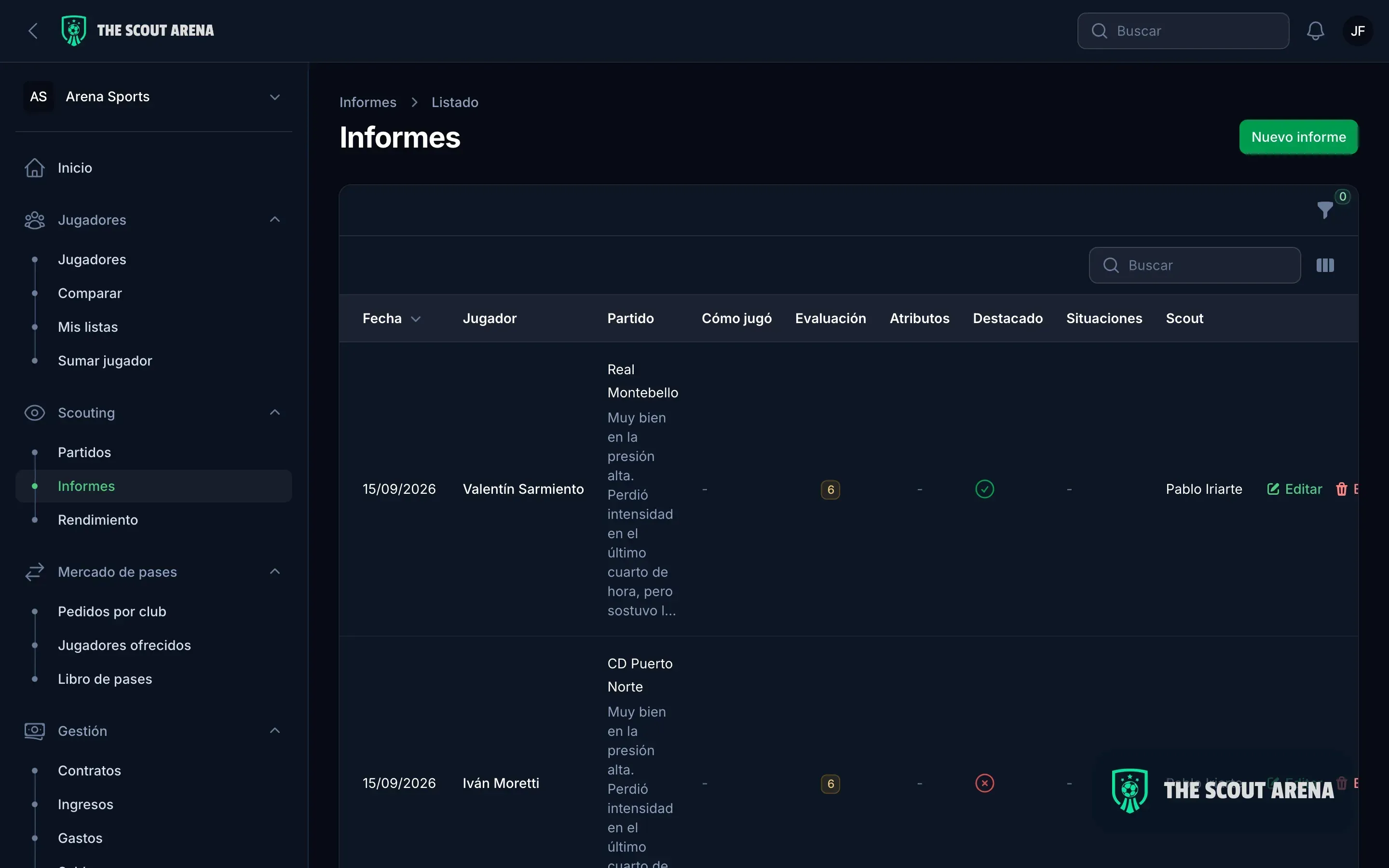
Every report carries the name of whoever wrote it and is attached to both the player and the game, so it shows up in the player profile next to his statistics and follow-up notes. A coordinator can assign the games to watch and read everyone’s reports; a scout files their own and does not see the agency’s finances. How that work is organized is covered on the page for soccer scouts.
If you are on the representation side and the report is part of how you present a player to a club, the guide on how to become a soccer agent is a useful companion.
In short
A soccer scouting report is written for someone who did not see the game and has two minutes. Conclusion and recommendation first; match context and player details to set the scene; technical, tactical, physical and mental assessment by position, written with facts; a rating scale the whole team reads the same way; and an honest note on how confident you are. Then file it where colleagues can find it: a report that cannot be searched does not exist.
Updated September 2026. There is no official format for a scouting report: the sections and scales described here are common practice in the trade, not a standard. The player, clubs and match in the example are invented.