

Scouting report app: filing reports from the ground
By Mariano David Pérez Co-founder
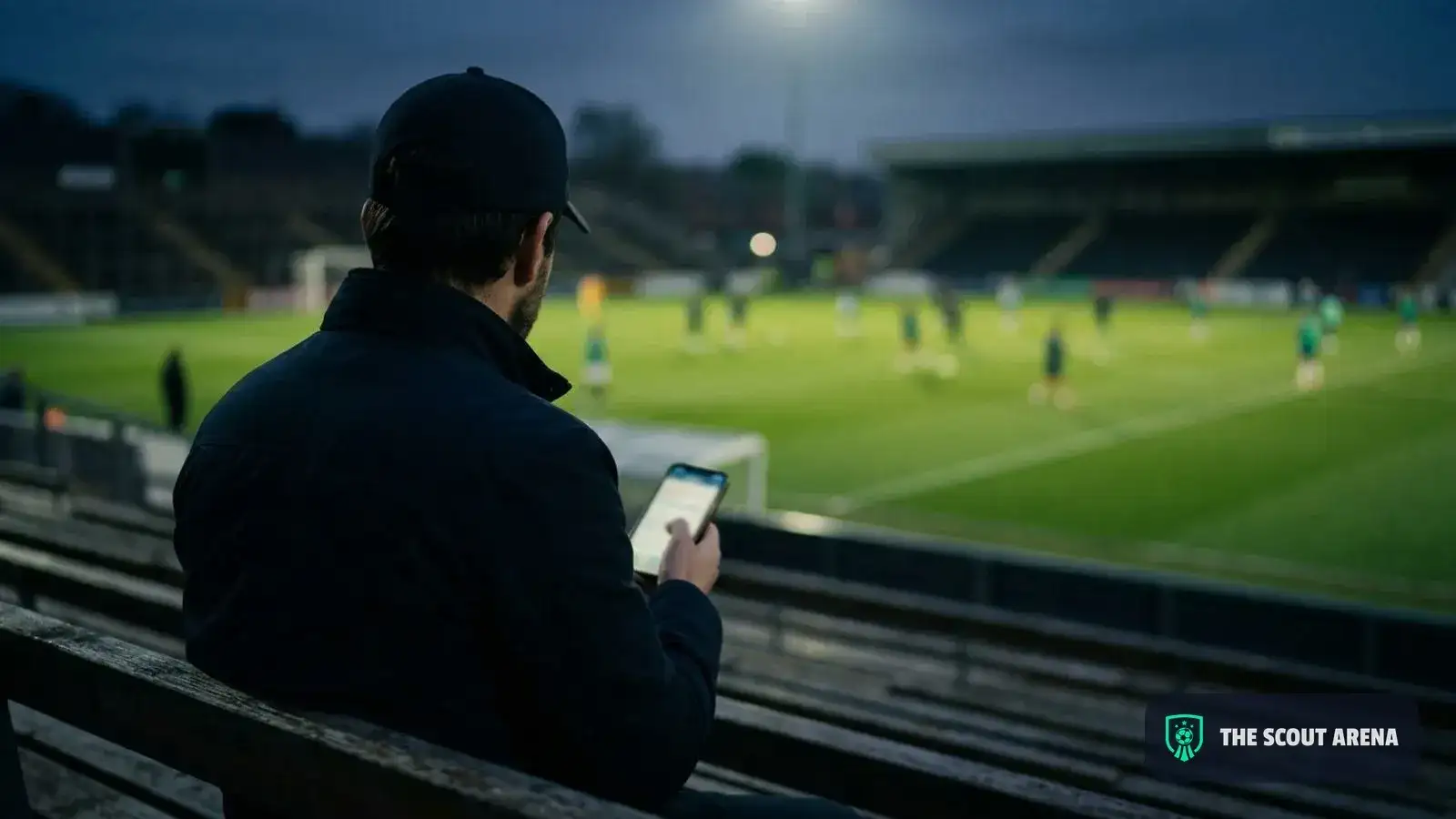
A scouting report app is worth having if the report is filed before you leave the ground: short notes during play, the undisputed facts at half-time and the assessment in the half hour after the final whistle. For that, the form has to fit a phone screen, arrive with the game already loaded and ask only for what can be answered standing in a stand. This guide sets out what to note at each point, what to demand from the app and the mistakes that push reports back to Monday.
Why file the report at the stadium and not on Monday?
Because a report written two days later no longer describes the game; it describes what is left of it. The exact minutes go, this full-back blurs into last week’s, and the comment ends up as “did his job”. A scout who watches three matches in a weekend reaches Monday with three reports outstanding and a clear memory of one.
The talent identification guide from FIFA’s Talent Development Scheme says that detailed and structured observations are what make the process thorough, standardised and efficient, and that the design of the player report scouts use when observing is critical (checked in October 2026). Both point the same way: the form needs to be in your hand while you watch, not on a computer you get to later.
This is not about looking at the phone instead of the game. It is about making sure the little you do note during play lands where it will stay, rather than in a notebook that has to be typed up afterwards.
What do you note during the game, and what afterwards?
A match lasts two halves of 45 minutes with a half-time interval of no more than 15, under Law 7 of the IFAB Laws of the Game. That quarter of an hour, plus the half hour after full time, is all the writing time you need if each thing is noted at its moment.
| When | What goes in | How long |
|---|---|---|
| Before you set off | Open the game, confirm who you are watching and reread his last report | 5 minutes |
| During play | Loose notes with the minute: “23’ loses his man at the far post”, “31’ wins three duels in a row” | Ten seconds each |
| Half-time | The undisputed facts: started or on the bench, position played, system, goals, cards. And one sentence on the first half | 5 to 10 minutes |
| Second half | More notes, and the minute of the substitution if he comes on or off | Ten seconds each |
| Half an hour after full time | Minutes played, position attributes rated, overall rating and the conclusion in one sentence | 10 to 15 minutes |
During play you note facts with their minute, not opinions. The opinion is formed at the end, with the facts in front of you. Three or four notes per half are enough; more than that and you are watching the screen.

The conclusion should be written while the game is fresh, but not in the ninetieth minute. Leaving the stand and sitting down for ten minutes — in the car, in a café, on the train — gives you distance from the result without losing the detail. What goes into that conclusion, and how the rest is laid out, is in how to write a soccer scouting report.
What must an app have for filing reports from a phone?
A general scouting app does many things; the full list is in what a soccer scouting app must have. For the specific moment of filing the report at the stadium, eight points matter:
- The game already loaded. Date, competition, opponent and score should be there. Typing them with a thumb is where the errors that later make two reports impossible to compare come from.
- Two or three taps to the report. From the game or from the player. If it takes five screens with the game going on, you open the phone’s notes app and the report waits.
- Few required fields. The minimum needed to save is small: how he took part, minutes, a rating. The rest is completed when there is time.
- Position attributes, already chosen. The form should show what you look at in a centre-back if the player is a centre-back. Nobody picks from a list of forty attributes in a stand.
- Rate with a tap, comment in free text. Numbers are tapped; what matters is typed or dictated.
- Adding a player who was not on file. The one who surprised you in the other team should go in with name, club and position, and be completed later.
- Knowing what happens with no signal. Coverage is poor at many grounds. Ask beforehand whether what you have written survives a dropped connection, and test it.
- Automatic name and date. Who watched and when are not typed: they are recorded.
The English FA’s national talent identification course teaches match reporting among the key principles of scouting. A key principle that depends on getting home and switching on a computer is met half the time.
How to test it at a real match
Before adopting any tool, take it to a ground on a Saturday and file one complete report. Measure three things: how many taps from unlocking the phone to typing, how long it took in total, and whether the report was complete when you got home or had to be “finished off”. If it had to be finished off, note which field it was: that is the one that is unnecessary or badly designed.
What mistakes are repeated when filing reports from the ground?
- Writing too much during play. Every paragraph on the screen is a move you did not see. One-line notes, with the minute.
- Leaving the hard facts to the end. Starter or substitute, position and cards go in at half-time, while they are still obvious.
- Rating with the result on top of you. A stoppage-time goal does not change how the full-back played for eighty minutes.
- Keeping notes in a personal chat or the notes app. That is where they stay: on one phone, with no match, no player and no date.
- A form designed for a computer. If you have to zoom or scroll sideways on a phone, it is not a form for the ground.
- Reporting on everyone. You went to watch two players; the report is on those two, plus the one who surprised you. Twenty-two reports from one match are twenty-two empty reports.
What about players’ data on the scout’s phone?
The phone is personal, and the report holds someone else’s data: name, age, club, sometimes an injury and always an opinion. When those notes live in a photo gallery, a chat or a loose file, the agency or the club does not know they exist, cannot correct or delete them, and loses them the day the scout stops working there.
The principles of the General Data Protection Regulation as summarised by the European Commission work as a yardstick in any country: collect only the data needed for the purpose, keep it no longer than necessary and protect it with appropriate technical and organisational measures. A report filed in a system, with a login and permissions, meets that far better than a forwarded screenshot.
With youth players the care is greater. The same English FA course requires a valid safeguarding children qualification before you can enrol. The practical rule: what is written about a minor stays in the organization’s system, not on the phone of whoever watched him.
How a report is filed from the ground in The Scout Arena
The Scout Arena is the software we built for this work. At the stadium it is used in two ways:
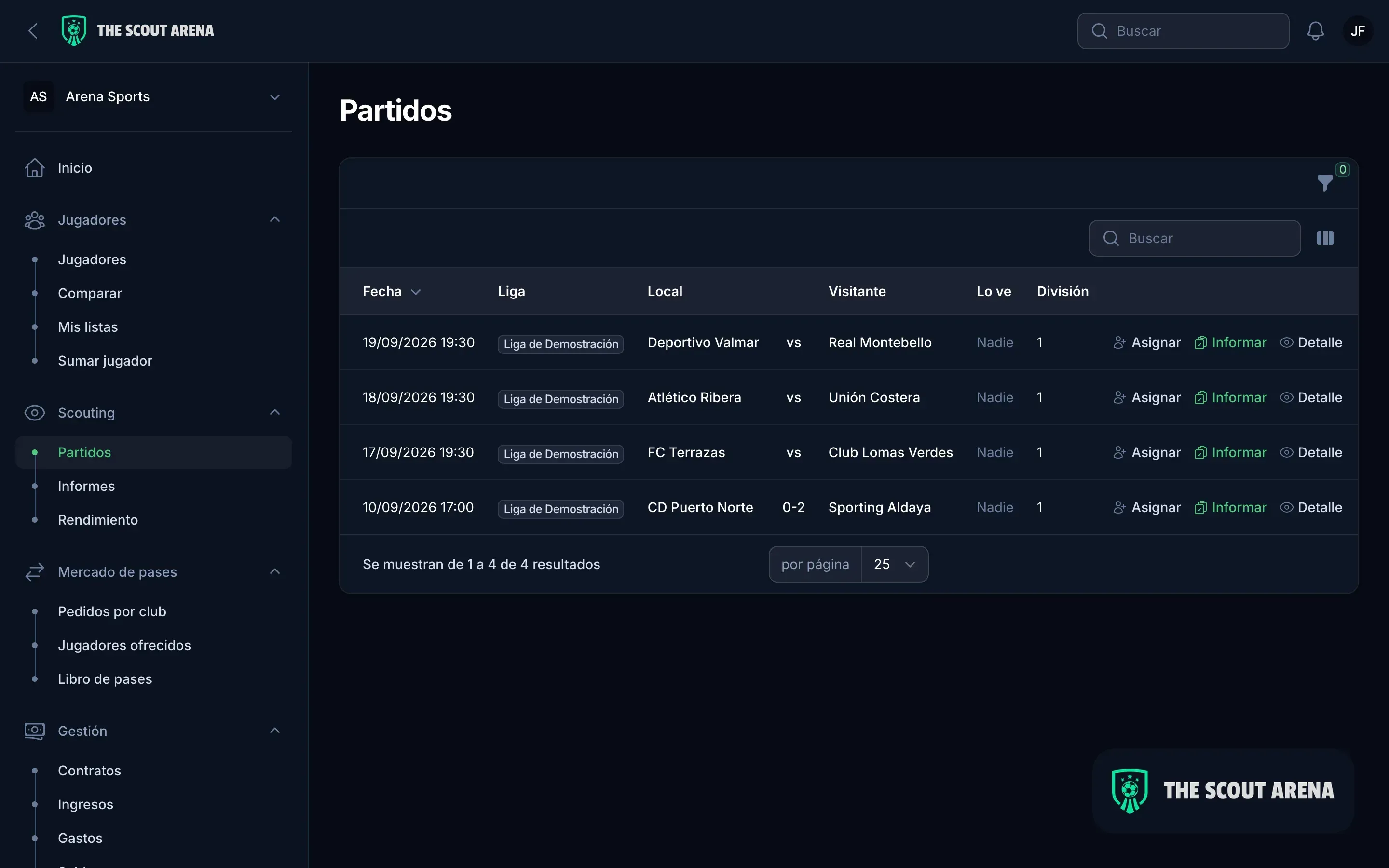
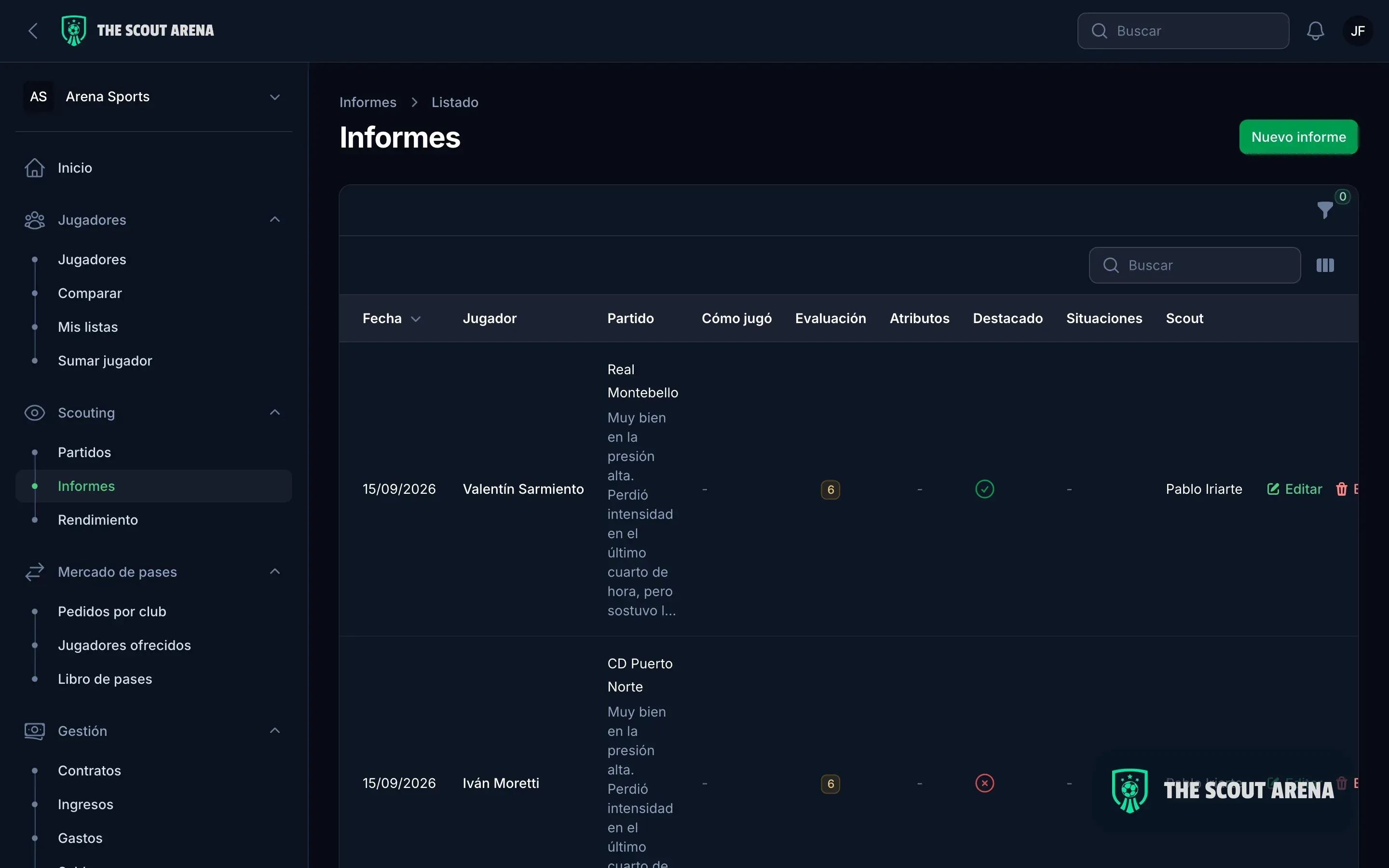
- From the platform, on a phone. The game is already in the schedule list. You tap “Report” and file the game report: how he took part, minutes, goals and cards, the attributes for his position rated, the overall rating and your observations. The name of whoever wrote it is recorded.
- Over WhatsApp. You finish watching and tell it in a chat: the assistant finds the player, finds the game, builds the report and shows you a summary. Nothing is saved until you confirm. It also works for leaving a tracking note on what you saw even if you do not file the full report.
Either way the report sits on the player profile, with date, opponent and rating, next to the earlier ones, and it also appears on the game. The coordinator can assign the week’s matches to each scout, who gets a notification and sees their own. The scout does not see the financial side, in the platform or in the chat.
What a full week of scouting looks like is on our page for soccer scouts. Plans are on the pricing page, and in a demo you can run the Saturday test with your own players.
In short
The report that works is the one finished before you leave the ground. One-line notes during play, the hard facts at half-time and the assessment in the following half hour. Ask the app for the game already loaded, few required fields, position attributes and a short path to the form, and test it at a real match before adopting it. Whatever you note about a player, especially a minor, should end up in your organization’s system and not on your phone.
Updated October 2026.
Sources
Checked in October 2026:
- FIFA Training Centre, Talent Development Scheme: Talent Identification Guide, module 3 (identification).
- The IFAB, Laws of the Game: Law 7, the duration of the game.
- The FA, England Soccer Learning: National Talent Identification & Scouting in Soccer.
- European Commission: principles of the General Data Protection Regulation.