

Football contract expiry: how not to lose a renewal
By Mariano David Pérez Co-founder
A football contract expiry starts to matter six months before the date on the page: from that day, FIFA’s rules allow the player to sign for another club for when he becomes free, and his current club receives no transfer fee. That is why a renewal is rarely lost on the day a contract ends; it is lost much earlier, when nobody was looking at the calendar. The fix is dull and it works: alerts at 12, 6 and 3 months, each with a named owner.
This article is current as of September 2026 and cites FIFA’s Regulations on the Status and Transfer of Players (RSTP) in the edition in force. On 10 June 2026 FIFA approved a new version, which enters into force on 1 January 2027: before acting, check which text applies on the date that matters to you.
What happens when a player has six months left on his contract?
A professional is only free to sign with another club if his contract has expired or is due to expire within six months. That is article 18, paragraph 3 of the RSTP, which also requires the interested club to inform the player’s current club in writing before opening negotiations with him. Breaches are subject to sanctions.
In practice, the rule splits the life of a contract in two:
- Before the final six months, anyone who wants the player has to sit down with the club and pay a transfer fee, or wait.
- Inside the final six months, the player can sign a pre-contract with another club, which takes effect when the current one ends. The club that holds his registration receives nothing for the move.
If the contract runs to 30 June, as in most European leagues, the date that matters is 1 January. If it runs to 31 December, as in much of South America and other leagues that play a calendar-year season, it is 1 July. Either way it lands in an open registration period, and it is no accident that this is when the approaches arrive.
A made-up example: a club has a 23-year-old midfielder under contract until 30 June 2028. During the 2026-27 season he is worth a fee. On 1 January 2028 he can sign with whoever he likes for the following summer. Whatever the club wants out of the situation — a renewal, a sale, or at least a sell-on percentage negotiated into a cut-price deal — has to be done before that date, not after it.
What does a club or an agency lose when a date slips by?
A missed expiry costs different things depending on which side of the table you sit, but it always costs negotiating power.
The club loses:
- The value of the registration. A player with two years left can be sold; a player with five months left goes for nothing, or for a token fee.
- Its position in renewal talks. Renewing with 18 months to run is a conversation; renewing with four is an auction against clubs that save the transfer fee and can offer part of it as a signing-on bonus.
The agency loses:
- The moment to negotiate for its player. The best contract is signed while the club still has something to lose and the player still has options. Once that window has gone, the player is a free agent in a market that is not always waiting for him.
- Its own commission. If the employment contract ends and nothing replaces it, the commission instalments end too. We explain how those instalments are paid in a separate article.
- The player himself. The representation agreement expires as well, and sooner than the club contract does — more on that below.
How far ahead should you be alerted to a contract expiry?
One reminder is not enough, because a different decision is taken at each stage. This outline suits most clubs and agencies:
| Time left | What gets decided | Who owns it |
|---|---|---|
| 12 months | Renew, sell or let go. It is the last window in which to sell at full transfer value. | The club’s sporting director; at an agency, the agent responsible for the player |
| 6 months | The player may now sign elsewhere. If a renewal was the plan, the offer has to be on the table before this day. | The same people, with the board or the partners kept informed |
| 3 months | Plan B: replacement lined up on the club side, destination lined up on the player side. Paperwork, registration deadlines, relocation. | Administration and the club secretary |
Three details make the calendar work:
- Count the 12 months against the transfer windows, not against the calendar. If the last useful window for a sale closes at the start of September, the decision is taken before then, even if 16 months remain.
- Every alert has one named owner. A reminder sent to everyone reaches no one.
- Academy players count too. Article 18, paragraph 2 of the RSTP says a player under 18 may not sign a professional contract for longer than three years (the general maximum is five, unless national law allows otherwise). A youngster’s first professional deal runs out sooner than clubs tend to remember, and just as the player starts to be worth something.
Which dates should you track besides the end of the contract?
The end date is not the only one that changes a negotiation. These are the ones that get missed most often:
- Extension options. Many contracts give the club an option to extend by a year, with a deadline for notifying the player. If the notice is late, the option lapses and the contract ends a year earlier than everyone assumed. The validity of unilateral options is argued case by case, so the date should come with a lawyer’s opinion attached.
- Clauses with a date in them. Release clauses that change with the season, salary rises triggered by appearances, bonuses that fall due on a given day, purchase options in a loan.
- Loans. When the player comes back, and how much contract he has left when he does: a one-year loan on a two-year contract returns the player already inside the alert zone.
- The representation agreement. Under the FIFA Football Agent Regulations (article 12), an agreement between an agent and a player may not run for more than two years, and any automatic renewal clause is null and void: it can only be extended by signing a new one. Do the sums: an agency with 40 clients, all on two-year agreements, has one coming up for renewal every two or three weeks on average. The detail is in our guide to representation agreements.
- Outstanding commission. Instalments that fall due on fixed dates and that someone has to invoice and chase.
How to run it day to day
A spreadsheet with a date column is enough until it isn’t: nobody opens it every day, and the person who used to fill it in has left the club. What is needed is a reminder that arrives on its own.
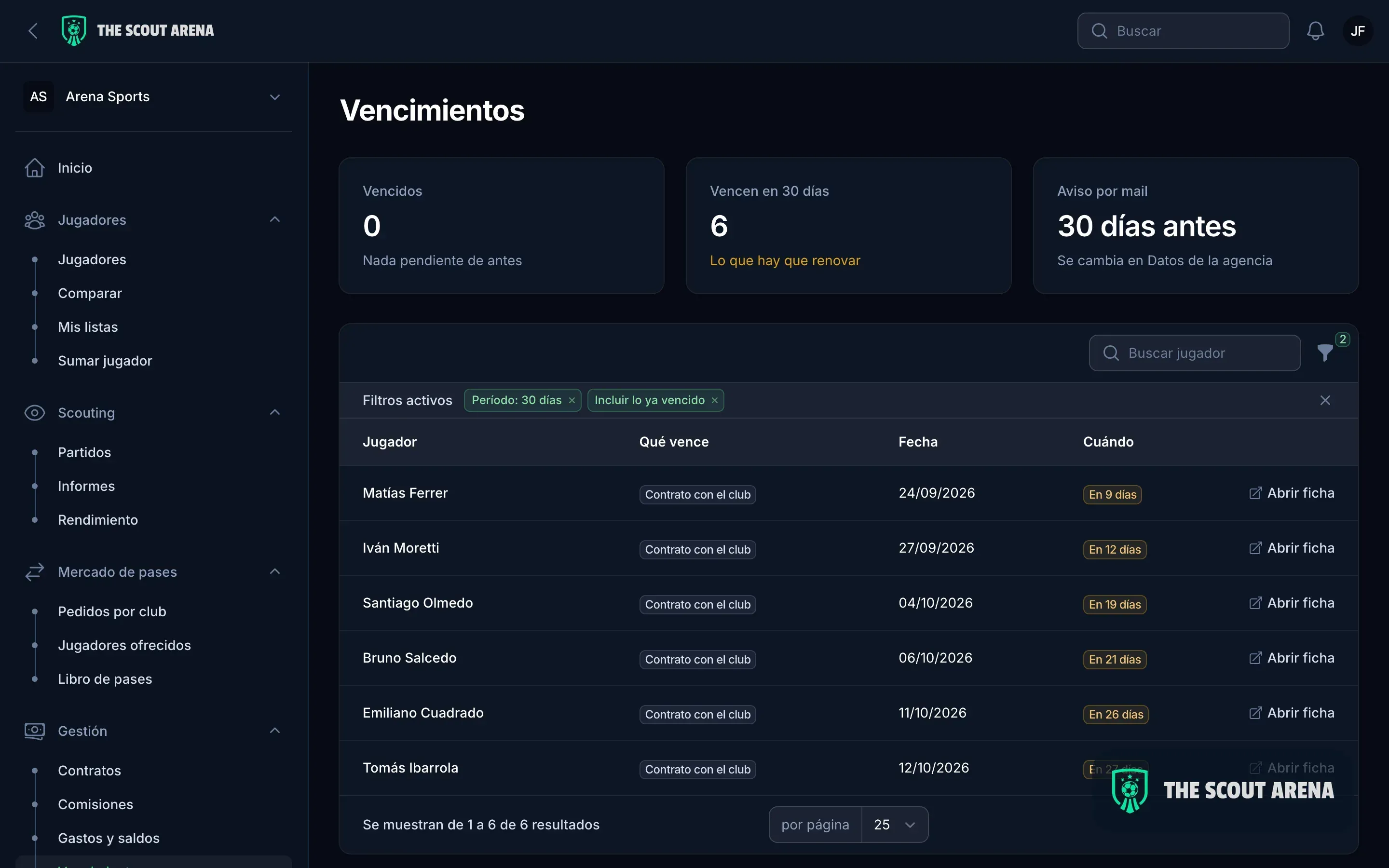
In The Scout Arena, contract expiry alerts send one email each morning with whatever has come into range — player contracts, representation agreements and outstanding commission — and only when there is something to report. In the panel, anything expiring within 30 days shows in red, within 90 in amber and within 180 in green, and every line leads to the player’s profile, with the club and the exact date. The period’s expiries also appear on the home screen, so they are seen even if nobody reads the email.
For a club, that sits alongside squad contracts and costs in the version for football clubs; for an agency, alongside each client’s contracts and commissions. The data in the screenshot belongs to a demonstration organisation.
In short
A player is not lost on the day his contract ends but six months earlier, when article 18 of the RSTP frees him to sign for another club. The defence is a calendar: at 12 months you decide, at 6 the offer must already be made, and at 3 you execute plan B. And the end date is not the only one to follow: options, loans and the representation agreement — which, with a player, cannot exceed two years — all belong on the same list.
Sources
- FIFA Regulations on the Status and Transfer of Players, edition in force in 2026 (July 2025), article 18.
- FIFA Football Agent Regulations, article 12.
- FIFA’s announcement of 10 June 2026 on the new regulatory framework, in force from 1 January 2027.
- Text of the new Regulations on the Status and Transfer of Players, January 2027 edition.
This article is for information only and is not legal advice.