

How to become a football scout: training, first steps and jobs
By Mariano David Pérez Co-founder
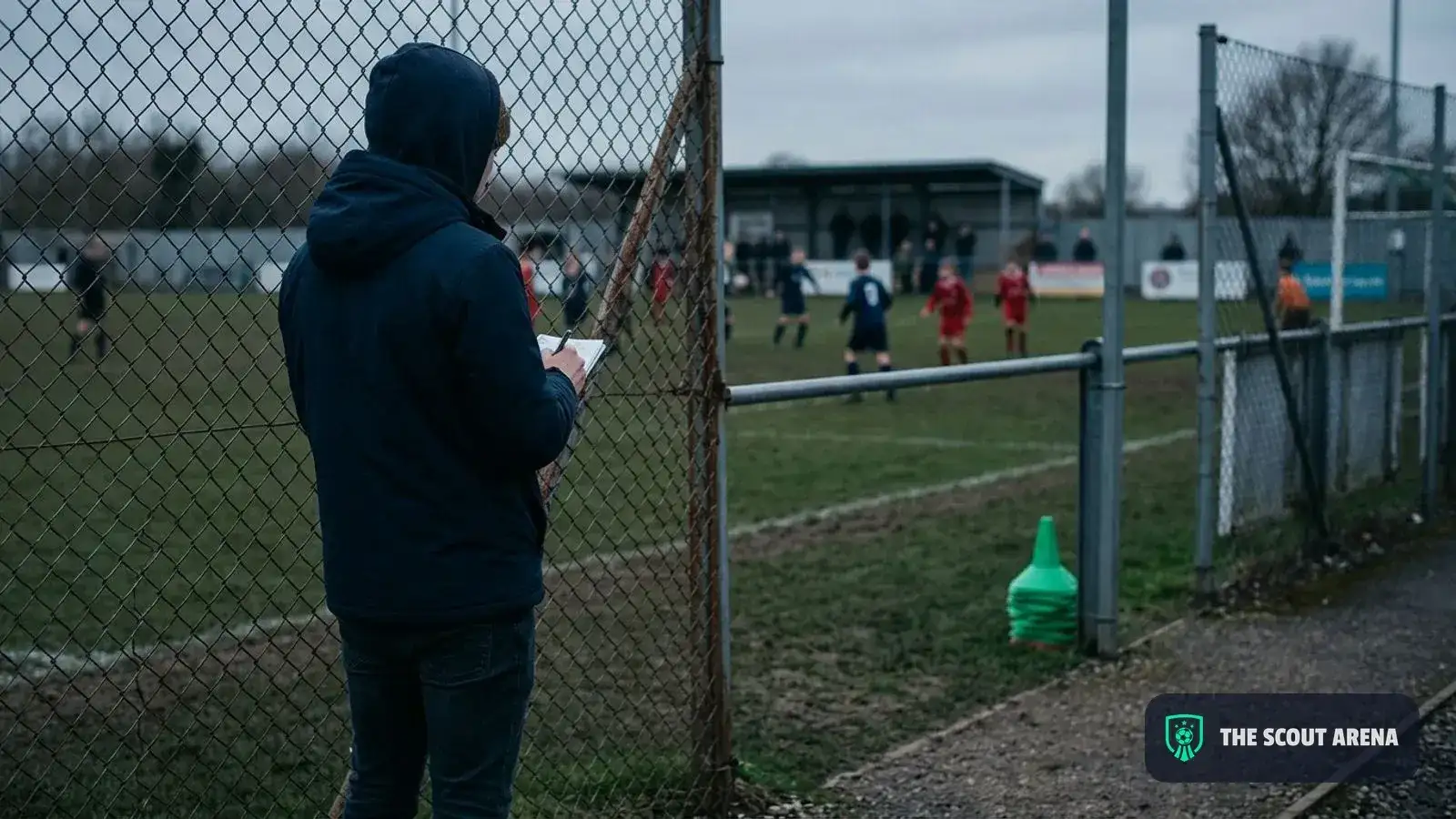
The short answer to how to become a football scout: you do not need a FIFA licence or any compulsory qualification; you need to learn to evaluate players, prove it in written reports and get someone — a small club, an agency, an academy — to read them. Federation and private courses help, but what opens the door is a portfolio of reports, and most people start unpaid or paid per report.
What does a football scout do, and how is it different from an agent and an analyst?
A scout identifies and evaluates players so that someone else can decide. They watch matches live and on video, write reports and make a recommendation: sign, keep monitoring or drop.
This article covers talent identification, not opposition scouting. Three roles that are often confused:
| Scout | Analyst | Agent | |
|---|---|---|---|
| What they do | Evaluate players and recommend | Study their own team and the opposition through video and data | Represent a player or a club and negotiate for them |
| Who they work for | Club, academy, agency or freelance | Coaching staff or sporting director | Their client, under a representation agreement |
| What they deliver | Player and match reports | Video clips, tactical reports, data models | Signed contracts and completed transfers |
| FIFA licence | No | No | Yes |
Do you need a FIFA licence to be a football scout?
FIFA does not regulate scouting as a profession and does not issue a scouting licence. The FIFA Football Agent Regulations — the edition in force since 1 January 2025 — define “Other Services” as anything an agent does for a client that is not a football agent service, and the examples listed expressly include scouting, alongside legal advice and image rights management. The same definition appears in the agents FAQ on FIFA’s website (checked in September 2026).
What does require a licence is football agent services: the negotiations and other activity aimed at concluding a transaction, whether an employment contract or a transfer. Only a person licensed by FIFA may provide them (article 11 of the regulations), and only after signing a written representation agreement with the client (article 12).
For a scout working with an agency, that draws a clear line: you can watch, report and recommend; you cannot negotiate on a player’s behalf or sign a representation agreement with them. If you want to represent players, that is a different route, covered in how to become a football agent.
What training exists for football scouts?
No qualification licenses you to scout: there are federation courses, university programmes and private courses, and none guarantees a job. These are the ones we verified on their official websites in September 2026, listed for reference and not as a recommendation:
- The FA (England), via England Football Learning. The entry point to its talent identification pathway is Introduction to Talent Identification: online, free, eight modules and about one hour and twenty minutes. Next comes National Talent Identification & Scouting in Football: face-to-face, two days, £220 according to the course page, requiring the introductory course, a valid safeguarding children qualification and a position at a professional club (or contact with one).
- The Spanish federation (RFEF). Its national coaching school runs, together with Rey Juan Carlos University, a university course in tactical analysis, scouting and technology applied to football, plus a master’s degree on the same subject, both taught in Spanish. Dates and fees change with each intake.
- The PFSA (Professional Football Scouts Association). A private UK organisation, not a governing body. It offers online courses by level — talent identification, opposition analysis, technical scouting, performance analysis and data analysis — with a free introduction and paid Level 2 courses listed on its website from £149. It describes them as CPD accredited (continuing professional development), which is not a formal federation qualification. Other national associations run courses too, and the offer changes every year: before paying, confirm on the federation’s own website that the course is really theirs and not a third party using the name. A course is worth it if you come out writing better reports; on its own, the certificate matters to almost nobody.
How do you build a scouting report portfolio?
A portfolio stands in for experience while you have none: a sporting director will not ask which course you took, they will want to read how you watch a game.
- Pick a league you can watch in person. Lower divisions, reserve and under-21 football, academy games or the women’s game near you. There are fewer eyes there than in the top flight.
- Always watch with the same criteria. Decide what you assess for each position — technical, tactical, physical and mental — and use the same grading scale in every report.
- One report per match, several matches per player. Three or four reports on the same player, against different opposition, show that you monitor rather than just have opinions.
- Write so that someone can decide. Match context, minutes and position, what the player does well, what they do badly, the level they could play at and a clear recommendation. One page.
- Use data to support what you saw, not to replace it.
- Keep everything in one place. Twenty reports scattered across a phone, a document and a spreadsheet are not a portfolio.
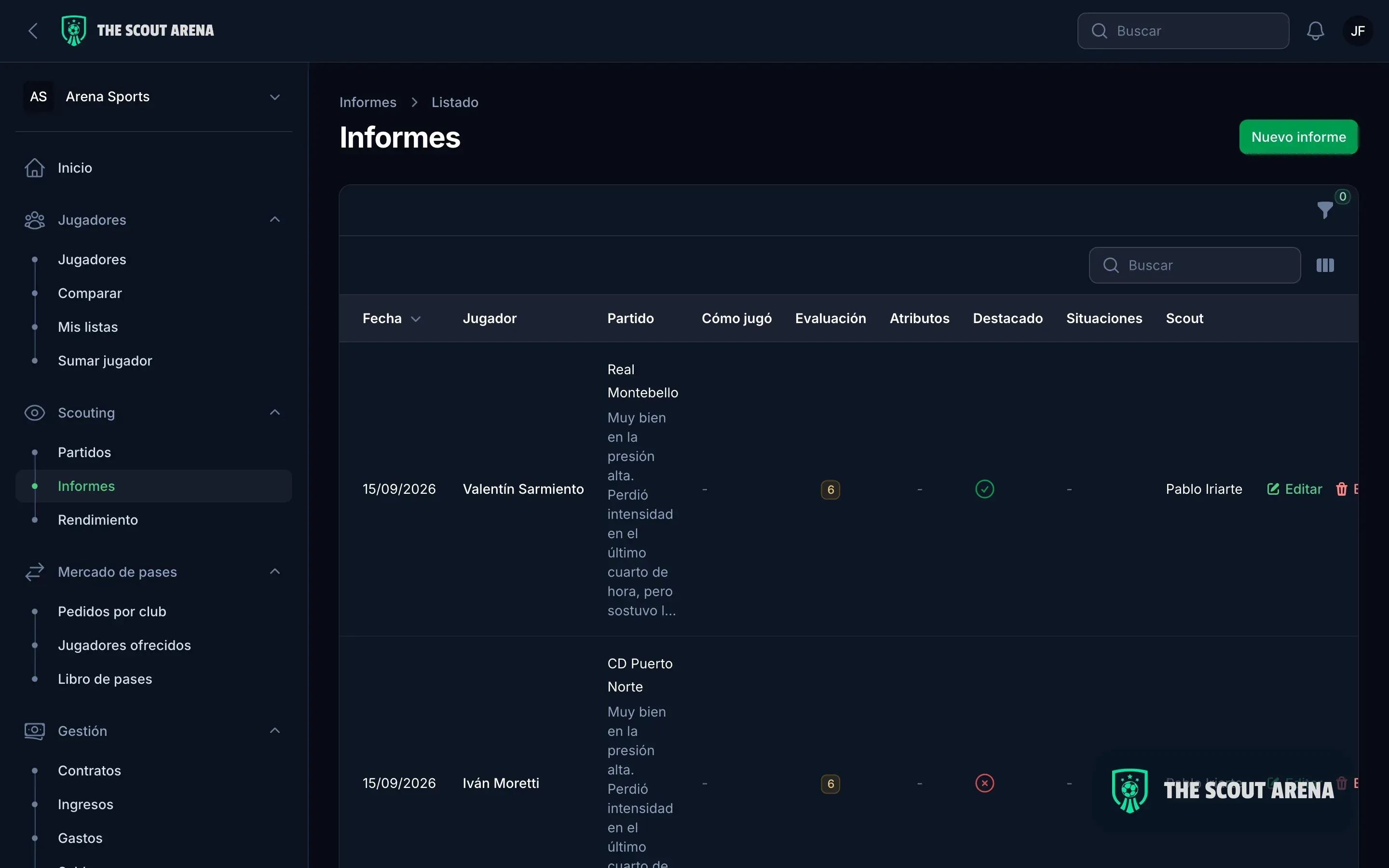
That last point is where a tool helps. In The Scout Arena every game ends in a match report with attributes by position that is added to the player’s history, and the player profile can be exported as a PDF or shared through a public link with whoever makes the decision. A tidy spreadsheet works too; what does not work is memory.
Be careful with anything involving minors: a harsh opinion about a 14-year-old does not belong on social media. If you work around youth players, clubs will — rightly — ask for safeguarding training.
How do you get your first job as a football scout?
Hardly anyone gets in through a job advert. The three most common doors:
- Small clubs and academies. A lower-league club rarely has a scouting department, which is why it may accept someone to watch opponents or local players. Expect no pay, or expenses only; what you gain is a club on your CV and someone willing to give a reference.
- Representation agencies. They need eyes in leagues and age groups they cannot cover, and usually pay per report or a small retainer. Remember the line: the scout recommends; the licensed agent negotiates and signs.
- Per-report work. Some clubs, agencies and scouting services commission one-off reports. It pays little, but it forces you to meet other people’s deadlines and formats.
To reach any of the three, send two or three real reports — not a CV — to a named person, on a league that club or agency does not cover.
What tools does a football scout use?
- Video. Professional platforms such as Hudl Wyscout bring together full matches, tagged events and statistics from hundreds of competitions. They are paid services usually licensed by clubs and agencies; to get started, broadcasts and going to games are enough.
- Reference data. Public sites such as Transfermarkt are useful for checking age and career history: a starting point, not an official source.
- A home for reports and shortlists. Our page for football scouts shows what a scouting week looks like inside the platform, with every player’s numbers compared against their position in the top leagues.
Can you make a living as a football scout?
It is a trade with many hopefuls and few paid positions, and the first years are usually part-time, alongside another job. There are no official figures on what scouts earn: be wary of any course that promises a salary.
On the plus side, the hybrid profile — a good eye at the ground plus video and data skills — is increasingly sought after, and anyone who writes clear reports, on time and with consistent criteria, stands out quickly. Ways forward: head of scouting, sporting director, analysis, academy recruitment or a role inside an agency.
In short
You do not need a FIFA licence to become a football scout: the agent regulations treat scouting as a separate service, and only negotiating and representing are reserved for licensed agents. Training exists — the FA’s pathway, the RFEF’s programmes in Spain, private courses such as the PFSA’s — and it is worth it if it makes you write better reports. The first job comes from a portfolio, at a small club, an agency or per report, and it almost always starts unpaid.
For information only, up to date as of September 2026. Prices and requirements change: confirm them before enrolling.
Sources
Checked in September 2026:
- FIFA: Football Agent Regulations, edition in force since 1 January 2025 (definitions and articles 11 and 12).
- FIFA: football agents FAQ.
- England Football Learning (The FA): Introduction to Talent Identification and National Talent Identification & Scouting in Football.
- RFEF and Rey Juan Carlos University: programmes for the university course and the master’s degree in tactical analysis, scouting and technology applied to football (in Spanish).
- PFSA: football scouting courses.
- Hudl: Hudl Wyscout product page.