
FIFA solidarity mechanism: who gets paid and how much
By Mariano David Pérez Co-founder
The FIFA solidarity mechanism is the rule under which, whenever a professional is transferred before his contract expires, 5% of the transfer compensation is shared among the clubs that trained him between the calendar years of his 12th and 23rd birthdays. The new club withholds and distributes it; in cases handled by the FIFA Clearing House, it is collected through the Clearing House instead. A training club does not have to sign anything or be part of the negotiation: the entitlement comes from having had the player registered.
The rule sits in article 21 and Annexe 5 of FIFA’s Regulations on the Status and Transfer of Players (RSTP), July 2025 edition, which is the one in force, and in the FIFA Clearing House Regulations, January 2026 edition. FIFA has approved a new edition of the RSTP that comes into force on 1 January 2027: in the published text, article 21 and the Annexe 5 table read exactly the same. This article is current as of October 2026.
The sums involved are not marginal. Since the Clearing House began operating in November 2022 it has allocated close to USD 1 billion in training rewards — training compensation and solidarity contribution — and has already distributed more than USD 639 million, according to FIFA’s media release of 17 July 2026.
How does it differ from training compensation?
They are two separate mechanisms, routinely confused because they are collected together and both reward whoever developed the player. The RSTP groups them as “training rewards”, but each has its own article and annexe:
| Training compensation (art. 20 and Annexe 4) | Solidarity mechanism (art. 21 and Annexe 5) | |
|---|---|---|
| What triggers it | The player’s first registration as a professional, and every transfer between clubs of different associations until the end of the calendar year of his 23rd birthday | A professional transferred before his contract expires, where transfer compensation is paid |
| How much | The training costs of the new club’s category, multiplied by the years of training | 5% of the transfer compensation |
| Years counted | From the calendar year of the 12th birthday to that of the 21st, as a general rule | From the calendar year of the 12th birthday to that of the 23rd |
| Taken out of the fee? | No: it is paid separately and is excluded from the 5% base | Yes: it is deducted from the total compensation |
| Women’s football | Does not apply (art. 20, final paragraph) | Applies, per FIFA |
The practical difference: training compensation is collected once, when the youngster turns professional or moves abroad young. Solidarity contribution can turn up a decade later, every time the player is sold again with a contract running, with no age ceiling on the payout.
How much does each training club receive?
The 5% is split in proportion to the calendar years the player spent registered with each club, in two bands. Annexe 5 expresses it as a “percentage of the 5%”, which is worth converting into a percentage of the fee so as not to be wrong by a factor of twenty:
| Calendar year of birthday | Share of the 5% | Share of the fee | On a EUR 5,000,000 transfer |
|---|---|---|---|
| 12th, 13th, 14th and 15th (four years) | 5% of 5% per year | 0.25% per year | EUR 12,500 per year |
| 16th to 23rd (eight years) | 10% of 5% per year | 0.5% per year | EUR 25,000 per year |
The twelve years add up to 100% of the 5%. Where a player spent less than a full year at a club, the share is calculated pro rata.
A worked example
A midfielder is transferred for EUR 5,000,000 with his contract still running, between clubs affiliated to different associations. The solidarity pot is 5%: EUR 250,000.
- Club A, where he was registered in the calendar years of his 12th to 15th birthdays: four years at 5% of 5% = 20% of the pot → EUR 50,000.
- Club B, where he was registered from 16 to 19: four years at 10% of 5% = 40% → EUR 100,000.
- The remaining 40% covers years in which the player was already at the selling club or had no training club entitled to claim. That share goes back to the former club — what FIFA calls the top-up.
When does the solidarity mechanism apply, and when does it not?
Three conditions must hold together: the player is a professional, he moves with his contract in force, and transfer compensation is paid. Annexe 5 adds an international dimension: a training club is only entitled if the transfer is between clubs of different associations, or between clubs of the same association where the training club is affiliated to a different one.
It does not apply to:
- A free agent. If the contract has expired there is no transfer in the sense of article 21, and no 5% to share. This is one of the reasons the expiry date moves the price of a deal, and why it is worth reading alongside the transfer window dates.
- A move with no fee. No amount, no base to calculate on.
- A purely domestic transfer with no training club in another association.
- Training compensation. The 5% is calculated on the transfer compensation, excluding anything paid as training compensation.
- Entitlements below EUR 100, which since the January 2026 edition of the Clearing House Regulations (art. 12.4) are discarded and left out of an Allocation Statement.
It does apply to loans: where there is a loan fee, solidarity contribution is due on that fee. The Clearing House, however, only processes payments in eleven-a-side football (art. 2.2 of its regulations).
How is solidarity contribution collected?
For cases handled by the Clearing House, a training club does not have to claim anything: FIFA starts the process itself, from what associations load into their systems. The sequence, per the FIFA Clearing House Regulations, January 2026 edition, is:
- TMS identifies the trigger: the international transfer entered in the system, or a domestic transfer for compensation communicated by the association.
- A provisional Electronic Player Passport (EPP) is generated, covering the player’s whole career from the calendar year of his 12th birthday. It stays open for inspection by all associations and clubs for 10 days.
- The EPP review process opens and runs for 15 days: the associations and clubs invited can request amendments, backed by registration documents, the International Transfer Certificate and the employment contract.
- FIFA settles the final EPP and TMS automatically calculates the Allocation Statement, with the amount due to each training club.
- The Clearing House issues a Request to Pay to the new club, which has 30 days to pay. Miss it and a 2.5% administrative levy is added — payable to the training clubs instead of late-payment interest — plus a further 7 days; after that, disciplinary proceedings.
- The Clearing House pays each training club into a bank account in the club’s own name, once the parties pass the Compliance Assessment (sanctions, money laundering, bribery, terrorist financing).
One detail that changes the arithmetic of a negotiation: the payment the new club declares in TMS is always treated as 95% of the transfer compensation, because the 5% is deemed already withheld. FIFA calls this the “95+5” model and sets it out in its explanatory notes on the Clearing House Regulations (October 2024). In cases not handled by the Clearing House, the duty falls on the new club: calculate the split from the player passport and pay within 30 days of registration, or of each contingent payment.
What does a club need on record to be able to claim it?
The split does not come from what the club remembers; it comes from the EPP, built out of what associations have on file. A club that wants to collect what it is owed needs, at a minimum:
- The exact registration dates of every player, calendar year by calendar year, from the year he turned 12. Not “he was in the under-15s and the under-16s”: from this date to that date, because part-years are pro-rated.
- The documents that prove it: association registration records, contracts, International Transfer Certificates. That is what article 9.4 of the Clearing House Regulations asks for in an EPP review.
- Its own details up to date at the association: club category, affiliation, address, an email somebody reads, and a bank account in the club’s name. If the association has no working contact, payment stalls.
- Somebody watching the clock. Ten days of inspection, fifteen of review. A club missing from the provisional EPP has to ask its association to be included — inside that window.
- A memory of what was already decided. The first final EPP of a player is binding on every later one (art. 10.6): a mistake left uncorrected the first time is carried into every future sale of that player.
This is record-keeping, not strategy, and it is exactly where clubs lose money: not for lacking the entitlement, but for being unable to prove it five years on. For the other obligations worth keeping at hand, see why football clubs need management software.
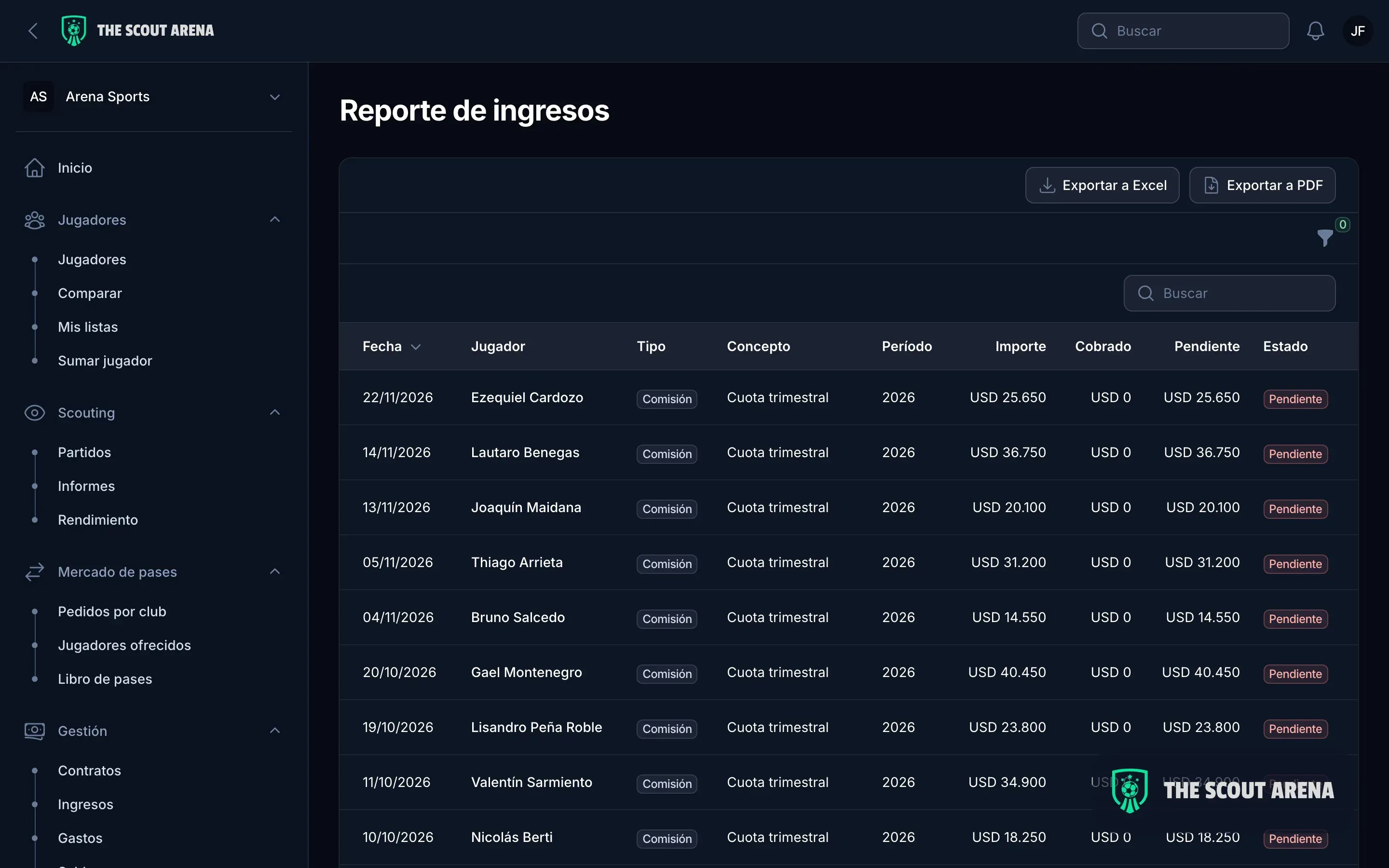
In The Scout Arena every academy player has a profile with his age group, documents and change history, and the club view shows them alongside the first-team squad. It does not calculate the contribution for you — TMS does that — but it keeps within reach what you will be asked for the day an EPP lands for review: since when the youngster has been there, in which age group, and with which paperwork.
What should an agent know about it?
Four things, and none of them is a legal footnote:
- In contract or out of contract is not the same deal. If the player leaves as a free agent there is no 5% and the training clubs get nothing. If he leaves under contract, the buying club withholds it. The expiry date is part of the price, which is why it is worth tracking with an alert before it arrives rather than finding out late.
- The headline number is not what the selling club banks. Under “95+5” there is a 5% gap between what was agreed and what lands. When negotiating, say out loud whether the figure is before or after solidarity; that is where the usual argument starts.
- Do not confuse the commission base. What an agent representing the selling club earns is a percentage of the transfer compensation, not of what is left after the deduction. We cover this in how much football agents earn.
- If you advise a training club, this is income to go after. A player who was there from 16 to 19 and is now sold in Europe represents 40% of the 5% pot. Keep his registration history on file from the day he left.
In short
The solidarity mechanism shares 5% of every in-contract transfer among the clubs that trained the player between the calendar years of his 12th and 23rd birthdays: 0.25% of the fee for each year up to 15, and 0.5% for each year from 16 to 23. It is not claimed; it is settled automatically from the Electronic Player Passport and the FIFA Clearing House. The only thing that decides whether a club gets paid is whether its registration dates are on file and provable.
This article is for information only and is not legal advice. It is based on FIFA’s Regulations on the Status and Transfer of Players, July 2025 edition, the FIFA Clearing House Regulations, January 2026 edition, and FIFA’s public information as of October 2026.
Sources
- FIFA: Regulations on the Status and Transfer of Players, July 2025 edition (PDF): articles 20 and 21, Annexes 4 and 5.
- FIFA: FIFA Clearing House Regulations, January 2026 edition (PDF).
- FIFA: explanatory notes on the FIFA Clearing House Regulations (PDF, October 2024).
- FIFA: the Clearing House and the Electronic Player Passport.
- FIFA: training rewards calculator (an estimate, not legally binding).
- FIFA TMS: solidarity mechanism.
- FIFA media release of 17 July 2026 on training rewards.
- FIFA: Council Bureau approves the new regulatory framework for the transfer system (in force from 1 January 2027).