

Football agent for minors: what FIFA allows and forbids
By Mariano David Pérez Co-founder

A football agent for minors may only approach the player or the family within the six months before the age at which that player can sign a first professional contract in the country where they will play, and only with the prior written consent of a legal guardian. The agent must also have passed FIFA’s designated course on minors, and cannot be paid anything until the player signs a professional contract. All of this is set out in articles 13 and 14 of the FIFA Football Agent Regulations (edition in force since 1 January 2025).
For FIFA, a minor is any player who has not yet turned 18: that is the definition in the Regulations on the Status and Transfer of Players (RSTP, January 2026 edition).
When an agent can first approach a minor
Article 13, paragraph 1 sets the window. An approach, and any representation agreement that follows, may be made no more than six months before the minor reaches the age at which they can sign their first professional contract under the law of the country or territory where they will be employed. And the approach may only happen once written consent has been obtained from the minor’s legal guardian.
Two points that are often misread:
- FIFA does not set the age; national law does. An agency working across several markets, say Portugal, Ghana and Brazil, has to confirm the age in each one with the national association or a local lawyer.
- An “approach” is far wider than a meeting. The regulations cover any in-person or electronic contact, contact with a family member or friend, and using a third party to make it. A direct message to a parent on social media counts.
The penalty is written into the article itself: a breach of paragraph 1 is sanctioned, at a minimum, with a fine and a suspension of the agent’s licence of up to two years.
The minors course and national requirements
Paragraph 2 of article 13 adds a condition. An agent who wishes to represent a minor, or to represent a club in a transaction involving a minor, must first successfully complete FIFA’s designated continuing professional development (CPD) course on minors. Holding a licence is not enough.
The same paragraph obliges the agent to comply with any requirement laid down by the law of the country where the minor will be employed, and some associations and national laws go further than FIFA. The working rule: the stricter standard wins. If you do not hold a licence yet, the full route is in how to become a football agent.
What makes a representation agreement with a minor enforceable
Under article 13, paragraph 3, a representation agreement with a minor is only enforceable if three conditions are all met:
- It contains the minimum requirements of article 12: the names of the parties, the duration, the amount of the service fee, the nature of the services and the signatures.
- The agent respected the six-month window, obtained the guardian’s written consent first and had completed the minors course.
- It is signed by the minor and their legal guardian, as required by the law of the country where the minor will be employed.
Miss one and the agreement cannot be relied on. The general rules apply on top: it may not run for more than two years, automatic renewal clauses are null and void, and before signing the agent must recommend independent legal advice in writing and keep the written confirmation of the answer; with a minor, the prudent course is to have the guardian sign it too. Each clause is covered in our guide to the football representation agreement.
When an agent can be paid for a minor, and when not
Article 14 is blunt: a football agent may not receive a service fee for services relating to a minor unless the player is signing their first or a subsequent professional contract, in accordance with the law of the country where the minor will be employed.
| Situation | Can a fee be charged? |
|---|---|
| The minor is an amateur and registers with a club, or moves clubs as an amateur | No |
| The minor signs a first professional contract | Yes |
| The minor, already professional, renews or signs for another club | Yes |
| “Advances”, gifts or payments to the family so that they sign with the agent | Always prohibited |
The last row comes from article 16, which bans offering or paying any undue advantage to a player or to their family member, legal guardian or friend.
On what is in force: the suspension FIFA announced on 30 December 2023 (Circular no. 1873) covered the service fee cap and several payment rules, but neither article 13 nor the fee rule on minors appears on that list. We track the wider status of the regulations in our guide to the FIFA football agent regulations.
International transfers of minors: article 19 of the RSTP
The rule in article 19 of the RSTP (January 2026 edition) is that international transfers are only permitted if the player is over 18, with five exceptions:
- a) Parents’ move to the new club’s country for reasons not linked to football.
- b) Aged 16 to 18 within the European Union or European Economic Area, or between two associations in the same country. The new club must guarantee football education, schooling and proper living arrangements.
- c) Border areas: player and club each within 50 km of the border and no more than 100 km apart; the player keeps living at home and both associations consent.
- d) Humanitarian grounds: the minor fled their country without their parents and the country of arrival permits them to reside or recognises them as vulnerable.
- e) Student exchange: one year at most, and only with a purely amateur club with no link to a professional one.
The same rules cover the first registration of a youngster who is not a national of the country and has not lived there continuously for the last five years. From the age of ten, the move must be approved by the Players’ Status Chamber of the Football Tribunal before any request for an International Transfer Certificate.
Two more RSTP points: a player under 18 may not sign a professional contract for longer than three years (article 18), and a minor may only go on trial from the season of their 16th birthday, or 15th if both player and club are domiciled in Europe, with the parents’ express written permission and at most two trials per calendar year (article 19ter).
What an agency should keep on record
The conditions of article 13 are proved with documents. For every minor, an agency should be able to produce on the spot:
- The guardian’s written consent, dated before the first contact. It is the document that decides whether there was a breach.
- The date of birth and the date on which the player reaches first-professional-contract age in the country where they will play, with the six-month calculation done.
- A log of every contact: who spoke to whom, when and by what channel.
- Proof of the minors course for the agent who signs, completed before the approach.
- The representation agreement signed by the minor and the guardian, with the independent legal advice confirmation.
- Identity documents and passports with their expiry dates.
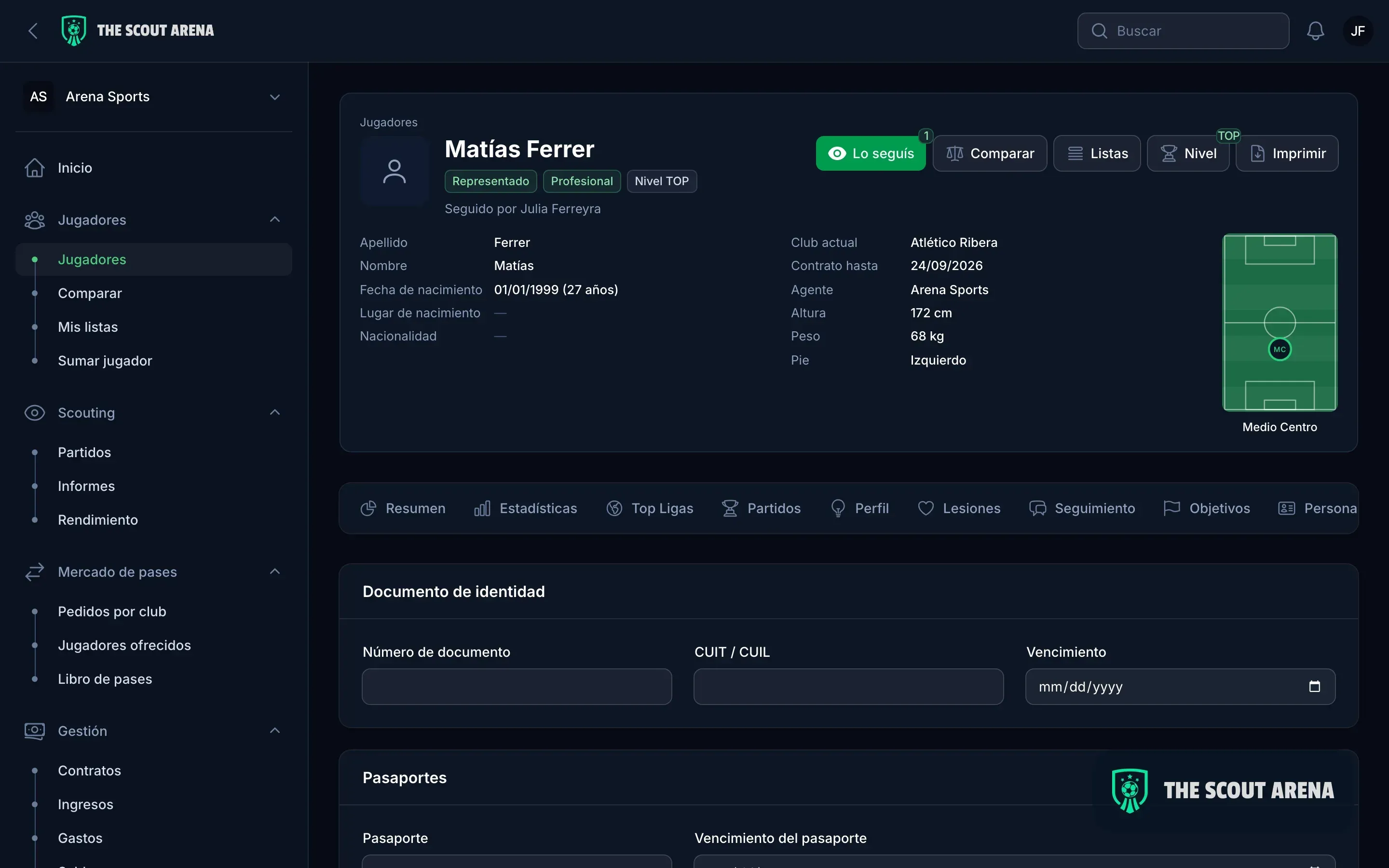
In TheScoutArena all of this lives in each player’s profile: date of birth, identity document and passports with expiry dates, attached files and a dated follow-up log for every conversation with the family. An example with made-up data: if Daniel Mensah reaches first-contract age in his country on 14 March 2027, the contact window opens on 14 September 2026, and a follow-up note dated 2 September would be a problem. The representation agreement, with its two-year ceiling, feeds into contract expiry alerts, so that renewing it does not depend on anyone’s memory.
In short
Representing a minor is allowed, but behind four locks: a six-month window before first-professional-contract age, prior written consent from the guardians, FIFA’s minors course completed, and an agreement signed by both the minor and the guardian. No fee is due until there is a professional contract, and a move abroad before 18 is only possible within the five exceptions of article 19 of the RSTP. And all of it is proved with dated documents.
This article is for information only and is not legal advice. It is current as of September 2026. Sources: the FIFA Football Agent Regulations (edition in force since 1 January 2025), the FIFA Regulations on the Status and Transfer of Players (January 2026 edition) and FIFA Circular no. 1873 (30 December 2023). National law may be stricter.