
Training compensation: what it is and how it is calculated
By Mariano David Pérez Co-founder
Training compensation is what a club pays to the clubs that trained a player between the ages of 12 and 21 when that player signs his first professional contract, and again every time he is transferred between clubs of different associations up to the end of the calendar year of his 23rd birthday. The amount is not negotiated: it comes from multiplying the training costs of the receiving club’s category by the years the player spent at each training club.
The rule sits in article 20 and Annexe 4 of FIFA’s Regulations on the Status and Transfer of Players (RSTP), July 2025 edition, which is the one in force. FIFA has approved a new edition of the RSTP that comes into force on 1 January 2027; once the final text is out, its Annexe 4 is worth rereading. This article is current as of October 2026.
What is training compensation for?
It compensates the club that spent years investing in a youngster — coaches, pitches, travel, schooling, meals — and loses him just as he starts to pay off. Annexe 4 starts from a simple premise: a player’s training and education take place between the ages of 12 and 23, and the club that ends up with the finished player reimburses the trainer what it would have cost to do the job itself.
It is not the same as the solidarity mechanism, even though both are collected through the same channel. Solidarity is 5% of a transfer fee paid while a contract is running; training compensation is due even without a fee, and even when the player leaves for free at the end of his contract. The differences, point by point, are in our article on the FIFA solidarity mechanism.
Two limits of scope worth being clear about from the start:
- FIFA’s rules govern moves between associations. The RSTP covers transfers between clubs of different associations (art. 1.1). What happens within a single country is regulated by each association, which must run its own system to reward training clubs (art. 1.2).
- It does not apply to women’s football. The last sentence of article 20 says so.
When is training compensation due?
Annexe 4 (art. 2) sets two triggers:
- First registration as a professional. The club registering him pays, and every club he was registered with from the calendar year of his 12th birthday is paid, pro rata to the time spent at each.
- Every transfer of a professional between clubs of two different associations, during or at the end of his contract, up to the end of the calendar year of his 23rd birthday. On these subsequent transfers only the former club is paid, and only for the time the player actually trained there.
And three cases where nothing is owed (Annexe 4, art. 2.2):
- The former club terminated the player’s contract without just cause.
- The player moves to a category 4 club, the lowest.
- The professional reacquires amateur status on being transferred. Note that if he re-registers as a professional within 30 months, the new club does pay (RSTP art. 3.2).
How is training compensation calculated?
The sum has three parts, and the one most often forgotten is that the paying club’s category is what counts, not the training club’s:
- The new club’s category. Each association ranks its clubs in up to four categories according to their investment in training, and records it in TMS. The category holds for the whole season and cannot be changed mid-way (FIFA Circular 1853).
- The annual cost of that category in its confederation, which FIFA publishes and updates at the end of each year.
- The years of training, counted by calendar year from the 12th to the 21st birthday, with two adjustments from Annexe 4 (art. 5): the four years from 12 to 15 are always paid at category 4 cost, so that the training of very young players does not produce unreasonable sums; and if the player clearly completed his training before 21, the count stops there.
How much is a year of training worth in each category?
These are the annual costs FIFA published in Circular 1853 of July 2023, which Circular 1936 of 16 July 2025 — here in the version circulated by the Spanish FA, in Spanish — kept unchanged for 2025:
| Confederation | Category I | Category II | Category III | Category IV |
|---|---|---|---|---|
| UEFA | EUR 90,000 | EUR 60,000 | EUR 30,000 | EUR 10,000 |
| CONMEBOL | USD 50,000 | USD 30,000 | USD 10,000 | USD 2,000 |
| AFC | — | USD 40,000 | USD 10,000 | USD 2,000 |
| Concacaf | — | USD 40,000 | USD 10,000 | USD 2,000 |
| CAF | — | USD 30,000 | USD 10,000 | USD 2,000 |
| OFC | — | USD 30,000 | USD 10,000 | USD 2,000 |
Only UEFA and CONMEBOL have a category I. Each club’s category is set by its association; the list by country is annexed to the same circular.
A worked example
A youngster was registered with training club A from the calendar year of his 12th birthday to that of his 18th: seven years. In the year he turns 19 he signs his first professional contract with club B, in another CONMEBOL association, category II (USD 30,000 a year).
| Period | Years | Cost per year | Subtotal |
|---|---|---|---|
| Year of 12th to year of 15th birthday | 4 | USD 2,000 (always category 4) | USD 8,000 |
| Year of 16th to year of 18th birthday | 3 | USD 30,000 (club B’s category II) | USD 90,000 |
| Total for club A | USD 98,000 |
Two years later, at the start of the year he turns 21, club B sells him to club C, a UEFA category I club (EUR 90,000 a year). As this is a subsequent transfer, club A is no longer paid: only club B is, for the years he trained there — those of his 19th and 20th birthdays. That is EUR 180,000, on top of the transfer fee and the solidarity contribution.
If the amount is clearly disproportionate to the case, the Dispute Resolution Chamber may review and adjust it (Annexe 4, art. 5.4). For a reference figure before a negotiation there is FIFA’s training rewards calculator, which FIFA itself describes as an estimate that is not legally binding.
What changes inside the European Union?
For transfers between associations in the EU and the European Economic Area, Annexe 4 (art. 6) adds three rules of its own:
- If the player moves up a category, the calculation uses the average of the two clubs’ training costs. If he moves down, the lower club’s costs apply.
- The last year of training may fall before the year of the 21st birthday if it is shown that the player had already completed his training.
- No contract offer, no training compensation. The former club must have offered the player a contract in writing, by registered post, at least 60 days before his current one expires and on terms at least equivalent; email also works if the player confirms he received it. Without that offer, the club is only paid if it can justify its entitlement. This does not affect the rights of the player’s earlier clubs.
Who pays, by when, and how is it collected?
When the case falls under the FIFA Clearing House, the training club neither invoices nor claims: the process starts from the player’s Electronic Player Passport (EPP), built from what each association has recorded, goes through a review with short deadlines, and ends in a payment request to the paying club. It is the same procedure as for solidarity, explained step by step in our solidarity mechanism article; FIFA’s own explanation is on its EPP page.
When the case does not go through the Clearing House, the registering club pays within 30 days of the registration, according to the career history in the player passport (Annexe 4, art. 3). And if the training club no longer exists — bankruptcy, dissolution, loss of affiliation — the compensation may go to its association, earmarked for youth football programmes.
What does a training club need to keep on record?
The calculation is mechanical; what decides whether a club gets paid is whether it can prove the years. A player who was there “roughly since the under-12s” counts for nothing: what counts are the registration and deregistration dates with the association, calendar year by calendar year. At a minimum:
- The exact registration dates of every academy player from the year of his 12th birthday, and the documents that prove them: association registration records, transfer certificates, contracts.
- The club’s category each season, which the association must record with every registration and which, inside the EU, enters the average when the player moves to a higher-category club.
- Contracts offered and when they were sent, if the club is in the EU: without the offer 60 days ahead, the entitlement falls away.
- What training actually costs. Categories are assigned according to a club’s investment in training; keeping the academy’s spending in order is the basis for arguing a category or an amount.
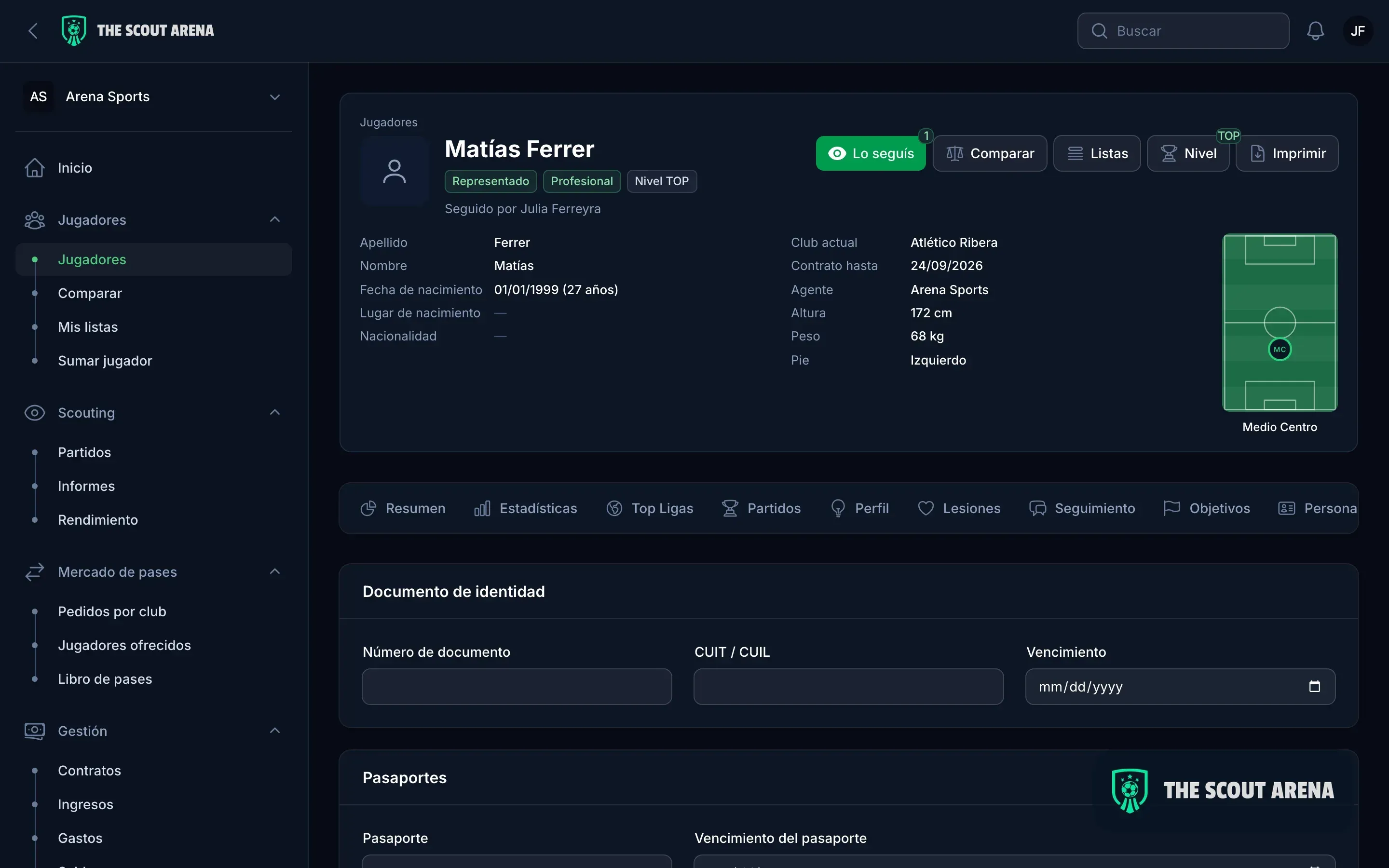
In The Scout Arena, every academy player has a profile with his category, documents and history, and the club panel tracks spending by player and by category alongside the first-team squad. It does not calculate training compensation — FIFA and its Clearing House do that — but it keeps at hand what you will be asked for the day a youngster leaves: since when he has been there, in which category and with which documents.
What should an agent know?
- Training compensation weighs on the first contract. A club that has to pay the trainer USD 98,000 before the youngster plays a minute will factor it into the signing. Know the figure before the meeting, not after.
- The destination club’s category changes everything. The same player can cost a few thousand or several hundred thousand in training compensation depending on where he goes. A category 4 club pays nothing.
- It stops after 23. From the year after his 23rd birthday, training compensation no longer applies; solidarity still does, if there is a fee for a transfer while under contract.
- It is not part of the agent’s fee. What an agent earns is calculated on the player’s remuneration or on the transfer compensation, depending on whom he represents; we explain it in how much football agents earn.
In short
Training compensation rewards the clubs that trained a player between 12 and 21. It is due on his first registration as a professional and on every international transfer up to the year he turns 23; it is calculated from the receiving club’s annual category cost times the years of training — the first four always at category 4 cost — and it is not owed if he joins a category 4 club, reverts to amateur status, or if his former club terminated his contract without just cause. A club that cannot prove the registration dates does not get paid.
This article is for information only and is not legal advice. It is based on FIFA’s Regulations on the Status and Transfer of Players, July 2025 edition, and FIFA Circulars 1853 (2023) and 1936 (2025), as of October 2026.
Sources
- FIFA: Regulations on the Status and Transfer of Players, July 2025 edition (PDF): articles 1, 3 and 20, Annexe 4.
- FIFA: Circular 1853, categorisation of clubs and registration periods, July 2023 (PDF): training costs by confederation.
- Spanish FA (RFEF): circular 14 of the 2025/26 season, circulating FIFA Circular 1936 (PDF, in Spanish).
- FIFA: the Clearing House and the Electronic Player Passport.
- FIFA: training rewards calculator (an estimate, not legally binding).
- FIFA: Council Bureau approves the new regulatory framework for the transfer system (in force from 1 January 2027).