

What a football agent CRM is and what it must record
By Mariano David Pérez Co-founder
A football agent CRM is the system where an agency keeps everything about its players and the people it negotiates with on their behalf: each player’s profile, their representation agreements and when they expire, service fees and who pays them, club contacts and transfer market requests. Unlike a general-purpose CRM, it is built around the player and FIFA’s rules rather than around a sales pipeline.
This article covers how it differs from Salesforce or HubSpot, what the FIFA Football Agent Regulations make you keep on record, how to move off spreadsheets without losing years of history, and what to ask any system before you choose it.
How is it different from a general-purpose CRM?
A general-purpose CRM such as Salesforce or HubSpot is designed for selling: a lead enters the pipeline, moves through stages and becomes a deal. Both are very capable tools that can be adapted to almost any business, but adapting them takes work, and an agency’s work has a different shape.
In an agency, the centre is not the deal but the player, and three different parties revolve around them: the player (and, for a minor, their family), the clubs that sign or sell them, and other agents. Money does not arrive in a single invoice: it comes in instalments over several years, based on what the player is actually paid. And the dates that matter are not sales follow-ups but the ones set by the regulations.
| What an agency needs | General-purpose CRM | Football agent CRM |
|---|---|---|
| Player profile with club, position, contract and performance | Built from custom fields | Ready out of the box |
| Representation agreements with their expiry | Possible, once configured | Part of the model |
| Service fees in instalments, agreed versus collected | Designed for one-off deals | Instalment by instalment |
| Club contacts with their role | Yes | Yes, linked to requests and players |
| Club requests and transfer windows | No | Yes |
| Expenses per player | No, usually another tool | Yes |
None of this makes a general CRM a bad choice: if your agency has someone to configure and maintain it, it can work. The real question is how much of what follows you would have to build yourself.
What do FIFA’s agent regulations make you record?
The FIFA Football Agent Regulations, in the edition in force since 1 January 2025, do not say “use a CRM”, but they do set out what you must be able to show. We cover them in full in our guide to the FIFA agent regulations; when choosing a system, this is what matters:
- Representation agreements and their expiry. With a player or coach, an agreement lasts two years at most and can only be extended by signing a new one; automatic renewal is void (article 12). Each agreement must state the parties, the duration, the fee, the services and the signatures. The details are in our article on the representation agreement.
- Exclusivity. Another agent may not approach a player under an exclusive agreement except in the last two months before it expires (article 16, paragraph 1). In practice, that is the date you most need in plain sight.
- The fee, who pays it and when. The regulations set caps (article 15), make the client pay and spread payment in instalments based on what the player actually receives (article 14).
- Minors. An agent may only approach a minor or their family within the six months before the age at which the player can sign a first professional contract, with the prior written consent of their guardians, and the agreement is signed by the minor and the guardians (article 13). See football agents and minors.
- The Agent Platform. Article 16, paragraph 2 requires uploading to the FIFA Agent Platform, within 14 days, every representation agreement and its changes, service fee payments, agreements for other services and arrangements with other agents; and, if you work through a company, its owners and employees.
What did Circular 1873 suspend?
Much of the above is on hold. On 30 December 2023, following a German court injunction, FIFA suspended several rules worldwide until the Court of Justice of the European Union ruled, as set out in its Circular 1873. The circular’s list includes:
- the service fee cap (article 15, paragraphs 1 to 4);
- the client-pays principle and the rules on how and when fees are paid (article 14);
- the ban on multiple representation (article 12, paragraphs 8 to 10);
- the reporting obligations in article 16 (paragraph 2, points h), j) and k), and paragraph 4), which include the platform uploads;
- the disclosure and publication rules in article 19;
- mandatory payment of fees through the FIFA Clearing House.
The circular also recommended that national associations suspend the equivalent rules in their own agent regulations. The licence, the minimum content of the agreement, its two-year limit and the rules on minors were not suspended.
The European court ruled on 16 July 2026: it found that the licence, the fee cap, the ban on multiple representation, the client-pays rule and payment in instalments may be justified, left it to a German court to decide whether they are proportionate, and said the two-month approach rule appears incompatible with EU law. Before treating any of these rules as in force or suspended, check the current circulars from FIFA and your national association.
What it means for your records: a suspended obligation does not make the data less important. If the suspension is lifted, the 14-day clock runs again, and in any dispute you will need the same things: the agreement, the dates, what was agreed and what was collected.
What should a football agent CRM include?
Beyond the regulations, an agency’s day-to-day work needs at least these pieces:
- A profile for each player. Personal details, passports, club, position, current contract, performance, reports from whoever watched them, documents. One screen per player, not five files.
- Two kinds of contract. The representation agreement (with the player or with a club) and the player’s employment contract with their club. Both expire, and both move money.
- Fees in three columns: agreed, invoiced and collected, instalment by instalment and in each contract’s currency. The maths for each case is in how much football agents earn.
- Expiry dates that alert you. Having the date on file is not enough: someone has to hear about it in time. More on that in football contract expiry.
- Club contacts with their role. The sporting director, the head of recruitment, the club’s lawyer: who is who and what you last discussed.
- The transfer market. What each club is looking for (position, age, budget) and who you offered each player to, so you never offer the same player twice or forget a request.
- Expenses per player. Travel, medicals, lawyers, relocations. Without them, you cannot tell what each client really earns you.
- Permissions per person. The scout filing a match report does not need to see what the agency bills.
What I have seen lost most often is not a fee instalment: it is a player. Someone the agency followed for months who ends up signing with another agent because nobody picked the conversation back up in time. The second thing is margin: where each player’s costs and income live in separate files, nobody can say which client leaves money and which one costs more than he brings in. And then those calls get made from memory.
How do you move from Excel to a CRM without losing history?
Most agencies start with a spreadsheet, and that is fine: it is quick and everyone understands it. The trouble comes with time, when there is one spreadsheet per topic, a version per person and columns that mean different things depending on who filled them in. The risk in migrating is not losing the spreadsheet but losing the history: fees already collected, expired agreements, players you no longer represent.
An order that works:
- Gather everything before moving anything. Player, contract, fee and expense spreadsheets, plus the signed agreements as PDFs. Note which version of each is the right one.
- Clean the basics. One player, one row: no duplicates from nicknames or misspellings. Dates in a single format. Amounts with their currency.
- Bring across what is no longer active too. Expired agreements, collected fees and former clients are the history that tells you what each player has earned you. Migrate only what is live and you start from zero.
- Ask for a differences report. Before signing off the migration, compare totals: number of players, fees collected per year, active agreements. If they do not match, something was left behind.
- Run both for a short time. A week or two with both systems to check; then freeze the spreadsheet and archive it.
- Make sure you can leave. The new system should export all your data whenever you want. It is your information, not the vendor’s.
In practice, a well-run migration takes four or five days. The hard part is not the volume: it is that everyone in the agency keeps their piece somewhere else — a notebook, phone notes, their own spreadsheet, a Trello board — and all of it has to be gathered and put into the same language before it can be loaded. Once that is sorted, the rest is quick.
What should you ask a CRM before choosing it?
These questions work for any system, whether it is built for agents, general-purpose or custom-made:
| Question | Why it matters |
|---|---|
| Does it record representation agreements and employment contracts separately, each with its expiry? | They are two different dates and both change a negotiation. |
| Does it alert me to expiries without me having to look? | A date nobody sees is as good as no date. |
| Does it track fees in instalments, agreed versus invoiced versus collected? | The regulations provide for quarterly instalments based on what the player is paid. |
| Does it handle several currencies? | A contract in euros and an invoice in dollars is money at stake. |
| Does it record expenses per player? | It is the only way to know what each client earns you. |
| Can I decide who sees what? | Financial data and data on minors are not for the whole team. |
| How do my spreadsheets come across, and what happens to the history? | Without history, your first year’s numbers tell you nothing. |
| Can I export everything whenever I want? | If you ever leave, your data leaves with you. |
| Is my data kept separate from other agencies’? | On a shared system, the agency next door must not see your roster. |
How does The Scout Arena handle it?
The Scout Arena is management and scouting software built for representation agencies, and it answers those questions like this (the screens show a demo agency):
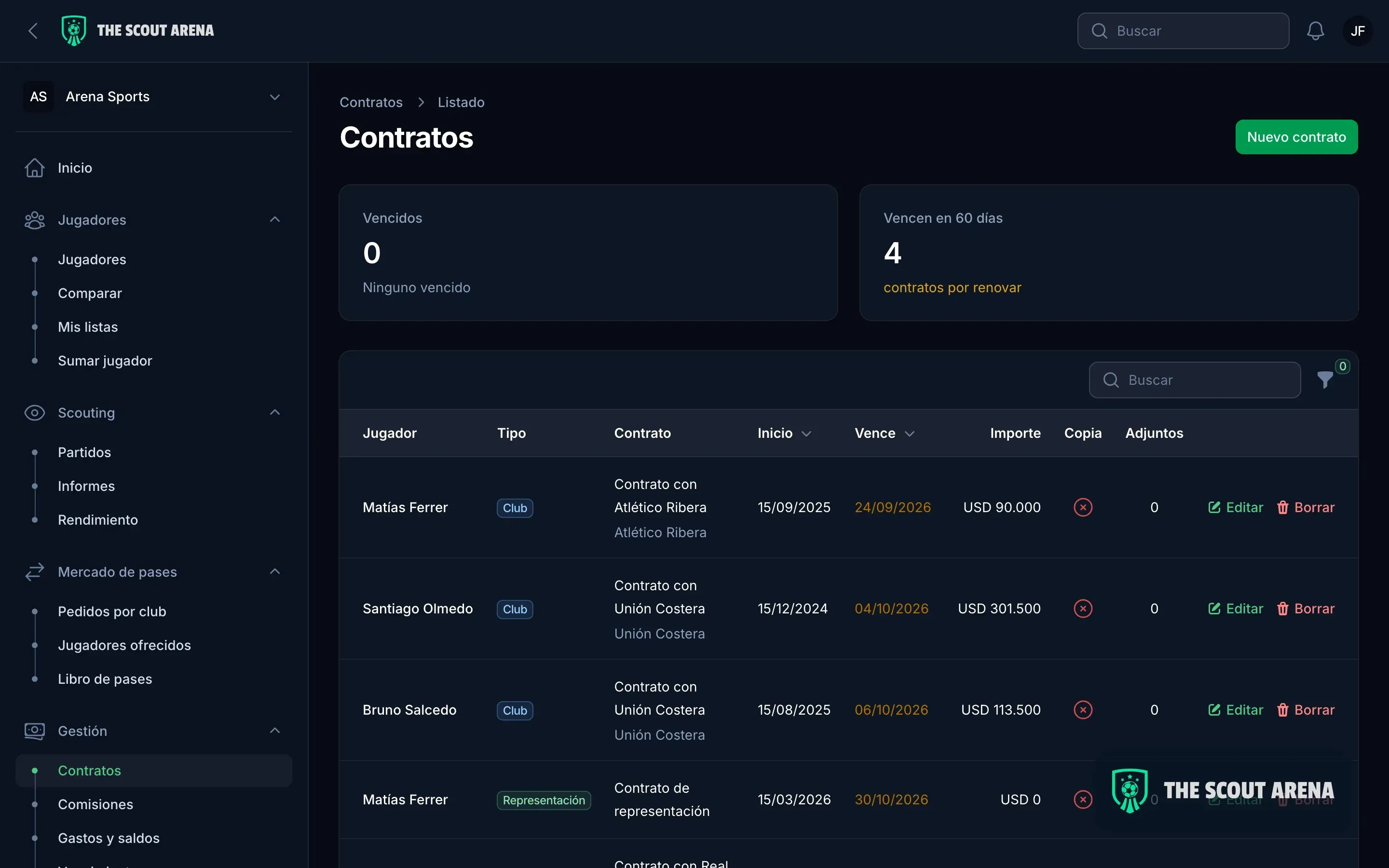
- One profile per player with ten tabs: details, contract, finances, performance, reports, tracking, objectives, calendar, lists and documents.
- Club and representation contracts, with their term and fee, and agreed, invoiced and collected on the same screen, with exchange rates for each currency.
- Expiry alerts by email every morning and a traffic light by deadline: what expires in 30, 90 and 180 days.
- Expenses and balances per player, with reports that export to Excel and PDF.
- Transfers and calendar: requests by club, players offered, transfer windows by country and contacts with their role.
- Four roles with different permissions, and each agency’s data isolated from the rest.
- Migration from your Excel spreadsheets, with a differences report before anything is confirmed, and a full export whenever you ask.
It does not replace uploading to the FIFA platform, but it keeps everything you declare there within reach. How each role in an agency works is on the page for football agents, and if you want to see it with your own cases, you can book a demo. Plans are on the pricing page.
In short
A football agent CRM earns its place if it keeps what the regulations can ask you for (agreements, expiry dates, fees and who pays them, consents for minors) and what daily work needs: the player profile, contacts, the market and expenses. General or specialised, the test is the same: it warns you before something expires, and you keep your history when you move in.
This article is for information only and is not legal advice. It is based on the FIFA Football Agent Regulations in force since 1 January 2025, Circular 1873 and the European ruling of 16 July 2026, with information checked as of September 2026.