

How to organise a football agency
By Mariano David Pérez Co-founder

How to organise a football agency comes down to five records and one routine: player profiles, contracts with their expiry dates, fees and expenses, documents, and tasks with the follow-up behind them; plus a fixed weekly review and a month-end close so none of the five goes stale. Nothing else is needed to start, and without them no software will save you.
What disorganises an agency is not volume — a roster of forty players is perfectly manageable — but having each piece live somewhere different and inside a different person’s head. This article is the parent guide to the subject: each section sets out the criterion and the minimum, and the articles that follow take them one at a time.
How can you tell an agency is disorganised?
Disorder rarely shows up as disorder. It shows up as bad luck. These are the symptoms that keep repeating, and none of the five is a talent problem:
- Expiry dates slip past. A contract reaches its final six months without anyone noticing, and a renewal you could have negotiated from a comfortable position gets negotiated against the clock. We go into it in how not to lose a renewal.
- Nobody knows which documents have expired. A youth player’s passport, the guardians’ consent, the medical file: they surface on the day you have to produce them.
- Two people from the agency talk to the same club in the same week, offering two different players without knowing it. The sporting director on the other side does notice.
- Nobody knows which client actually makes money. If a player’s income sits in a spreadsheet and their costs sit in card statements, no one can say which of the forty keeps the agency running and which costs more than they bring in.
- Information leaves with the person. The scout who was tracking a youngster moves on, and the conversations, the phone numbers and the judgement behind the tracking go with them.
- Every question from a partner costs two days. “How much did we collect this half-year?” should not be a project.
Three of these show up first. Contract expiry dates that slip by with nobody warning anyone. Poor conversion when signing new players: you follow someone for months and the conversation goes cold halfway through. And expenses out of control, money going out everywhere with nobody able to say which player it went to. If all three sound familiar, the problem is no longer anyone’s memory: it is that the information does not live in one place.
What five things must every agency keep in order?
Before choosing a tool you have to decide what gets recorded. These five records are the minimum: with them you can work off a spreadsheet, and without them the best software in the world is useless.
1. A profile for every player
One place per player, not five files. Personal details and passports, club and age group, position, current contract, who inside the agency looks after them, and their status: signed client, being tracked, former client or passed on.
The rule that organises the most: every player has an owner with a name. A player with no owner is a player you lose.
2. Contracts and their expiry dates
There are two different contracts and they get mixed up constantly: the representation agreement between player and agency, and the player’s employment contract with their club. Both expire and both move money. A representation agreement with an individual cannot run longer than two years and does not renew itself — any automatic renewal clause is null and void, under article 12 of the FIFA Football Agent Regulations.
What you need in sight is not the end date but three dates before it: when the contract enters its final six months, when it enters its final two — the window in which another agent may lawfully approach your client — and when you have to sit down and renew.
3. Fees and expenses
Every contract produces instalments, and instalments are where agencies lose money without noticing. The minimum is three columns per player: agreed, invoiced and collected, with the date and currency of each instalment. The arithmetic, the caps and who pays are in how much football agents earn.
On the other side, the costs: travel, medicals, lawyers, moving a family. Logged per player, not into one pot. It is the only way to answer what each client leaves you, which is the question you use to decide who to sign and who to let go.
4. Documents
Paperwork with an expiry date: ID and passports, work permits, medical files, written consent from guardians when the player is a minor, and the written confirmation that the player obtained or waived independent legal advice before signing, which article 12, paragraph 4 of the regulations requires.
Every document stored on the player’s profile with its expiry date recorded. A PDF in somebody’s downloads folder is not a filing system.
5. Tasks and follow-up
The last thing to get organised and the first to fall apart. Two separate things: tasks (call that club, send the report, renew the passport) and follow-up (what was discussed with whom and when, on the player’s profile and on the club contact’s).
The test is simple: if an important conversation exists only in one person’s messaging app, the agency does not have it.
What information do the FIFA agent regulations require you to keep?
The FIFA Football Agent Regulations, in the edition in force since 1 January 2025, set no retention period and nowhere say “keep your files for five years”. What they do is oblige you to be able to produce them:
| What the regulations require | Where | What you have to have kept |
|---|---|---|
| A representation agreement is valid only if it states the parties, the duration, the agent’s fee and the nature of the services, and is signed by everyone | Article 12, paragraph 7 | The signed agreement, in full |
| Before signing you must advise in writing that independent legal advice is sensible, and obtain written confirmation that the player took it or waived it | Article 12, paragraph 4 | That written confirmation, per player |
| The client may request from the agent a schedule detailing all payments of any kind made by or regarding that client: remuneration, fees and expenses | Article 18, paragraph 1(e) | The full payment and expense history of every client |
The third row is the one that catches people out: the party who can demand the full schedule is not only FIFA, it is your own client, whenever they like. And unlike the reporting duties in article 16, which have been suspended worldwide since FIFA Circular 1873 of 30 December 2023, the client’s right in article 18 was not on that list. The Court of Justice of the European Union’s judgment of 16 July 2026 did not settle the matter either: it left several of those rules to a German court. Before treating any of them as in force or suspended, check the current circulars from FIFA and from your national association. The full walk-through is in the guide to the agent regulations.
Why this matters for organisation: a reporting duty being on hold does not make the underlying data optional. If the suspension lifts, the 14-day deadline to upload everything to the FIFA Agent Platform starts running again, and in a dispute you will need exactly the same things: the agreement, the dates, what was agreed and what was collected.

What is the minimum routine for a well-run agency?
Getting organised takes an afternoon; staying organised takes a routine. Two fixed slots are enough, and short and always-the-same beats long and whenever-there-is-time.
| Every week (half an hour, same day) | Every month-end (an hour) |
|---|---|
| Contracts entering their last 180 days | Fees invoiced and collected this month |
| Documents expiring in the next 90 days | Expenses logged, per player |
| This week’s matches and who is going to each | Balance per client: earned and spent |
| Last week’s reports still not written up | Tracked players with no update in 60 days |
| Open club requests and who was offered what | Roster: additions, exits and status changes |
| Players with no owner assigned | One number for the partners, always the same one |
The weekly review is not a team meeting: it is one person looking at six lists. The month-end close is worth doing in pairs, because that is where decisions get made.
What can you delegate, and what can you not?
A small agency does not get organised by hiring, but it does not get organised either if the person negotiating is the person logging expenses. In practice the line falls here:
Delegate freely: writing up match reports, logging invoices and expenses, building player lists, updating documents and their expiry dates, preparing the month-end reports, chasing missing paperwork.
Do not delegate: negotiating with the club and with the player, deciding who to sign and who to let go, what gets promised to a family, and reading the month-end number. Nor do you delegate who sees what: the scout filing a report does not need to see what the agency charges, and a minor’s data is not for the whole team.
One detail that saves arguments: delegating a task is not delegating the judgement. If the person logging expenses does not know which player a trip belongs to, the record ends up worse than empty, because it looks reliable.
What does this look like in practice?
Five records and two routines are enough to work off spreadsheets. A system earns its place when it does the two things a spreadsheet cannot: tell you without you going to look, and stop the same thing being entered in two places. What to ask any system before choosing it is in what a football agent CRM is.
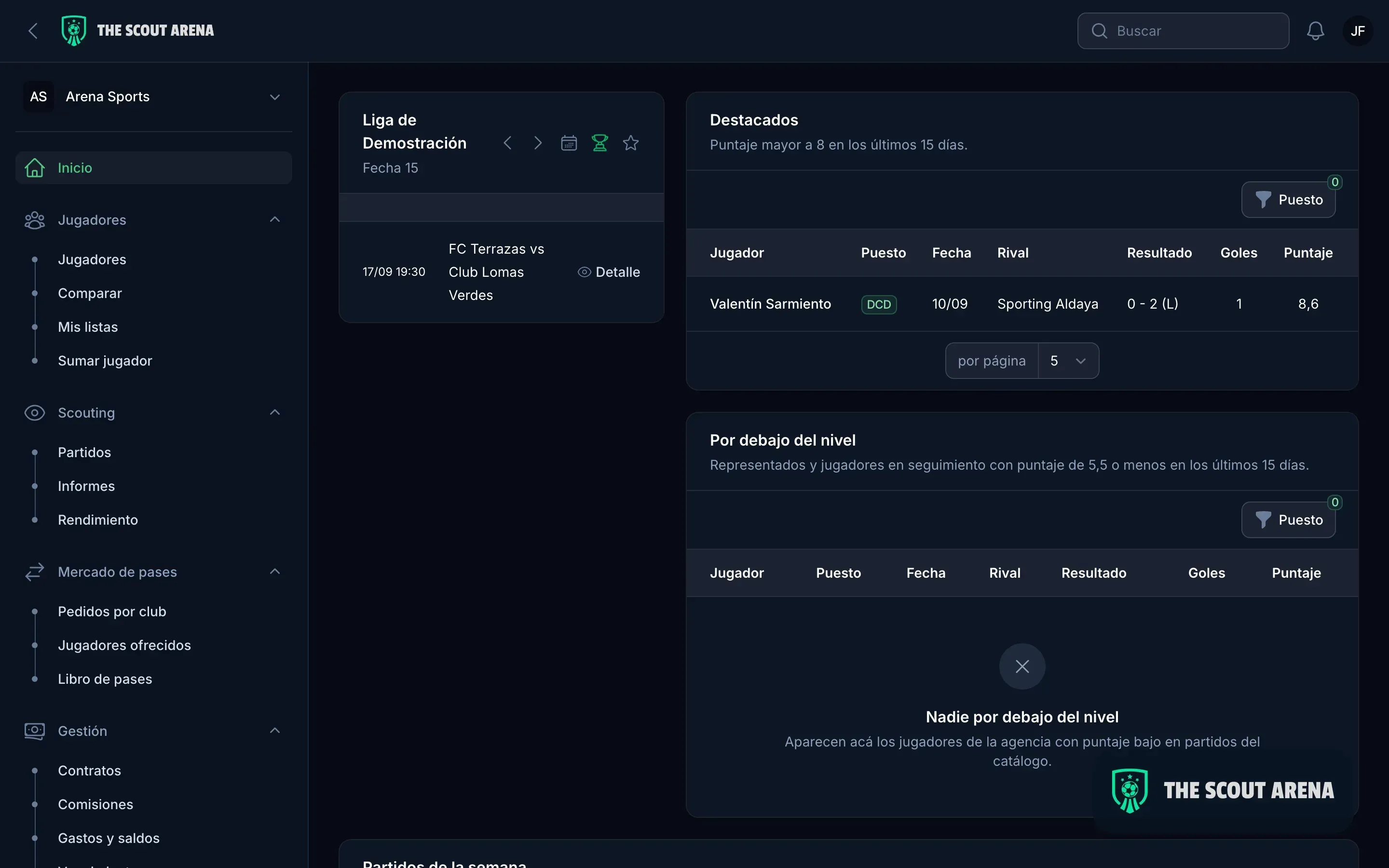
In The Scout Arena the five records are the same five screens (screenshots use a demo agency’s data):
- the player profile, with documents, finances and follow-up in one place;
- club and representation contracts with agreed, invoiced and collected side by side, in several currencies;
- expiry dates with an email every morning and a traffic light by time left, which is the weekly review done for you;
- expenses logged per player, and reports that export to Excel and PDF for partners and accountants;
- four roles with different permissions, so each person sees their own part.
How the work splits between the owner, the finance person and the scout is on the page for football agents.
Checklist
If you can tick all ten, the agency is in order:
- Every player has a profile and a named owner.
- Representation agreements and employment contracts are recorded separately, each with its expiry date.
- You know which contracts are entering their last six months without having to work it out.
- Every fee has its three columns: agreed, invoiced, collected.
- Expenses are logged per player, not into one pot.
- Every document with an expiry date is stored and has that date recorded.
- You hold the written independent-legal-advice confirmation for every client.
- Conversations with clubs live somewhere other than one person’s phone.
- There is a fixed weekly review and a fixed month-end close.
- Each person on the team sees their own part and nothing more.
In short
Organising a football agency is not buying software: it is deciding which five things always get recorded — profiles, contracts and expiry dates, fees and expenses, documents, tasks and follow-up — reviewing them for half an hour a week and an hour a month, and keeping whatever the regulations may ask you to produce. Software comes afterwards, so the routine does not depend on someone remembering. If you want to see it against your own cases, you can book a demo.
This article is for information only and is not legal or accounting advice. It is based on the FIFA Football Agent Regulations, the edition in force since 1 January 2025, on Circular 1873 and on the European judgment of 16 July 2026, with information verified as at October 2026.
Sources
- FIFA Football Agent Regulations, 2025 edition (PDF) — articles 12 and 18.
- FIFA Circular 1873: FIFA Football Agent Regulations, update on implementation (PDF, 30 December 2023)
- Court of Justice of the European Union: press release on judgment C-209/23, RRC Sports (PDF, 16 July 2026)
- FIFA Agent Platform