

Scouting in amateur and youth football: organising it with an app
By Mariano David Pérez Co-founder
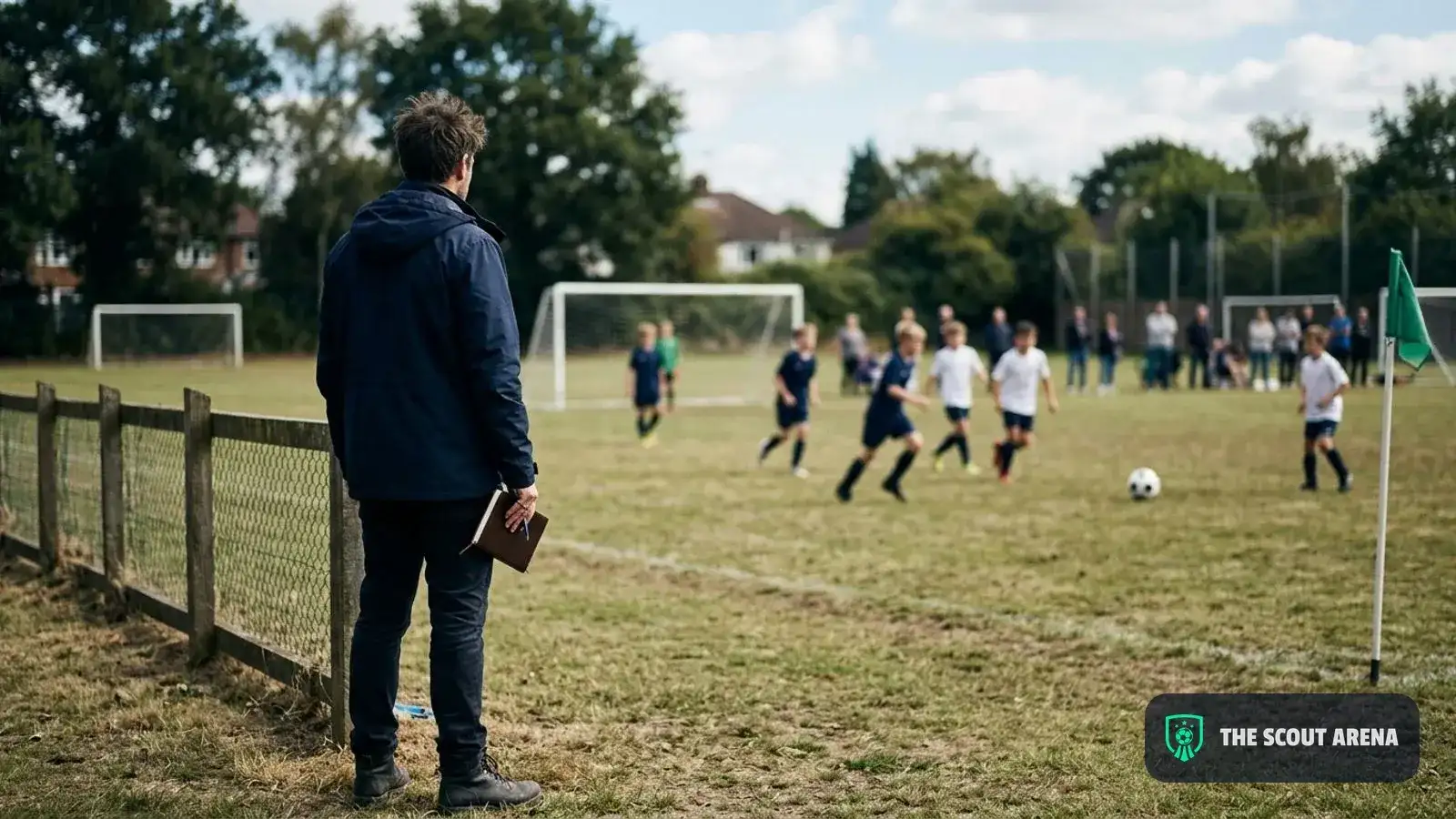
A scouting app for amateur football and youth levels has to solve the opposite problem to one built for the professional game: there is no data to look up, so the tool is worth what it lets you record and how it keeps it in order. Three things are essential: creating a player who is in no database, following the same player across several seasons, and storing a minor’s details with care. This guide covers what changes on pitches nobody films, what to demand from the app and which mistakes keep coming back.
What changes when you scout amateur or youth football?
The raw material changes. In a top division there is video of every match, published statistics and a fixture list anyone can find. In a regional league, a local tournament or an under-14 side, almost none of that exists: the only record of the match is the one made by whoever went to watch it.
“Amateur” also has a regulatory meaning. For FIFA, a professional is a player who has a written contract with a club and is paid more than the expenses he incurs for playing; all other players are amateurs, under article 2 of the Regulations on the Status and Transfer of Players (July 2025 edition). That group includes nearly every youth player and the vast majority of adults who play.
| Professional football | Amateur and youth football | |
|---|---|---|
| Player data | Published and kept up to date | You record it, or it does not exist |
| Video | Every match | Sometimes a parent’s, rarely complete |
| Fixtures | Public and stable | Day, pitch and kick-off time all move |
| Compared against | The position in the league | The age group, and the same player six months ago |
| What is assessed | Performance today | Projection: what the player could be in three years |
| Whose data it is | An adult’s | Often a minor’s |
The practical consequence: a tool whose strength is its database is of limited use here. The one that helps is the one that works as a good archive of your own.

What must a scouting app have for these levels?
The general checklist is in what a football scouting app must have. For amateur and youth football, seven points decide it:
- Creating a player in a minute. Name, year of birth, club, age group and position. If the app only lets you pick from a catalogue, the player you saw on Saturday cannot go in and ends up in a note on your phone.
- Year of birth and age group as data, not free text. They are the two filters you will use most: “the 2011s I saw this year”, “under-15 full-backs”.
- Clubs season by season. Where the player was each year, not only where he is today. The reason is further down.
- Several reports on the same player, side by side. At youth level a single observation says little; the series is what counts.
- Stand-alone follow-up notes. The chat with the academy coordinator, the change of position, the injury. Not everything is a match report.
- Lists by criteria. “Watch again”, “left-footed 2010s”, “for the December trial”. It is how nobody gets lost among forty names.
- Permissions per person. Who sees what, above all when the notes are about minors.
What goes into each report, and how to write its conclusion, is in how to write a football scouting report.
Why should you watch the same youth player several times?
Because at 13 or 14, what you see in one match depends heavily on when the player was born and how much he has grown. FIFA’s talent identification guide asks organisations to consider the influence of relative age and maturation when drawing up short lists, and to reflect on possible biases when selecting. The same guide describes how Belgium and Denmark set up “futures” teams so that late developers are not left out (accessed October 2026).
For the person watching, that becomes a handful of habits:
- Record the month of birth, not just the year. A January-born and a December-born player in the same age group are almost a year apart.
- Separate the physical from the rest. The English FA organises player assessment into four corners: technical/tactical, physical, psychological and social, and treats them as equally important. A report that only says “quick and strong” describes one corner.
- Go back. Two or three observations in different settings — home and away, against a stronger opponent, in another position — before deciding anything.
- Keep a long list. The player who is not ready today stays in follow-up, with a date to watch him again, instead of dropping off the radar.
None of this works unless the second report can be read next to the first. Without that, every visit starts from zero.
Which details of a youth player are worth recording from day one?
The usual ones — full name, date of birth, position, stronger foot — and one that tends to be missing: which club the player was at each season.
It is not a detail. FIFA’s regulations oblige the association that registers a player to provide a player passport indicating the clubs with which he has been registered since the calendar year of his 12th birthday (article 7). That history is what the entitlements of the clubs that trained him are later calculated on, as we explain in what the FIFA solidarity mechanism is. The official passport is issued by the association; your record does not replace it, but years later it tells you whom to ask and which club has something to claim.
The rest of what is worth writing down:
- Age group and division he plays in, and whether he has played up.
- Who watched him and when, on every report.
- Club and family contacts, who was spoken to and what was said.
- Injuries, with start and return dates.
And what is better left out: opinions about the family, health information that has nothing to do with football, anything you would not be comfortable showing the parents.
What care does minors’ data need?
More than an adult’s, and the regulations are explicit about the context. FIFA only permits the international transfer of a player who is over 18, with a short list of exceptions, in article 19 of the same regulations. What an agent can and cannot do with a minor is covered in football agent for minors.
For the data itself, the principles of the General Data Protection Regulation summarised by the European Commission work as a yardstick in any country: collect only what the purpose requires, keep it no longer than necessary and protect it. In practice:
- Reports on a minor live in the organisation’s system, not on the phone of whoever watched him or in a group chat.
- Each person sees what they need. The scout records and reads the football side; there is no need to see more.
- If the player is no longer of interest, his data does not stay for ever: it is reviewed and deleted.
- Photos and video of children are requested from the family or the club, not lifted from social media.
Each country’s data protection law adds its own rules for minors; this is a baseline, not legal advice.
How amateur and youth scouting is organised in The Scout Arena
The Scout Arena is the software we built for this work. What it does for these levels:
- Add the player who is in no database. If he is in the catalogue it links him; if not, you create him with his details. It can also be done over WhatsApp on the way out of the ground.
- Reports and follow-up on the same profile. Each match report carries the attributes for the position, the rating and the name of whoever filed it, and sits on the player profile next to the earlier ones. Loose notes go into threaded follow-up.
- Youth players measured separately. Age groups and divisions, and performance by age group with minutes, goals and ratings, because a 15-year-old is not measured with the same yardstick as a professional.
- Lists by criteria and goals per player, so you know who needs watching again.
- Roles. The scout files reports and follows his players; he does not see the financial side.
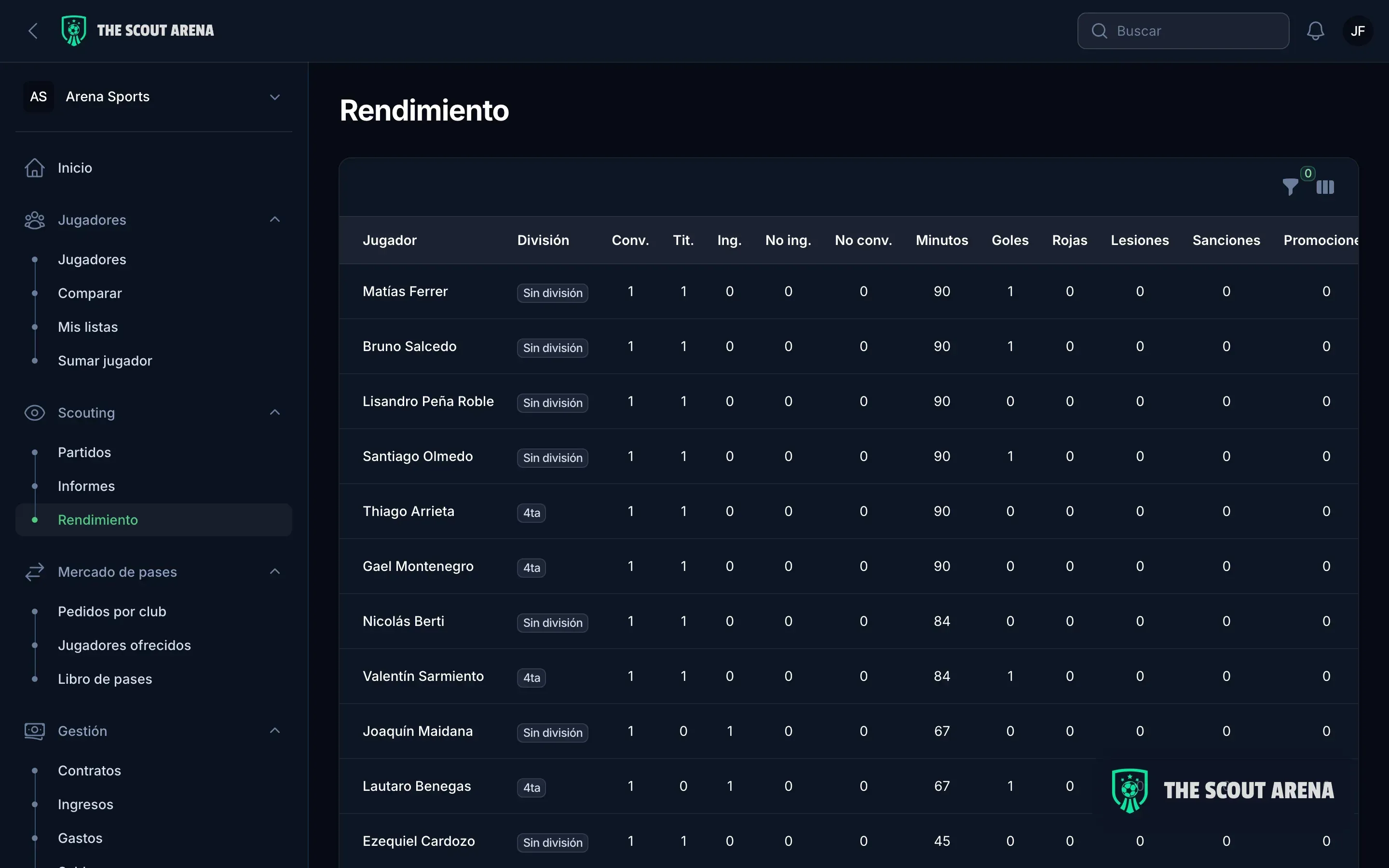
One limit worth knowing beforehand: in leagues that no data source covers, match numbers do not arrive on their own. What you have is what your team records. Whether your league is in the catalogue is one of the first questions to ask in the demo.
How a scout’s full week looks is on the page for scouts; if what you are organising is a club’s academy, see the page for clubs. Plans are on pricing.
In short
In amateur and youth football the app does not bring the information: it keeps it. Ask that it lets you create any player in a minute, that it records year of birth, age group and clubs by season, that it shows reports on the same player side by side and that it controls who sees what. Watch the same youth player more than once before deciding, note the month he was born and keep the one who is not ready yet on the long list. And whatever you write about a minor should stay in your organisation’s system.
Article updated October 2026. It is for information only and does not replace legal advice.
Sources
Accessed October 2026:
- FIFA: Regulations on the Status and Transfer of Players, July 2025 edition (PDF): articles 2, 7 and 19.
- FIFA Training Centre, Talent Development Scheme: Talent Identification Guide, module 4 (selection).
- The FA, England Football Learning: The FA 4 Corner Model.
- European Commission: principles of the General Data Protection Regulation.