

Chatbot for football agents: what it can answer today
By Mariano David Pérez Co-founder

A chatbot for football agents that is connected to your agency’s data can already answer whatever has been recorded: what expires and when, how a client is doing, what came in and went out this month, and it can put together a player’s profile for you to send to a club. It can also record things for you — an expense, a note, a match report — as long as it shows you a summary and waits for your confirmation. What it cannot do is know what nobody wrote down, negotiate, file on FIFA’s platform or message a club on its own. This article keeps the two lists apart and goes through the two sets of rules that limit it today: WhatsApp’s business policy and the EU Artificial Intelligence Act.
Updated November 2026. The regulatory points come from the FIFA Football Agent Regulations, the edition in force since 1 January 2025.
What is a chatbot for football agents?
It is an assistant you message in plain language that answers with your agency’s own data: each player’s contracts, commissions, expenses, reports and follow-up notes. What separates it from a general-purpose assistant — ChatGPT, Gemini or any other — is not intelligence but access. A general assistant does not know when your client’s contract runs out or how much a club owes you; ask it and it either says it doesn’t know or, worse, gives you an answer that sounds right and isn’t.
So the useful question is not “how clever is it?” but three more specific ones:
| Question | Why it matters |
|---|---|
| Where does the answer come from? | If it doesn’t read your data, any date or amount it gives you is a guess. |
| Can it write, or only read? | Logging an expense from your phone saves more time than looking things up, but it needs confirmation. |
| Does it respect who can see what? | If a scout asks about commissions, the right answer is that they don’t have access. |
What can a chatbot for agents answer today?
Anything that has a date, a number or a piece of text already in the system. These are the questions you currently answer by opening three spreadsheets and scrolling back through a chat:
- What’s expiring. Club contracts, representation agreements, documents and passports, with the days left. The representation agreement is the one that hurts most: it cannot run longer than two years and can only be extended by signing a new one, because automatic renewal clauses are void (Article 12(3)).
- How a player is doing. Club, contract, minutes, goals and the latest note someone at the agency left.
- How the month looks. What has been collected, what has been spent and the balance in each currency, for the agency or for one client.
- What’s on this week. Tasks with a due date and the matches assigned to each scout.
- Send me their profile. The player’s PDF, ready to forward to a club from the same chat.
None of these answers is an opinion: they are data someone recorded, handed back in answer to a question. That is where their value lies, and also their limit.

What can it record for you?
It can record what usually gets left for “when I’m back home”: an expense with its amount, currency and the player it belongs to; a follow-up note after a call with a club; the report on the match you have just watched; a task with a due date. That is where it saves the most time, because what isn’t recorded on the spot usually never is.
There is one condition: before saving, the chatbot shows you a summary and waits for you to say yes. A message is easy to misread — “80 for travel” could be euros or dollars, for one player or another — and a wrongly saved figure is worse than a missing one, because nobody checks it. If an assistant saves without asking, that is your first reason not to use it.
What can’t it answer or do?
It cannot do the work that depends on you, and it cannot know what isn’t written down. It is worth being clear about this list before you start, because the most common disappointment with any tool is having asked it for something it could never give:
- It doesn’t know what nobody recorded. If the contract is sitting in a drawer, it never expires for the chatbot. If the scout didn’t log the injury, the player is still fit.
- It doesn’t negotiate or sign clients. The conversation with a sporting director and the trust of a family are still yours.
- It doesn’t file on FIFA’s platform. Every representation agreement must be uploaded to the FIFA Agent Platform within fourteen days of being signed, amended or terminated, and every service fee you receive must also be reported within fourteen days (Article 16(2)(j)). The chatbot can remind you of the deadline and put the contract at hand; the filing is yours.
- It doesn’t give legal advice. It can tell you which date appears in a contract, not whether a clause is valid in your country.
- It doesn’t message a club on its own. It prepares the profile for you to send; the relationship with each club stays in your hands, as covered in organising your club contacts.
What changes when the chatbot runs on WhatsApp?
You get it in the chat you already have open all day, but WhatsApp’s business rules apply too. The WhatsApp Business Messaging Policy (last updated 23 September 2026) sets two that matter for an assistant:
- It can reply freely within 24 hours. A business may answer without a template while the 24-hour customer service window is open, and that window opens and resets with every message from the user. Outside it, the business can only send approved message templates. In practice, the chatbot is good at answering when you ask; alerts that need to reach you even if you haven’t written — an expiry date, say — are better received through another channel, such as email.
- Automation needs a route to a person. The same policy allows automated replies within that window as long as there are clear escalation paths to a human: an in-chat human agent, a phone number, an email address or a support form.
What does the EU AI Act say about chatbots?
It says people must know they are talking to an artificial intelligence. Article 50(1) requires providers of AI systems meant to interact directly with people to design them so that those people are informed they are dealing with an AI, unless that is obvious from the context. Under Article 113, that part of the regulation has applied since 2 August 2026.
For an agency team using its own assistant, it is obvious there is no person on the other end. The rule carries more weight if you ever plan to put a chatbot in front of players, families or clubs: then it has to be clear from the very first message.
The other limit is personal data. A player profile contains injuries, and the European Commission points out that health data is a special category that can only be processed under specific conditions, such as explicit consent. Pasting a client’s medical report into a general-purpose chatbot means handing it to a third party your agency has no agreement with. An assistant connected to your own system reads the data where it already lives, under the permissions that already exist.
How The Scout Arena handles it
The Scout Arena is the software we built for player representation agencies, and its assistant runs on WhatsApp on the same data and permissions as the dashboard.
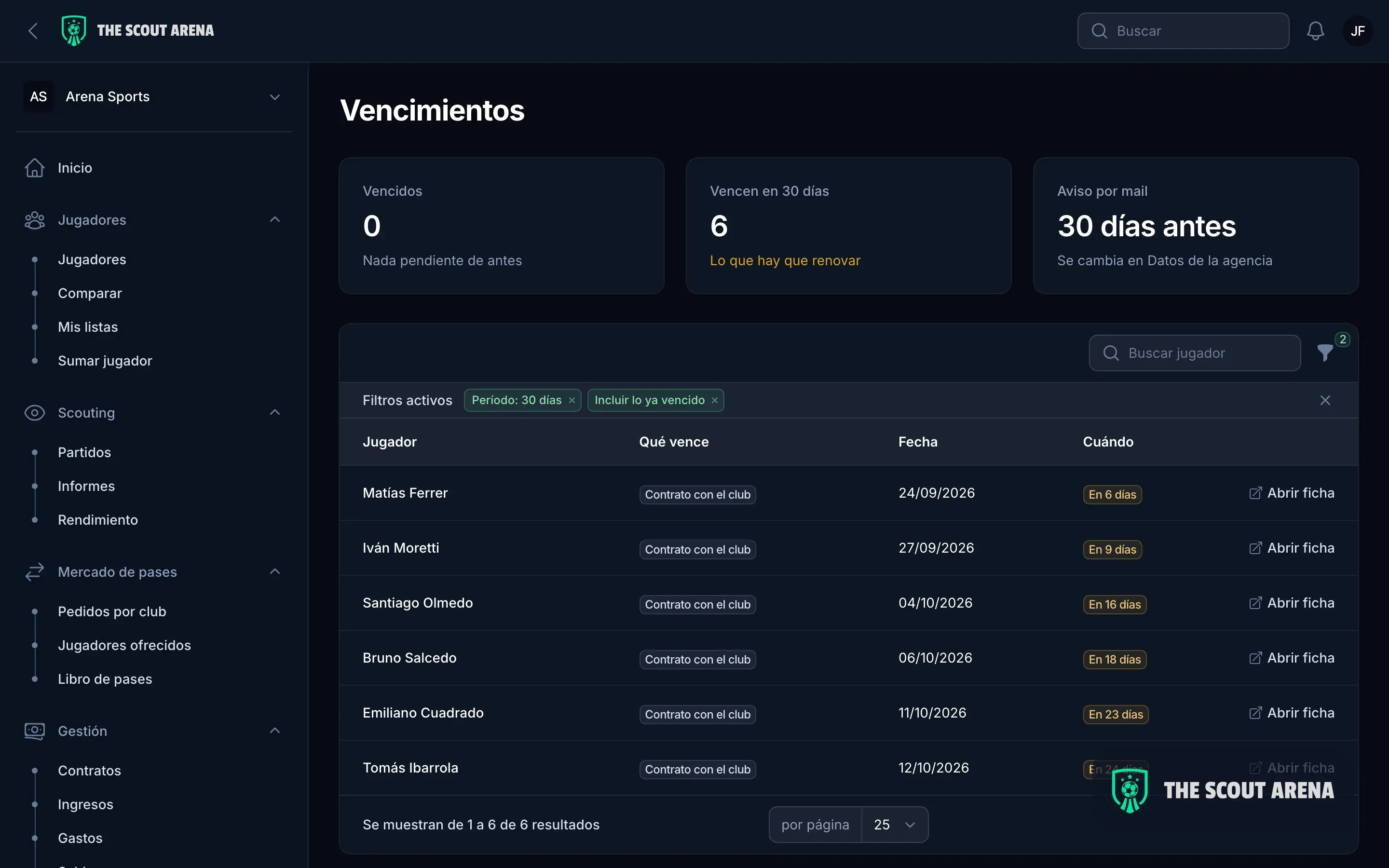
- Questions. Ask about a client and you get their profile back: club, contract, minutes, goals and their latest note. Ask what’s expiring — contracts, representation, documents and passports — or how the month looks, by currency.
- Recording with confirmation. Expenses, follow-up notes, match reports and tasks, always with a summary before saving. Whatever you record by chat lands on the player’s profile, just as if you had entered it in the dashboard.
- The same permissions. Scouts don’t see the financials and admin staff don’t see the sporting side, in the chat or on the platform: the assistant can never do more than the person using it.
- Alerts by email. Contract expiry alerts arrive every morning with whatever is coming up, without depending on you opening the chat.
- Reports from the stand. The scout describes the match by chat and the assistant finds the player, finds the fixture and puts together the match report.
How the assistant fits into each role’s work at an agency is on the page for football agents. What each plan includes is on pricing, and you can book a demo to ask it your own questions.
In short
A chatbot for football agents is worth exactly as much as the data it reads: it answers dates, figures and notes that are already recorded, and records new ones if it asks you to confirm. It doesn’t negotiate, it doesn’t file on FIFA’s platform and it doesn’t know what nobody wrote down. Before using one, ask where its answers come from, whether it respects each role’s permissions and where your players’ data goes. And if your agency doesn’t yet have the habit of recording things, a chatbot won’t replace it: start with how to organise a football agency and what a football agent app solves.
This article is for information only and is not legal advice. The regulatory points were checked in November 2026 against the sources below.
Sources
Checked in November 2026:
- FIFA Football Agent Regulations, in force since 1 January 2025 (PDF): Articles 12(3) and 16(2)(j).
- FIFA Agent Platform.
- WhatsApp Business Messaging Policy, last updated 23 September 2026: the 24-hour customer service window, message templates and escalation paths to a human.
- European Commission, AI Act Service Desk: Article 50 and Article 113 of Regulation (EU) 2024/1689, consolidated version.
- European Commission: legal grounds for processing personal data and special categories.