

Football agent app: what it solves and what it doesn't
By Mariano David Pérez Co-founder

A football agent app solves four specific problems: no date slips past, you know which instalment each commission is on, what each person at the agency knows lives in one place, and what you send a club is ready in minutes. It does not solve the rest of the job: it does not find clients, it does not negotiate, it does not replace filing on FIFA’s platform or your accountant, and it does not organise an agency that has no routine. This article keeps the two lists apart, so you know what to expect before paying for one and what will still depend on you.
Updated October 2026. The regulatory points come from the FIFA Football Agent Regulations, the edition in force since 1 January 2025.
What does a football agent app solve?
It solves what gets lost when the work lives between a spreadsheet, a notebook and a chat: the dates, the money paid in instalments, the information spread across people and the time it takes to put together what a club asks for. A three-person agency already has these problems, even if it has not noticed yet.
| The problem | What an app does with it |
|---|---|
| Dates slip past. A representation agreement with a player lasts two years at most and can only be extended by signing a new one; any automatic renewal clause is void (Article 12(3)). And in the final two months of that agreement, another agent may approach your client (Article 16(1)). | Each contract’s date is entered once and the app warns you ahead of time, without anyone having to log in and look. |
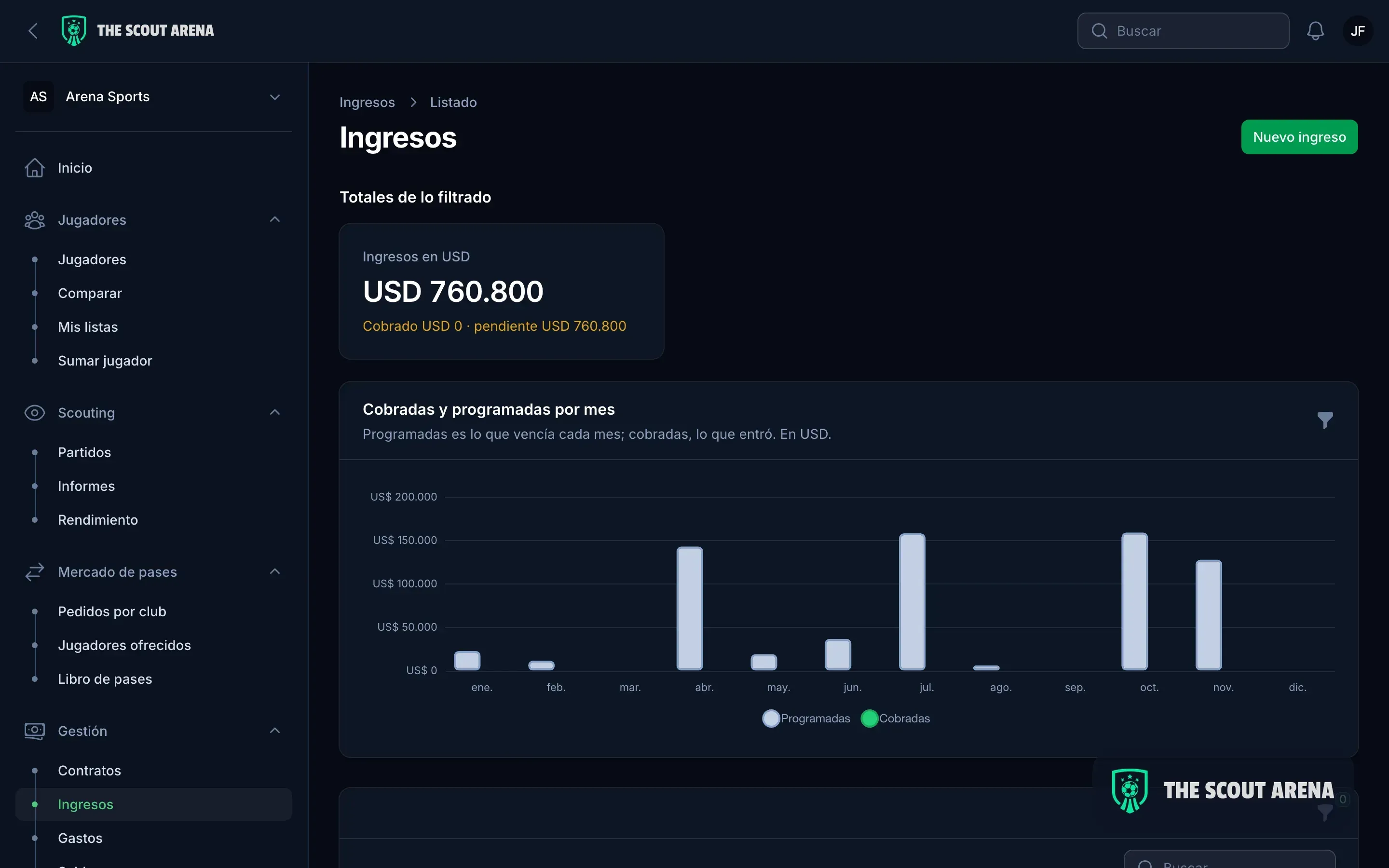
| Instalments nobody tracks. Service fees are paid every three months for the duration of the employment contract you negotiated, and only on the remuneration the player actually receives (Article 14(6) and (7)). A three-year contract is twelve instalments, and if the player moves club halfway through, the remaining ones are lost. | What was agreed, invoiced and collected, instalment by instalment and per currency, with the month’s balance without rebuilding it by hand. |
| Information in everyone’s head. The scout has their notes, the administrator their Excel, you your WhatsApp. When one of them is away, their part is away too. | One profile per player with everything that belongs to them, by date: contracts, reports, documents, follow-up and expenses. |
| What a club asks for. Pulling together a player’s minutes, goals, injuries and reports takes an afternoon, and the club wanted it yesterday. | The profile goes out as a PDF or a link, showing only what you choose. |
| Who sees what. In a shared spreadsheet, the scout sees what the agency earns and the administrator sees the reports. | Roles with permissions: each person sees what is theirs. |
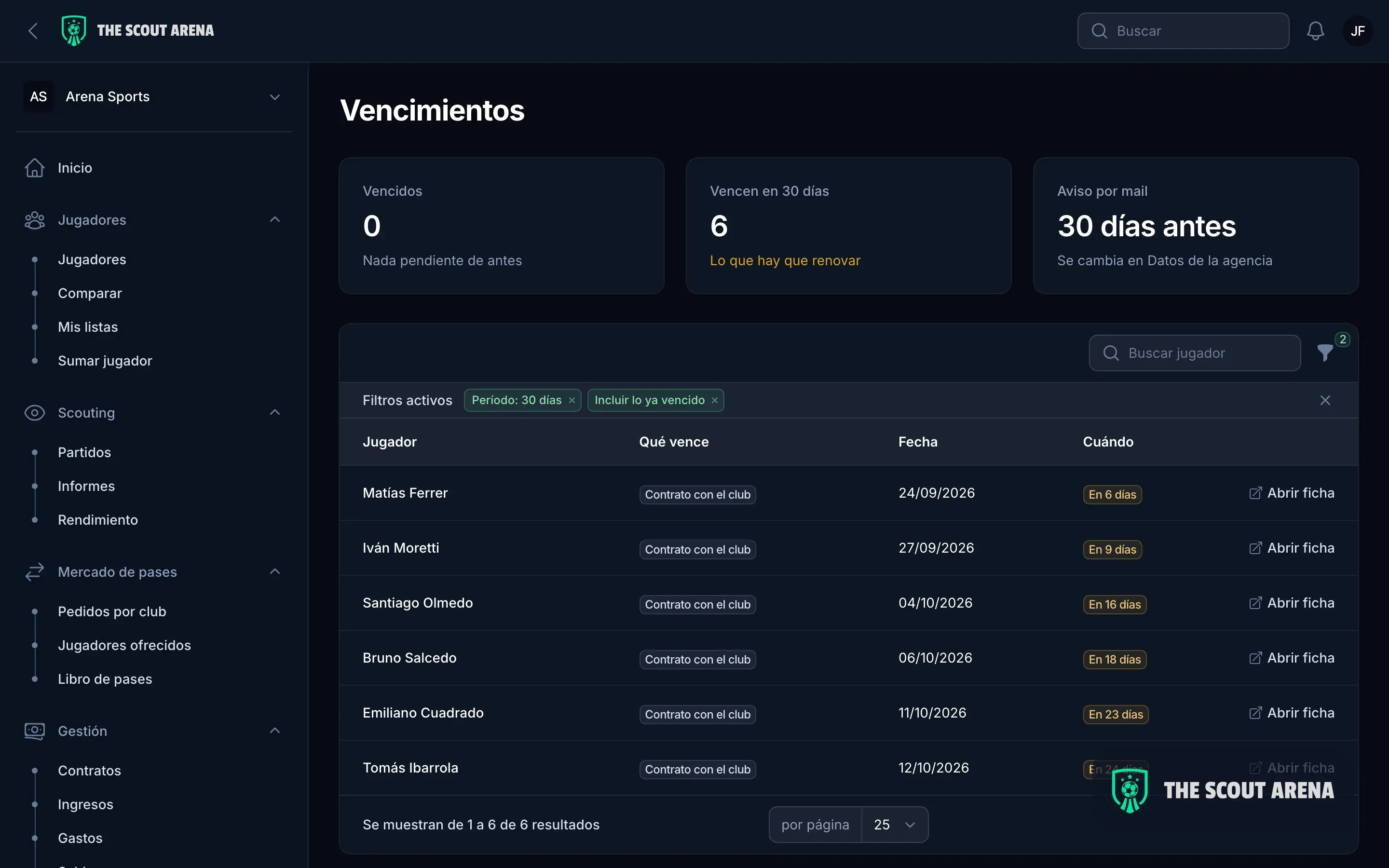
Dates come first because they are the only problem with a deadline written into the regulations, and the most expensive one when it slips. How not to lose a renewal develops that point; instalments and what comes in and goes out per player are in how to organise a football agency’s expenses.
What doesn’t a football agent app solve?
It does not solve the job itself: an app organises what you already do, it does not do what you don’t. Worth being clear about before paying, because the most common disappointment with any software is having asked it for something it could never give.
- It does not find clients or negotiate. The relationship with a player and their family, the conversation with a sporting director and the price a deal closes at are still yours. The app keeps the context on each of them so you arrive prepared; it does not speak for you.
- It does not replace FIFA’s platform. The regulations require you to upload every representation agreement to the FIFA Agent Platform within 14 days of signing, amending or terminating it, and to report the payment of each service fee within 14 days as well (Article 16(2)(j)). If you work through an agency, its ownership structure and staff must be declared too (sub-paragraph (k)). No app does this for you: a good one keeps what has to be declared within reach and reminds you of the deadline, but the filing is yours.
- It does not replace your accountant or your lawyer. Service fees go through the FIFA Clearing House where its regulations provide for it (Article 14(13)), every country has its own tax regime and every contract has clauses a form does not review. The app records the money; the invoice, the tax and the clause belong to others.
- It does not organise a disorganised agency. If nobody has the habit of recording the expense on the day or the report on the night of the match, the app is empty after three weeks. Routine first, tool second: that is covered in how to organise a football agency.
- It does not know what you didn’t enter. The expiry alert comes from a date somebody typed. A contract left in a drawer never expires as far as the app is concerned.
- It does not watch matches. Video and data platforms show you players; the app keeps what your scout thought of each one. You need both, and they are different things: the football scouting app guide explains why.
How do you know your agency needs an app?
It needs one when any of these has happened twice. Once is an accident; the second time it is the system you have.
- A date slipped past. A representation agreement that expired without anyone noticing, a passport that needed renewing before a trip, a window that closed with a request left unanswered.
- “How much did this player bring in?” takes a day to answer. If the answer comes from combining three spreadsheets and an email from the accountant, you do not have it.
- Two people have two versions. The scout says the player has been injured since March; in the spreadsheet he is still playing.
- Someone sees what they shouldn’t. The external scout has access to the Excel where the commissions are, because it is the only file there is.
- The week of filing on FIFA’s platform turns into a puzzle. Hunting for the contract PDF, the signing date and the amount of each instalment in five different places.
If none of the five has happened to you, the spreadsheet still works, and there is no rush. A football agent’s tasks, week by week helps build that routine with what you have.
What should you ask of a football agent app before paying?
Ask it to solve the four problems above, with your own data, in a short trial. What a football agent CRM must record has the full list of questions; these are the ones that separate an agent app from a task manager with football in its name:
| Ask for | How to check |
|---|---|
| Expiry alerts without logging in to look | Enter a contract that expires in 20 days and see whether anything reaches you the next day |
| Commissions in instalments and in more than one currency | Enter a contract in euros with quarterly instalments and an invoice in dollars |
| Expenses recorded per player | Enter a trip and ask how much you have invested in that player |
| Roles with different permissions | Log in as a scout and see whether you can see the money |
| Match reports filed from a phone | Do it from the stand, at a real match, and time it |
| A full export whenever you want it | Ask for the Excel before entering anything that matters |
| Your data kept separate from other agencies’ | Ask in writing, with the answer in the contract |
There is one more point a demo will not show you: personal data. A player profile holds a date of birth, injuries and a written opinion about a person, often a minor. The principles of the General Data Protection Regulation summarised by the European Commission work as a checklist in any country: collect data for a specific purpose, only what is necessary, keep it no longer than needed and protect it. Ask the provider where the data is stored, who else can see it and whether you can delete a player, with everything attached, when you stop following them.
How The Scout Arena handles it
The Scout Arena is the software we built for representation agencies, and it answers the two lists this way: it solves the four problems and does not promise the rest.
- Dates. Expiry alerts bring together club contracts, representation agreements, documents and passports, with an email every morning and a colour code per deadline. The date is entered once, on the profile.
- Instalments. Contracts and commissions track what was agreed, invoiced and collected, instalment by instalment, with exchange rates for each currency, and expenses and balances per player alongside.
- One place. Every player has a profile with contracts, finances, reports, follow-up, documents and lists. The scout files the report from their phone or tells the assistant on WhatsApp, which finds the player, finds the match and saves it once you confirm.
- What you send the club. The profile goes out as a PDF or a public link, with your logo and the sections you choose, and with the player compared against their position in the top leagues.
- Who sees what. Four roles, with the same permission matrix in the panel and in the chat: the scout does not see the money and the administrator does not open the reports.
- What stays yours. Filing on FIFA’s platform, negotiating and invoicing. For those it keeps the contract, the signing date and each instalment within reach, imported from your spreadsheets with a report of differences before anything is confirmed, and exportable whenever you ask.
How each role at an agency works inside the panel is on the page for football agents. Plans are on pricing, and you can request a demo to run the table above with your own contracts.
In short
A football agent app solves dates, instalments, scattered information and what you send a club; it does not find clients, negotiate, file on FIFA’s platform or replace your accountant. Ask any app for the first four with your own data in a short trial, and do not ask any of them for the others. If no date has slipped past you today and you know what each player brought in, the spreadsheet still works; when that stops being true, you know what to look for.
This article is for information only and is not legal or accounting advice. The regulatory points were checked against the FIFA edition cited above, as of October 2026; each national association may have its own rules on agents.
Sources
Checked in October 2026:
- FIFA Football Agent Regulations, in force since 1 January 2025 (PDF): Articles 12(3), 14(6), 14(7), 14(13), 16(1) and 16(2)(j) and (k).
- FIFA Agent Platform.
- European Commission: principles of the General Data Protection Regulation.