

From WhatsApp to a system: organising your club relationships
By Mariano David Pérez Co-founder

Club contacts for football agents are the asset that gets lost most often and organised least: who picks up the phone at each club, what their role is, what they asked for and what you offered them. Moving them from WhatsApp to a system isn’t about switching apps; it’s about every conversation leaving a record — the person with their role and club, the request with position and budget, and every written offer received, because FIFA’s rules require you to pass it on to the player whatever channel it came through.
Updated on 29 October 2026. The regulatory points come from the FIFA Football Agent Regulations, edition in force since 1 January 2025. The data protection points come from the EU General Data Protection Regulation; outside Europe your own country’s law applies.
Why isn’t WhatsApp enough to manage club relationships?
Because WhatsApp stores conversations, not relationships. It’s great for a quick word with a sporting director, but it can’t answer the questions an agency asks every week: which clubs are looking for a left-back, who has already been offered a given player, who replaced the head of recruitment who left in June.
The problems always show up in the same places:
- The contact lives on one phone. If the agent who talks to a club changes number, falls ill or leaves the agency, the relationship goes with them.
- The request gets buried. “We’re after an under-23 striker, up to 300k” was said in a voice note three weeks ago. When the right player turns up, nobody remembers who asked.
- The same player gets offered twice. Two people at the agency send the same player to the same club on different terms. Few things damage credibility faster.
- There’s no history. When the coach or sporting director changes, there’s no record of what was discussed with the previous regime.
None of this is fixed by banning WhatsApp. It’s fixed by agreeing that the important part of every conversation goes into a shared place, the same day.
What should you record for each club contact?
Whatever helps you call back with context, and nothing more. A good contact record is only a few lines long:
| Field | Why it matters |
|---|---|
| Name and role | Knowing whether you’re talking to the decision-maker or the gatekeeper: sporting director, head of recruitment, manager, academy coordinator |
| Club and country | Matching against requests and against which transfer windows are open |
| Work phone and email | The channels that person uses for the club, not the personal number they once gave you |
| Who at the agency owns the relationship | So the club has a single point of contact and nobody calls off their own bat |
| Last conversation | What was discussed, when, and what was left open |
Role is the field that ages fastest. Clubs change sporting director every few seasons, and your contact moves to another club — which is when the record is worth double: you don’t lose the person, you gain a club.
Club contacts are personal data. In Europe, keeping them to work with is usually based on the agency’s legitimate interests (GDPR, Art. 6(1)(f)), provided that person’s rights don’t override them. And they are kept “for no longer than is necessary” (Art. 5(1)(e)): the number of a head of recruitment who retired four years ago doesn’t need to stay in the database. If someone else gave you the contact rather than the person themselves, Article 14 sets out what information they’re entitled to receive. How this fits with what each person on the team can see is covered in roles in a football agency.

How do you log what each club is asking for?
As a request with fixed fields, not a free-text note. What a club asks for almost always takes the same shape: position, age range, budget, deadline and who asked. Written that way, it can be filtered: the day you sign a 21-year-old left-back, you pull up the open requests for full-backs aged 18 to 24 and you know whom to call.
Three simple rules keep requests in order:
- One request, one record. If the same club wants a goalkeeper and a winger, that’s two requests, because they close separately.
- Always with a status. Open, on hold or closed. An August request nobody closed by October is just noise.
- Always with the person. The request hangs off the contact who made it. If that person leaves the club, the request gets reviewed.
When you offer a player against that request, the offer is logged too: to whom, when, on what terms. That way nothing is offered twice and you know how each club replied. It’s the same discipline as player follow-up, applied to the other side of the table.
What does FIFA require when a club makes an offer on WhatsApp?
That you tell your client straight away, like any other written offer. The FIFA Football Agent Regulations require an agent to “immediately inform a Client of any written offer (by any means of communication)” received in relation to that client (Art. 16(4)(a)). Failing to report a written offer made to a client also counts as concealing material facts (Art. 16(3)(c)(ii)).
“By any means of communication” includes a WhatsApp message from a sporting director. That’s why the offer shouldn’t live only in the chat: log it with its date, the club and who sent it, and keep a record of when the player was told. The same article requires you to give the client, on request, copies of the written documents obtained in relation to your services (Art. 16(4)(b)).
Two more rules touch your dealings with clubs:
- Working for a club needs a contract. Agent services may only be provided after a written representation agreement has been signed with the client (Art. 12(1)), and an agreement with a club has no maximum duration (Art. 12(5)). If a club asks you to find a player and wants to pay you, put it in writing.
- Dual representation is the exception. Acting for the player and the engaging club in the same transaction is only allowed with prior explicit written consent from both (Art. 12(8)(a)).
How do you move from WhatsApp to a system without slowing down?
In a week, without migrating everything at once. What works is starting with what’s live:
- Day one: add the club contacts you’ve spoken to in the last three months, with their role and who owns each one.
- Day two: log the open requests you can remember, with position, age and budget. Where the details are fuzzy, ask the club — it’s a good excuse to call.
- Day three onwards: every new conversation with a club leaves a line in the system the same day. Older ones get added only when they come up again.
- At the end of the week: check which requests are still open and who has been offered what.
WhatsApp stays the channel; the system becomes the memory. How a whole agency week fits together, this review included, is in football agent daily tasks.
How contacts and requests are organised in The Scout Arena
In The Scout Arena, each club’s contacts are stored with their role in the agency’s address book, and requests hang off the person who made them (the screens are from a demo agency with made-up data):
- Contacts with their role. Each person with their club, country, phone and email, somewhere the whole agency can see rather than on one person’s phone.
- Requests by club. Position, age range, budget, status and date, linked to the contact who asked.
- Offered players. Each player offered is linked to the request it answers, so you can see who has already been sent what.
- Message templates for the things you always write the same way, and the player profile as a PDF to send to the club.
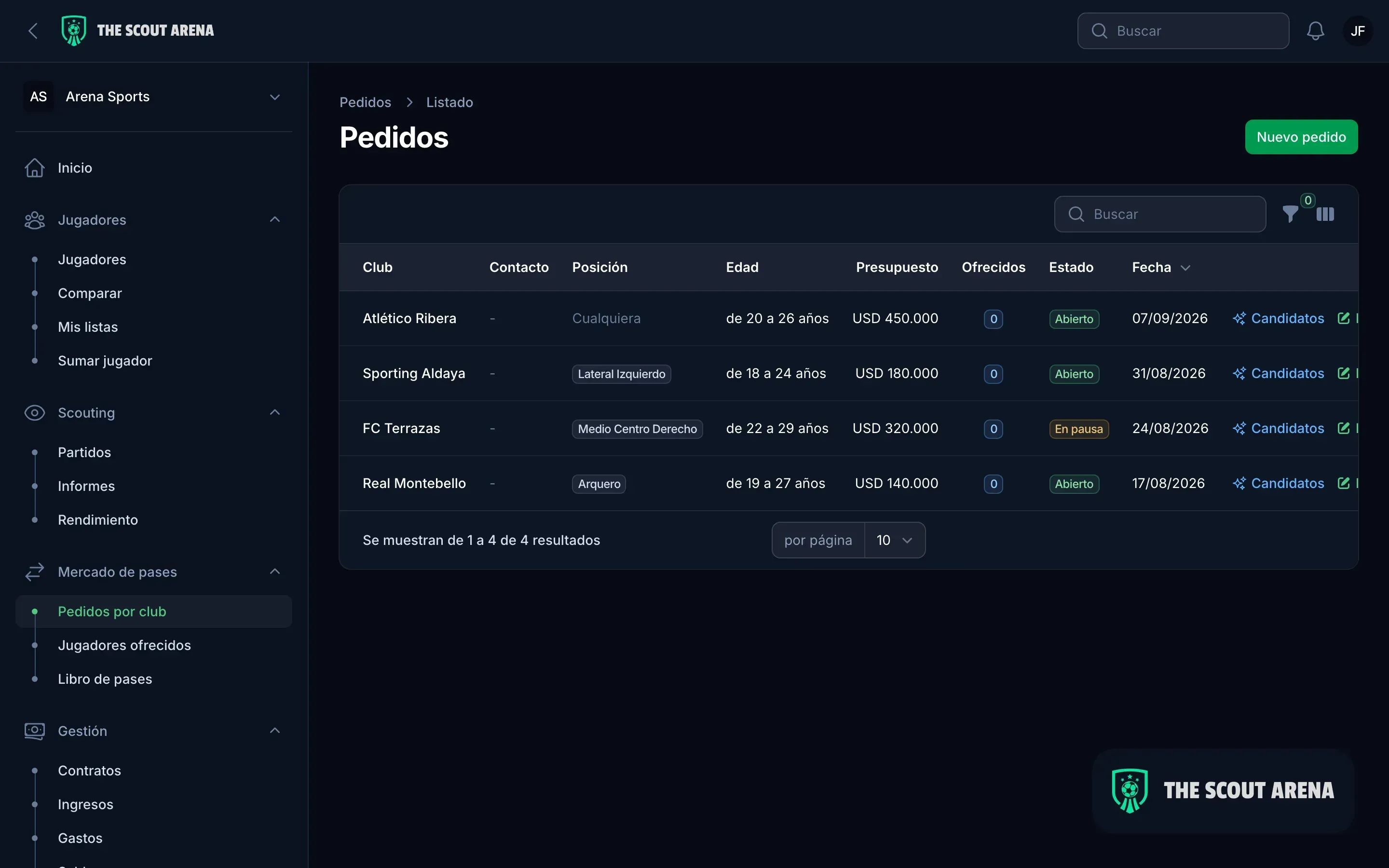
All of this sits in transfer market tracking, and through the WhatsApp assistant you can ask for a player’s profile or note an update without opening the panel. Everything else the product does for an agency is on the page for football agents.
Organising your club relationships is one piece of how to organise a football agency.
In short
Club contacts for football agents come down to three records: the person with their role and who at the agency owns the relationship; the request with position, age, budget and status; and every offer sent or received. WhatsApp stays the channel, but not the memory. And an offer that arrives on WhatsApp is a written offer: FIFA’s rules require you to pass it on to the player immediately.
This article is for information only and is not legal advice. The regulatory points were checked against the editions cited at the top, as of October 2026.
Sources
- FIFA Football Agent Regulations, in force since 1 January 2025 (PDF) — Articles 12(1), 12(5) and 12(8)(a), and 16(3)(c)(ii), 16(4)(a) and 16(4)(b)
- Regulation (EU) 2016/679, General Data Protection Regulation (EUR-Lex) — Articles 5(1)(e), 6(1)(f) and 14