
Football agent daily tasks: the working week, day by day
By Mariano David Pérez Co-founder

Football agent daily tasks fall into six areas that come round every week: talking to clients, watching matches, dealing with clubs, checking contracts and expiry dates, keeping the books and meeting what FIFA requires to keep the licence. Negotiation — the part people see from outside — takes up a few weeks a year; the rest is follow-up, and it stays under control when each area has a fixed day.
Updated on 7 October 2026. The regulatory points come from the FIFA Football Agent Regulations (edition in force since 1 January 2025) and the Regulations on the Status and Transfer of Players (RSTP, January 2025 edition). The sample week below is not regulation: it is one way of organising the work, and every agency adjusts it to its league and its size.
What does a football agent do day to day?
The FIFA regulations split the job in two. Football Agent Services are football-related services performed for or on behalf of a client “with the purpose, objective and/or intention of concluding a Transaction”, including negotiation and any preparatory communication. Other Services are everything else: the regulations themselves list legal advice, financial planning, scouting, consultancy, management of image rights and negotiating commercial contracts.
In practice those two definitions become six areas of work:
| Area | What it covers | How often |
|---|---|---|
| Clients | Speaking to the player and the family; knowing how they are, what they need, what happened at the club | Every week |
| Matches and scouting | Watching your own players, tracking the ones you want to sign, writing the report | Every week |
| Clubs | Knowing what each one is looking for, proposing players, replying, keeping the relationship alive outside the window | Every week, daily during a window |
| Contracts and expiries | Dates of employment contracts and representation agreements, renewals | Weekly review |
| Administration | Fees invoiced and collected, expenses per player, documents | Small items weekly, the close monthly |
| Licence and compliance | Continuing education, annual fee, what you must be able to produce | Dated, once a year |
None is optional, and the usual mistake is letting the first three — the enjoyable ones — crowd out the last three. The five records behind these areas are covered in how to organise a football agency; this article is the next step: which day each task lands on.
What does a football agent’s week look like?
Football is mostly played at the weekend, and that shapes everything else: what you saw gets written up at the start of the week, and what you are going to see gets decided before Thursday. Outside a transfer window, a sample week might look like this:
| Day | Main task | What must be done by the end of it |
|---|---|---|
| Monday | Close the weekend | Reports for the matches watched, filed; minutes, injuries and suspensions for each client, noted |
| Tuesday | Clients | A call or a message to every player who played, did not play or got injured; what was said, logged on the profile |
| Wednesday | Clubs | Open requests reviewed, who was offered what, replies outstanding |
| Thursday | Fixed review | The half hour with the six lists: expiries, documents, requests, players with no owner |
| Friday | Prepare the weekend | Which matches to watch and who goes to each; the week’s expenses entered |
| Saturday and Sunday | At the ground | Watching matches, with a note taken on the spot rather than from memory on Monday |
Three rules that make the table work:
- Monday is not negotiable. A report not written within 48 hours gets written badly or not at all. What it should contain is in how to write a football scouting report.
- The call to the player who did not play matters more than the call to the one who scored. The player having a bad time is the one who listens to another agent.
- One person does Thursday’s review, not a meeting. It is reading lists, not debating.
What changes when the transfer window opens?
The proportions change, not the list. Article 6 of the RSTP provides that players may only be registered during one of the two annual registration periods fixed by each association, so there are two stretches of the year in which club work goes from one day a week to every day. Each country’s dates are in the transfer window dates guide.
What decides a window, though, is done beforehand. Two deadlines in the regulations mark when that work starts:
- Six months before the employment contract ends. Article 18, paragraph 3, of the RSTP says a professional is only free to conclude a contract with another club if the current one has expired or is due to expire within six months, and that the interested club must inform the current club in writing before entering into negotiations. That is the day the renewal conversation changes tone; we cover it in how not to lose a renewal.
- Two months before the representation agreement ends. Article 16, paragraph 1, of the Football Agent Regulations bars an agent from approaching a client bound by an exclusive representation agreement with another agent, except in the final two months of that agreement. Seen from the other side: in those two months, your client can take calls from anyone.
Which is why the most important transfer-window task falls in an ordinary week, far from the window: knowing which contracts enter those two periods next half-year.
During the window some tasks do become daily: going through club requests every morning, logging every proposal the same day — which player, to which club, to whom — and checking that the file of any player who may move is complete, as set out in the guide to football player documents. And one duty allows no delay: among the conduct that article 16, paragraph 3, prohibits is failing to report a written offer to a client. The offer is always passed on, welcome or not.
What does FIFA require a licensed agent to keep doing?
Not much, all of it dated, and none of it solvable in the final week.
Continuing professional development. Article 9 requires an agent to comply with CPD requirements every year in order to keep the licence. According to FIFA’s CPD page, that means a minimum of 20 credits per year, earned through courses on the agent platform, and the CPD year runs from 1 October to 30 September. Legacy agents follow a different regime of 40 credits a year for five years. The weekly task that follows is modest: one fixed hour, so September does not arrive with everything still to do.
The annual fee. Article 16, paragraph 2, requires payment of the annual licence fee within the deadline shown on the platform.
What happens if the date is missed. Article 17 is blunt: an agent who fails to pay the fee on time or to meet the year’s CPD requirements has the licence automatically provisionally suspended, and if the failure is not put right within 60 days, the licence is withdrawn.
Uploads to the platform. The same article 16 asks the agent to upload the representation agreement to the FIFA agent platform within fourteen days of signing, amending or terminating it, and the details of each fee payment within the same period. Those reporting duties — article 16, paragraphs 2 h), j), k) and 4 — are among the rules FIFA suspended worldwide by circular 1873 of 30 December 2023. CPD and the annual fee are not on that list. Before treating anything as in force or suspended, check the current circulars from FIFA and from your association; the full picture is in the guide to the FIFA Football Agent Regulations.
Suspended or not, the underlying task is the same: the signed agreement, its dates and every payment, recorded the day they happen.
Which tasks can the team do, and which only a licensed agent?
Here the regulations draw a line worth keeping in mind when sharing out the week. Article 11, paragraph 3, allows an agent to work through an agency, but states that employees or contractors who are not football agents may not perform Football Agent Services or approach a potential client to enter into a representation agreement. It adds that the agent remains fully responsible for the conduct of the agency and its staff should they breach the regulations.
| Anyone on the team can | Only a licensed agent can |
|---|---|
| Watch matches and file reports | Approach a player with a view to representing them |
| Enter expenses, invoices and documents | Sign the representation agreement |
| Keep profiles, lists and expiry dates current | Negotiate with the club on the player’s behalf |
| Prepare the month-end reports | Put their name, signature and licence number on the contract |
The rest of the week — Monday, Thursday and Friday in the table above, almost entirely — can be shared out. Responsibility cannot.
How the routine survives a difficult week
A sample week breaks the first time there is a trip, a serious injury or a club that calls on a Thursday night. What holds it together is not discipline but every task having a place to be recorded and someone who gets the reminder.
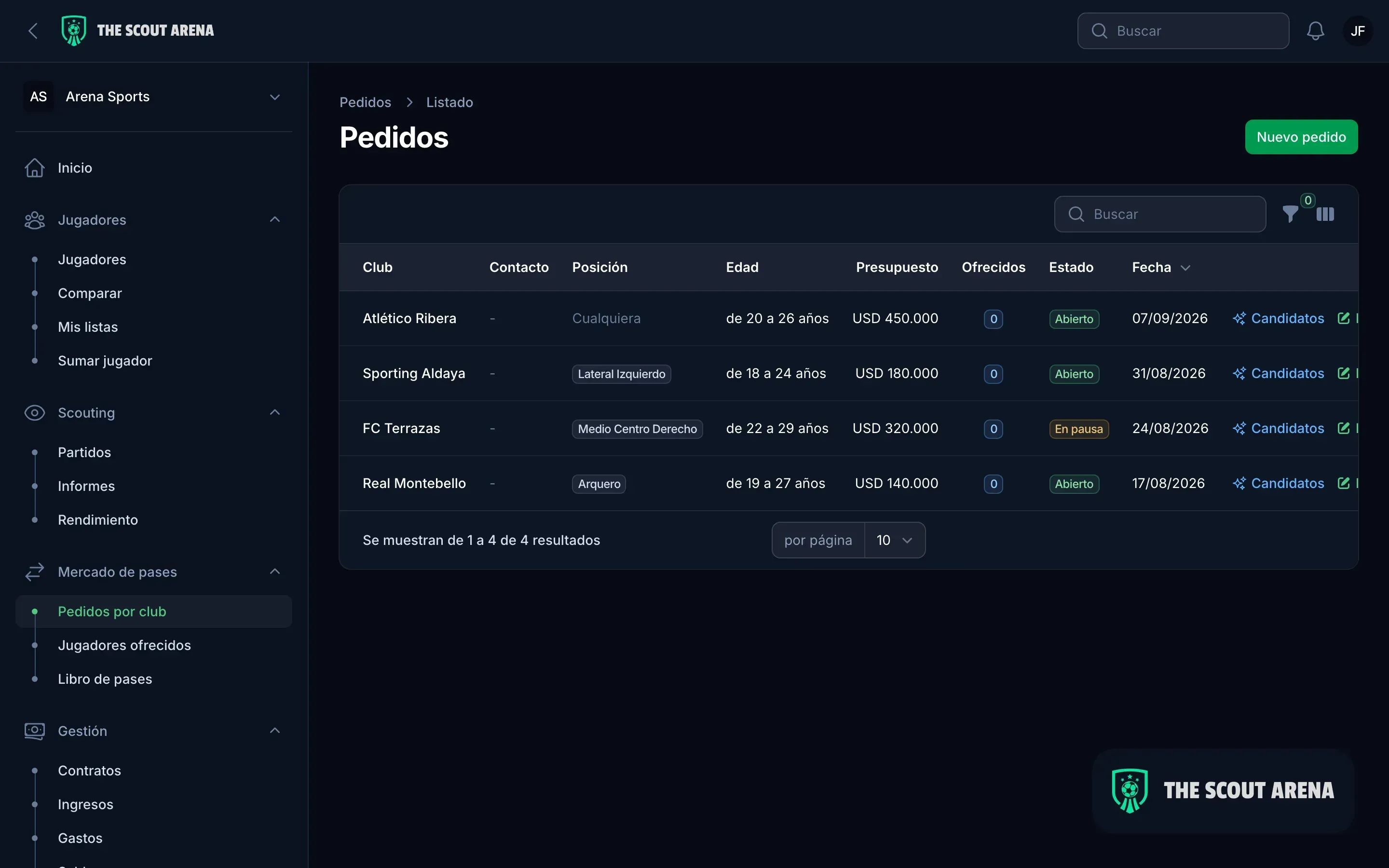
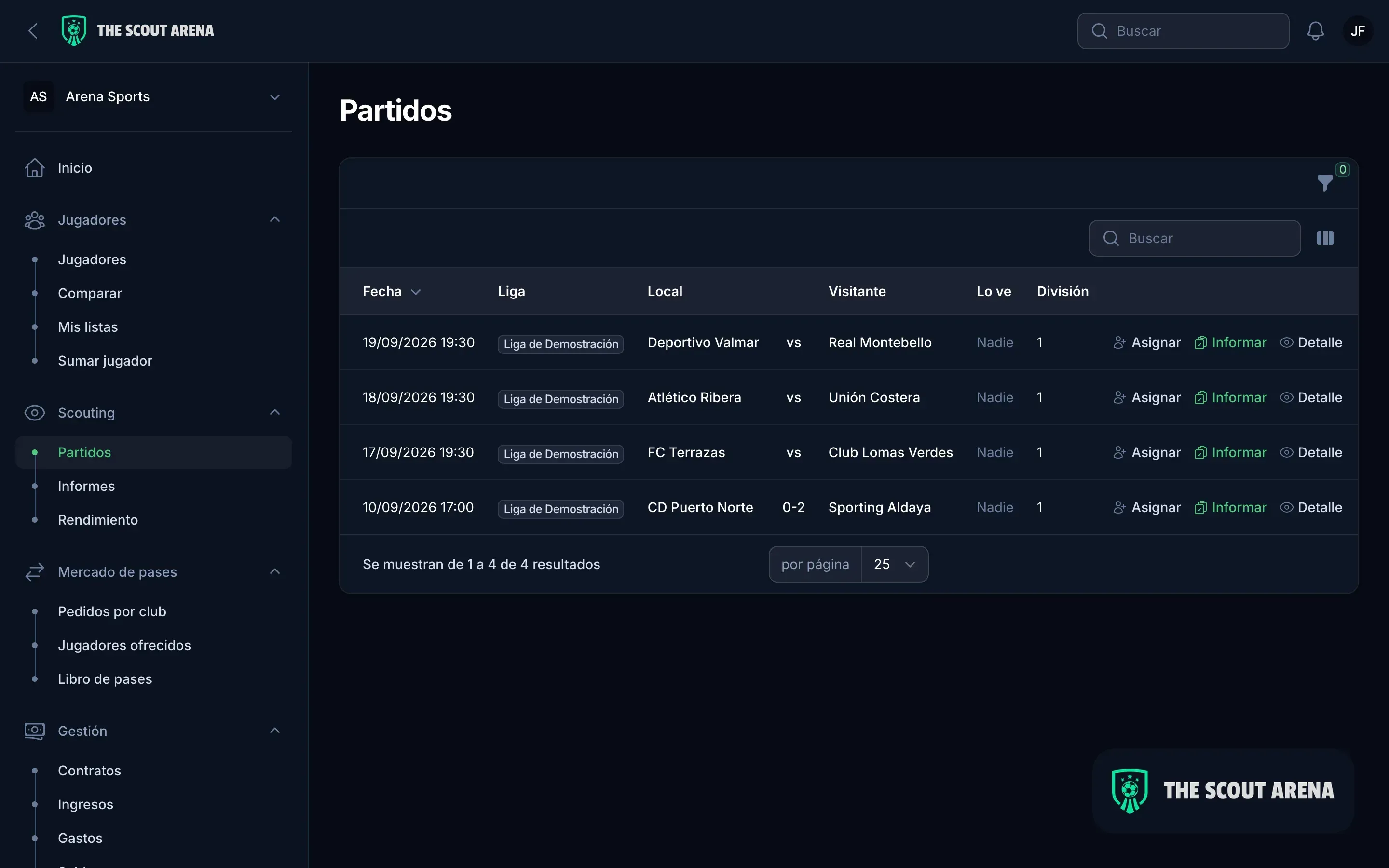
In The Scout Arena, the week above rests on four screens (shown with a demonstration agency’s data):
- Matches, with the fixture list and the option to assign each one to someone on the team, and the match report filed from the same place.
- Contract expiry alerts, with an email every morning and a traffic light at 30, 90 and 180 days: Thursday’s review without having to remember Thursday.
- The transfer market, with each club’s requests and the players proposed, so two people do not offer the same thing to the same club.
- The player profile, which holds what was said on Tuesday, Friday’s expenses and the documents.
What no system does is call the player who did not play. How roles are split and what each person sees is on the page for football agents.
In short
A football agent’s tasks are six areas — clients, matches, clubs, contracts, administration and licence — and the way to keep any of them from slipping is to give each a day: Monday to close the weekend, Tuesday for the players, Wednesday for the clubs, Thursday for the review, Friday to prepare what comes next. The window changes the intensity, but what decides it is done months earlier, by watching which contracts enter their final six months and which representation agreements enter their final two. And the licence work — 20 credits and one fee a year — goes in the diary in October, not September.
This article is for information and is not legal advice. The regulatory points were checked against the FIFA editions cited at the top, as of October 2026; CPD requirements are published every year and may change.
Sources
- FIFA Football Agent Regulations, in force since 1 January 2025 (PDF) — definitions and articles 9, 11, 16 and 17
- FIFA Regulations on the Status and Transfer of Players, January 2025 edition (PDF) — articles 6 and 18
- FIFA: continuing professional development for football agents
- FIFA circular 1873: Football Agent Regulations, update on implementation (PDF, 30 December 2023)
- FIFA agent platform