
Player follow-up for agents: how not to lose a player
By Mariano David Pérez Co-founder
Player follow-up for agents comes down to recording three things about every footballer: who in the agency is responsible for them, when the last contact took place and what was left pending. An agency rarely loses a player over a bad negotiation; it loses them because two months went by without a call, or because two people were watching the same player and each assumed the other had it covered. The fix is one named owner per player, a dated note after every contact and a next step with a day attached.
Updated on 13 October 2026. The regulatory points come from the FIFA Football Agent Regulations (edition in force since 1 January 2025) and the Regulations on the Status and Transfer of Players (RSTP, January 2025 edition). The contact frequencies suggested below are not regulation: they are a working rule of thumb, and every agency adjusts them to its size.
What does player follow-up mean in an agency?
It is everything the agency knows about a player that is not in a contract or a stat line: what they said on the last call, how things are at the club, what the family asked for, what was promised and who said they would do it. An agency follows two groups, and it loses them in different ways.
| Clients | Players being watched | |
|---|---|---|
| Who they are | Players with a signed representation agreement | Players the agency is considering signing |
| What is followed | The relationship: how they are, what they need, what they are owed | Their progress: how they play, who has seen them, whether to approach |
| How they are lost | They leave for another agent when the agreement ends | Someone else signs them, or they quietly drop off the radar |
| Warning sign | Weeks without contact | Nobody is listed as responsible |
Clients tend to be clear: there are few of them and their names are on a contract. The players being watched are the silent problem, because there are more of them, the list changes constantly and no document forces anyone to look after them. Follow-up is one of the five records described in how to organise a football agency; this article opens it up.
Why does an agency lose a player?
Almost always for one of these five reasons, none of which has to do with negotiating skill:
- Nobody owns the player. The player “belongs to the agency”, which in practice means to no one. When the owner travels or the scout who brought them in leaves, the player has no one to talk to.
- The memory lives in one phone. What was discussed sits in one person’s chat. If that person is away, the rest of the team calls the player without knowing what they were told last week.
- The calls go to whoever is doing well. The player who scored gets three messages; the one who has spent a month on the bench gets none. And the one having a hard time is the one who listens to another agent.
- Promises carry no date. “I’ll sort the boots”, “I’ll speak to the club about the flat”: without a day and a name beside it, it gets forgotten. Not by the player.
- Dates are checked late. The representation agreement runs out and nobody opened the conversation in time.
Which FIFA deadlines matter when following a player?
Follow-up is more than a good habit: the regulations set when another agent may approach your client and when you may approach someone else’s client or a minor. The Football Agent Regulations define an “Approach” broadly: any in-person or electronic contact with a client, any direct or indirect contact with someone linked to them — a family member, a friend — and any contact made through a third party on the agent’s behalf.
| Deadline | What it says | Article |
|---|---|---|
| Two years | The maximum term of a representation agreement between an agent and a player or coach. It can only be extended by a new agreement; any automatic renewal clause is null and void | Art. 12, para. 3 |
| Two months | An agent may not approach a client bound by an exclusive representation agreement with another agent, except in the final two months of that agreement | Art. 16, para. 1 b) |
| Six months (minors) | An approach to a minor or their legal guardian may be made no more than six months before the minor reaches the age at which they may sign their first professional contract under the law of the country where they will be employed, and only with the guardian’s prior written consent | Art. 13, para. 1 |
| Six months (employment contract) | A professional is only free to sign with another club if their contract has expired or is due to expire within six months | RSTP, art. 18, para. 3 |
Three practical consequences follow:
- Every representation agreement has an end date, always. With no automatic renewal, at least once every two years you have to sit down with the player and sign again. What that agreement must contain is covered in the football representation agreement.
- The final two months are the window in which anyone may call your player. The follow-up that counts is what happened in the months before: the agent who reaches that window with a satisfied player renews; the one who has not called has to compete.
- With the youth players you watch, watching is not approaching. Seeing matches and filing reports is unrestricted; approaching the player or the family has a date and conditions. See acting as a football agent for minors.
There is also a limit on who makes the approach. Article 11, paragraph 3, states that employees or contractors of an agency who are not football agents may not approach a potential client to enter into a representation agreement, and article 12, paragraph 2, reserves that to football agents. An agency scout can follow a player for a year; the approach to represent them is made by the licensed agent. None of these articles is among the provisions FIFA suspended by circular 1873 of 30 December 2023, but before treating anything as in force, check FIFA’s current circulars and your own association’s regulations, which may add requirements.
What should you write down after every contact with a player?
Five things, which fit in two lines and are written the same day:
| Item | Why it matters |
|---|---|
| Date | So you know how long it has been without relying on memory |
| Who spoke to whom | The player, a parent, the club: they are not the same, and the next caller needs to know |
| What was discussed | In one sentence that someone who was not there can understand |
| What was promised | By the agency and by the player |
| Next step, with a day and an owner | Without it the note is an archive; with it, it is a task |
An example with invented details: “14/10 · Julia spoke to Arrieta’s father. Worried that he was left out of the squad two weeks running. Agreed that Pablo will speak to the academy coordinator. Next step: call the father on 21/10 with the answer (Julia).”
What to leave out: opinions you would not want the player to read, and health or family details that are not needed to do the job. The rest of the team will read the note, and in many countries that personal data is protected by law.
How often should an agent speak to each player?
There is no rule, and the honest answer is that it depends on what the player is going through. One approach that works is to set a maximum number of days without contact for each situation, and check once a week who has gone past it:
| Player’s situation | Maximum without contact (indicative) |
|---|---|
| Injured, not playing or in dispute with the club | One week |
| Client in a normal season | Two weeks |
| Representation agreement ending within six months | One week, with renewal on the agenda |
| Priority player being watched | One report or note a month |
| Background player being watched | One review a quarter: keep or drop |
The figures are indicative; what is not optional is that a maximum exists and that someone checks it. The check belongs in the weekly half-hour described in football agent daily tasks: a list sorted by last contact, oldest first, with the players you are losing at the top.
Two decisions that are also follow-up: dropping a player you were watching — with the reason noted, so nobody starts from zero a year later — and reassigning the owner when someone leaves the agency, on the same day and not when the player rings to ask who they deal with now.
How follow-up works in The Scout Arena
A spreadsheet is enough to start with, provided it has one row per contact and a next-step column. What it does not solve is several people writing at once, reminders that arrive on their own and the note sitting next to the same player’s contract and reports. This is how The Scout Arena handles it (the screens are from a demonstration agency, with invented data):
- One owner per player, in plain sight. The player list shows each player’s relationship with the agency — client, being watched — and who follows them. A “Nobody” in that column is exactly the player you are about to lose.
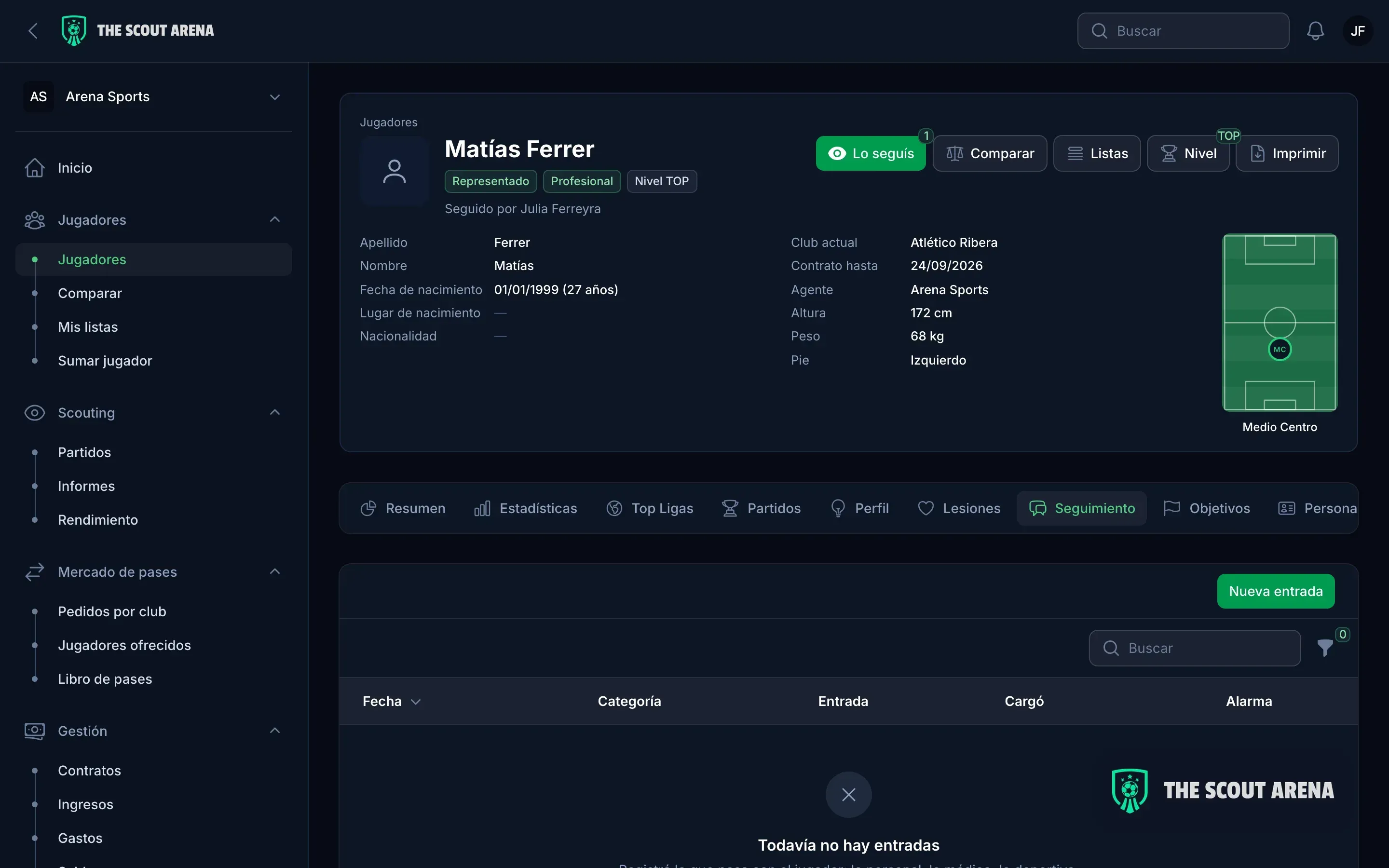
- Follow-up inside the profile. Each entry carries a date, a category, who logged it and, where needed, a reminder. It is one of the tabs of the player profile, alongside objectives, match reports and documents.
- Lists by criterion, to separate priority players from background ones, and a level for each player.
- Contract expiry alerts by email, which include representation agreements: the two years and the two months in the table above stop depending on memory.
- Notes from your phone. The WhatsApp assistant saves a follow-up note or creates a dated task from a message, and asks for confirmation before saving. It lets you write the note as you leave the meeting, not on Monday.
- A follow-up report by period, exportable to Excel and PDF, for the weekly check.
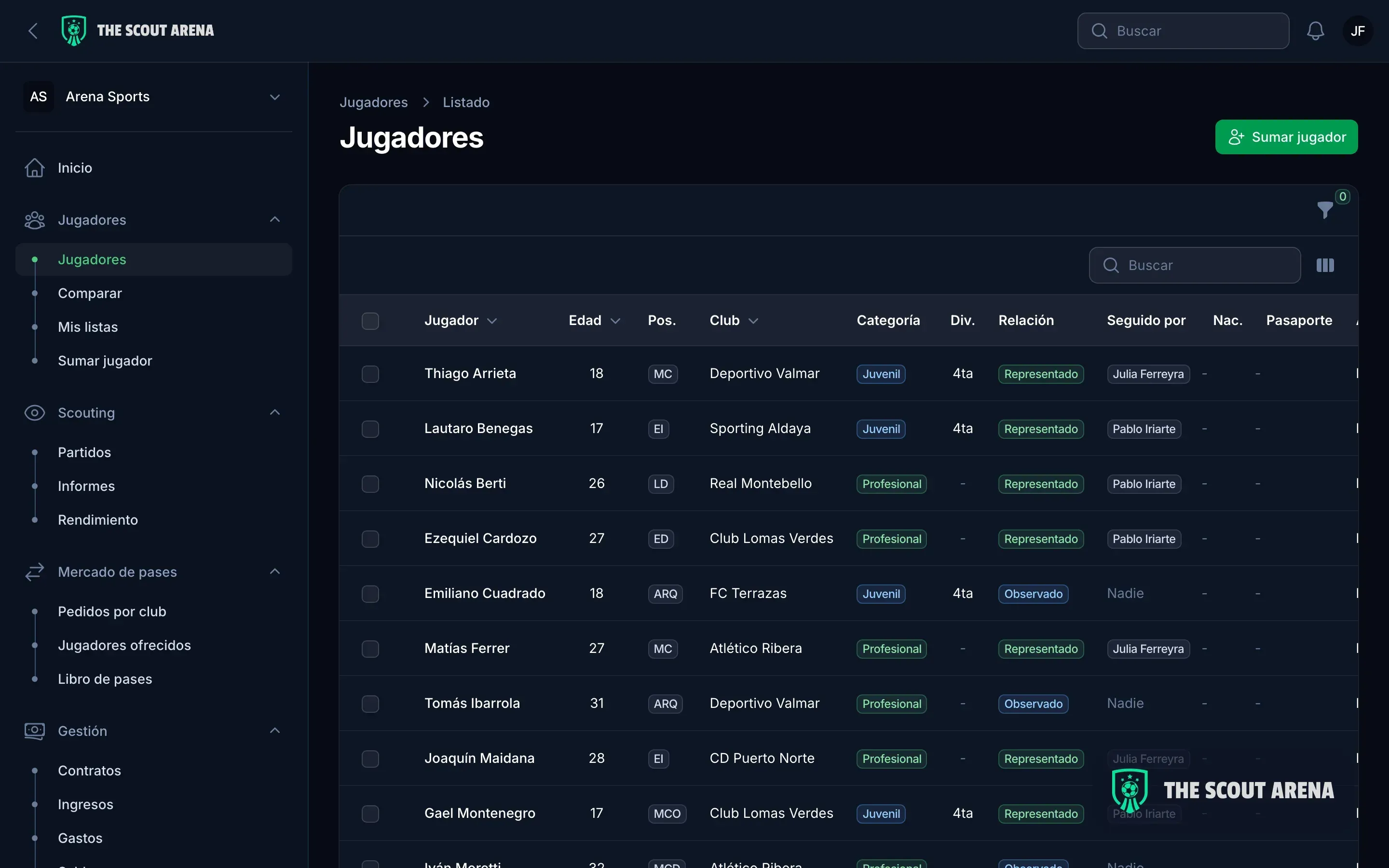
What no system does is make the call. How roles are shared out and what each team member can see is on the page for football agents.
In short
Player follow-up rests on three rules: every player has a named owner, every contact leaves a dated note with a next step, and once a week someone checks who has gone too long without contact. FIFA’s regulations put dates on what is at stake: a representation agreement lasts two years at most and does not renew itself, in its final two months any agent may approach your player, and a minor may only be approached within the six months before the age of their first professional contract and with the guardian’s written consent.
This article is for information only and is not legal advice. The regulatory points were checked against the FIFA editions cited at the top, as of October 2026; each association may have its own rules on agents and on minors.
Sources
- FIFA Football Agent Regulations, in force since 1 January 2025 (PDF) — definition of “Approach” and articles 11, 12, 13 and 16
- FIFA Regulations on the Status and Transfer of Players, January 2025 edition (PDF) — article 18, paragraph 3
- FIFA circular 1873: Football Agent Regulations, update on implementation (PDF, 30 December 2023)