

Football player documents: what to keep up to date
By Mariano David Pérez Co-founder

The football player documents an agency or a club has to keep up to date come down to eight things: the identity document, the passport, the visa or work permit, the employment contract with the club, the representation agreement, the medical file and insurance, the International Transfer Certificate when the player changes association and, for a minor, the guardian’s consent and the article 19 application. Four of those eight carry a date and expire on their own — passport, visa, employment contract and representation agreement — and those are the ones to check before every window.
Updated on 2 October 2026. The regulatory points come from FIFA’s Regulations on the Status and Transfer of Players (RSTP, January 2025 edition) and the Football Agent Regulations, in force since 1 January 2025. FIFA has already published an amended RSTP that enters into force in January 2027: this article will be revised then. What each country asks for — which visa, which permit, which identity document — is set by that country, not by FIFA.
The full list, document by document
| Document | What it is for | Does it expire? |
|---|---|---|
| Identity document | Identifying the player in any association paperwork | Depends on the issuing country |
| Passport | Travelling, trialling abroad, signing in another association | Yes, with a date |
| Visa and work permit | Letting the player live and work where they play | Yes, and usually before the contract does |
| Employment contract with the club | Pay, term, clauses, bonuses | Yes: from end of season up to five years |
| Representation agreement | Entitles the agent to act for the player | Yes: two years maximum with an individual |
| Medical file and insurance | Screening, history, injuries, cover | Cover does; the history accumulates |
| International Transfer Certificate (ITC) | Allows registration at the new association | Not a file you hold: it is a step |
| Article 19 consents and application | Authorises the registration of a minor | Per transaction |
Two rows in that table are misread constantly, so it is worth clearing them up first.
FIFA’s “player passport” is not the travel passport. Under article 7 of the RSTP, the player passport is the registration history: the clubs the player has been registered with since the calendar year of their 12th birthday. Where the case runs through the Clearing House, it is generated as an Electronic Player Passport. It exists to allocate training rewards, not to board a plane. Two different documents share a name, and confusing them costs phone calls.
The ITC is not a piece of paper you keep. Article 9 of the RSTP says a player registered at one association may only be registered at a new one once the latter has received the International Transfer Certificate from the former, issued free of charge and without conditions or time limits. Associations request and deliver it through FIFA’s transfer system. For players under the age of ten it is not required at all. Nothing called an ITC goes into your folder: what goes in is the date it was requested and the status it ended up in.
What documents does FIFA require in an international transfer?
This is the part that is actually written down, and worth knowing by heart, because it is the part that stops a deal. In an international transfer, Annexe 3 of the RSTP obliges the engaging club to upload the following mandatory supporting documents to the transfer system:
- Proof of the player’s identity: passport or national identity card.
- Proof of the end date of their last employment contract and the reason for its termination.
- The player’s employment contract with the new club.
- The transfer agreement between the two clubs, permanent or loan, with any amendments.
- A copy of the representation agreement signed with a football agent, within 14 days.
- A copy of any other agreement signed with a football agent that is not a representation agreement, also within 14 days.
On the agent’s side two obligations run in parallel, and nobody chases them until one fails. Article 18 of the RSTP requires any employment contract concluded following agent services to state the agent’s name, their client, their FIFA licence number and their signature. And article 16 of the Football Agent Regulations requires the representation agreement to be uploaded to FIFA’s platform within 14 days of execution, of each amendment and of termination too. That is three moments, not one.
The representation agreement also has content requirements: article 12 treats it as valid only if it contains the names of the parties, the duration, the service fee, the nature of the services and the parties’ signatures. With an individual it may not exceed two years, and no automatic renewal clause can stretch that. We go through it in the article on the representation agreement.
What happens if a document is missing during a transfer window?
The deal goes into a “validation exception” and stops moving on its own. Annexe 3 of the RSTP lists when that happens: when the player is under 18 and the minor application has not yet been accepted, when the engaging club is serving a registration ban, when the loan limits have been exceeded, when the former association has rejected the ITC request and the new one has disputed it, and when the ITC was requested outside the registration period.
That last one hurts most, because it is the only one entirely within your control. The same annexe sets out that, for the transfer to happen inside a window, the ITC must be requested at the very latest on the last day of that registration period of the association doing the registering. There is no extension for an incomplete folder: if the missing document is the one that unlocks the request, the window shuts with the player on the other side of it. Country-by-country dates are in the article on transfer window dates.
And there is a classic escape hatch the regulations close in advance: article 18 of the RSTP says the validity of a contract may not be made subject to a successful medical examination or to the grant of a work permit. So you cannot sign first and write in “if the permit does not come through, the contract is void”. The contract stands, and the player still cannot play. The permit gets solved before, not after.
A case we saw up close. A player was in Greece waiting to sign with the club, and neither his birth certificate nor the rest of his paperwork could be found. It was unblocked when we tracked down the person who had everything saved. That search is exactly what disappears when the documents sit in one place and anyone on the team knows where to look.
Documents for a player who is a minor
This is where the folder weighs most. Article 19 of the RSTP starts from a prohibition: international transfers are only permitted if the player is over the age of 18, with five exceptions — among them the player’s parents moving to the country of the new club for reasons unrelated to football, or the player being aged between 16 and 18 with the transfer taking place inside the European Union or the European Economic Area.
What matters for the folder are the two paragraphs that follow:
- From the age of ten, the Players’ Status Chamber of the Football Tribunal must approve the minor’s international transfer or first registration.
- That approval is required before the association requests the ITC or the first registration. It is not something to run in parallel.
Exactly which documents go into that application depends on the exception being claimed, and FIFA asks for them through the transfer system: this is not the place to improvise your own list or to reuse last year’s. What can be prepared in advance is what always comes up — the player’s identity, the parents’ situation, and where the player will live and study.
On the agent’s side, the Football Agent Regulations add three more pieces of paper: the guardian’s prior written consent before any approach, the certificate for FIFA’s designated course on minors, which the agent must have passed, and a representation agreement signed by the minor and by their legal guardian. The approach itself may only be made within the six months before the age at which that player may sign a first professional contract in the country where they will be employed. It is all in the article on being a football agent for minors.
One last figure that changes a player’s file: a player under 18 may not sign a professional contract for a term longer than three years, under article 18 of the RSTP. Any clause referring to a longer period is not recognised.
How often should the documents be reviewed?
Three rhythms, and all three are needed because each one catches a different problem.
A monthly pass over the dates. Half an hour, list in hand, looking only at what expires in the next six months. This is the one that finds the passport lapsing in March and the work permit lapsing before the contract does.
A full review before every window. FIFA requires two registration periods per season and each association picks its own dates, so twice a year the folder of any player who might move has to be complete. Not everyone’s: the ones who might move.
A review triggered by events. New contract, renewal, loan, change of club, international call-up, long injury. Each of those changes at least one document, and the moment to update it is then, not six months later.
Two practical rules that are not regulation and are worth adopting anyway: treat a passport with less than six months left as already expired — plenty of countries ask for validity beyond the trip — and record the work permit expiry separately from the contract’s, because they almost never match and the permit is the one that decides whether the player can play.
Who can see what, and where are they kept?
Four rules are enough to keep the folder from becoming the problem itself.
- One place per player, not an email thread. If the contract lives in one person’s inbox, the agency does not have it — that person does.
- Every expiry as a date, not as a memory. A document stored without its expiry date is a document that will expire without warning.
- Different permissions for different people. The scout filing a match report does not need the medical file or the contract. Being able to see them is not generosity, it is exposure.
- Copies you can account for. A copy of a passport sent over WhatsApp stopped being your copy. If it has to go out, it goes to whoever asked, and the fact that it went out is recorded.
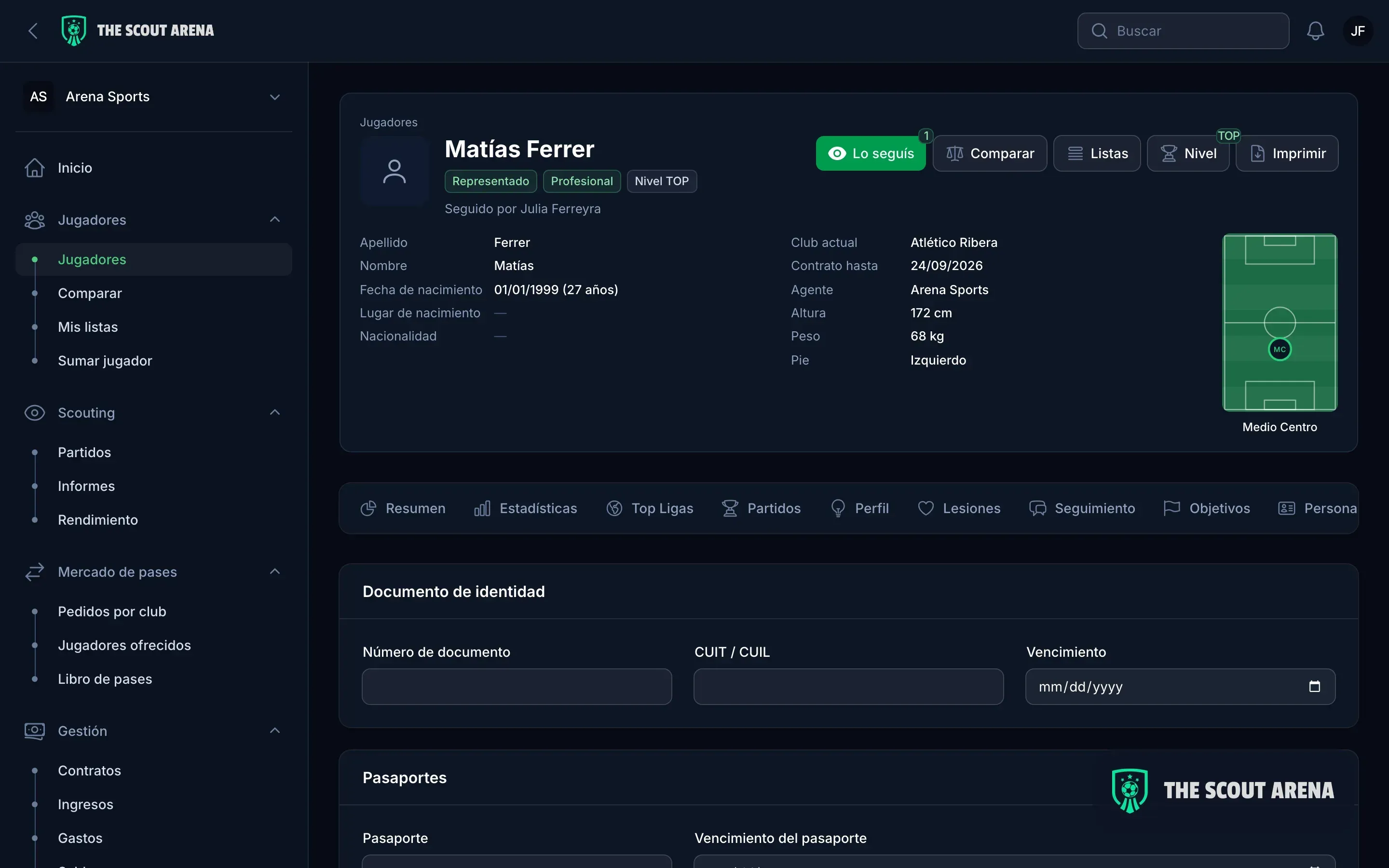
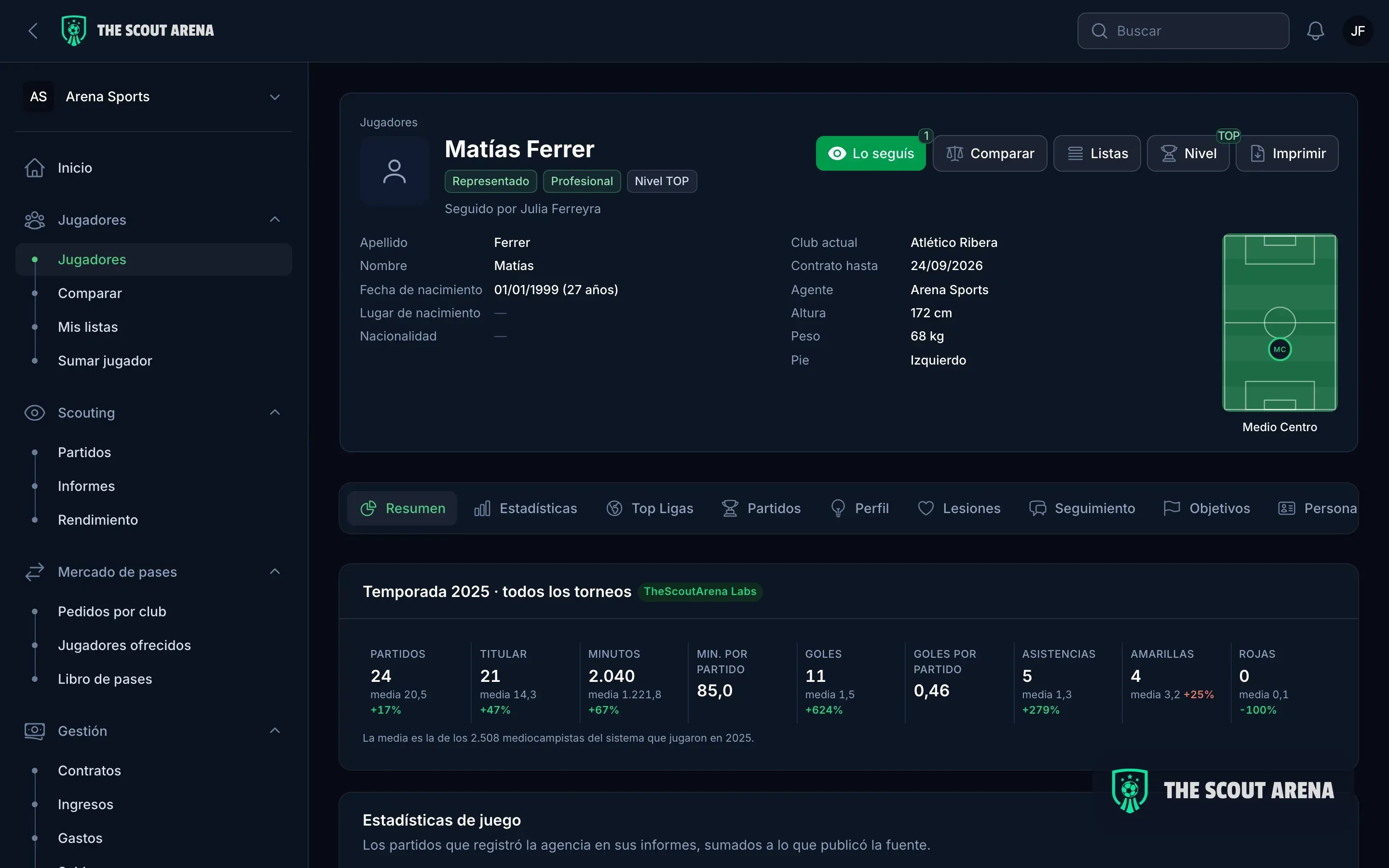
In The Scout Arena that lives in the player profile: one of its tabs holds the player’s documents and files, and roles decide who gets into what, with a permissions matrix that is tested rather than promised. Contract dates — employment and representation — feed the daily expiry alert, with its 30, 90 and 180-day traffic light. To be precise: that alert covers contracts and commissions, not passports or visas; those sit in the profile and get picked up in the monthly pass. It is part of organising a football agency, and part of what a club recruitment department needs within reach when an agent calls.
How it actually gets stored today: private clouds, Drive, Dropbox, iCloud, folders on somebody’s laptop and a lot of WhatsApp messages. Everything somewhere, nothing in one place. The problem is not the tool — Drive works fine — but that nobody knows which version is the good one, what is missing and what has expired.
These are a person’s data, not loose files
Worth saying plainly, because it gets treated as an administrative detail and it is not one. A passport, a medical file, the file of a fifteen-year-old with their parents’ employment and home address: that is not paperwork, it is somebody’s personal data, and some of the most sensitive kinds there are. Health data in particular is specially protected under almost every data protection law, starting with Europe’s General Data Protection Regulation. Which law applies to you depends on where your agency sits and where the player plays, and that is a question for a lawyer, not a blog post.
What you can do without legal advice is the reasonable part: ask only for what the transaction needs, be able to explain why you hold it, limit who sees it, leave no copies lying around, and delete what no longer has a reason to exist. A player who leaves the agency is entitled to ask what you still hold in their name, and “I don’t know” is the worst possible answer. For a football agency, having the folder in order and knowing who looks at it is the same thing as having it secure.
In short
Football player documents fall into two groups: the ones that identify the player and entitle them to work where they play — identity, passport, visa or permit — and the ones that define their relationship with the club and the agent — employment contract, representation agreement, medical file and insurance. On top of those sit the steps that are not files at all: the ITC the associations request, and for minors the Football Tribunal’s prior approval. Half the list expires on a date, so the review is monthly, complete before every window, and immediate whenever something changes. And because these are a person’s data, what matters is not only holding them: it is knowing who looks at them.
This article is informative and does not replace legal advice. The regulatory points were checked against the FIFA editions cited at the top; visa, work permit and identity document requirements are set by each country and change often.
Sources
- FIFA Regulations on the Status and Transfer of Players, January 2025 edition (PDF) — articles 7, 9, 18 and 19, and Annexe 3
- FIFA Football Agent Regulations, in force since 1 January 2025 (PDF) — articles 12, 13 and 16
- FIFA publishes the 2026 edition of the Legal Handbook, with the amended RSTP entering into force in January 2027
- General Data Protection Regulation (EU) 2016/679, official text on EUR-Lex