

Football agency expenses: how to track them per player
By Mariano David Pérez Co-founder

Football agency expenses are kept in order with one rule: every expense is recorded on the day it is incurred, with its date, category, currency and the player it belongs to, or as an overhead if it belongs to nobody in particular. That way you know how much the agency has invested in each footballer, you can set it against what that player brings in through commission, and you can show the player the breakdown if they ask for it, which FIFA’s rules entitle them to do.
Updated on 19 October 2026. The regulatory points come from the FIFA Football Agent Regulations, edition in force since 1 January 2025, and Circular 1873. How expenses are treated for tax depends on your country and on how the agency is set up: that is for your accountant, not this article.
What expenses does a football agency have?
They fall into two groups, and the first step is not to mix them: the money spent on a player and the money that keeps the agency running, players or not.
| Player expenses | Overheads |
|---|---|
| Flights and travel to trials, signings or matches | The annual FIFA agent licence fee |
| The scout’s travel allowance for following them | Office, phones and connectivity |
| Accommodation or rent while they settle at a new club | The agency’s accountant and lawyer |
| Medical tests before a trial or a transfer | Software, data and video subscriptions |
| Boots, kit and training gear | Prospecting trips with no specific player in mind |
| Translations, legalisations and document paperwork | Insurance and bank charges |
| Meals and meetings during a negotiation | Staff salaries |
The line is not always sharp. A trip to a tournament where the scout watches three of the agency’s players and ten who belong to nobody can be split across the three or kept as an overhead; what matters is choosing a rule and sticking to it. This record is one of the five described in how to organise a football agency, and it is usually the last one an agency gets round to.
Why should every expense be assigned to a player?
Because the question that matters is not how much the agency spent this year, but how much it has invested in each player and how much that player has returned. Without expenses assigned to players, that sum cannot be done, and three problems follow:
- Decisions are made blind. An agency can spend two years paying for a youth player’s travel and medicals without noticing it has already put in more than his first contract will pay back. When the representation agreement comes up for renewal, that figure needs to be on the table.
- You cannot account for the money. If the player or the family ask what was paid on their behalf, “roughly this much” is not an answer.
- Partners argue over impressions. Who brings in players who pay off and who brings in players who cost money is a question for numbers, not for memory.
Commission is the other half of the sum. How much an agent can earn, and from whom, is covered in how much football agents earn.

What do FIFA’s rules say about an agent’s expenses?
The regulations do not tell you how to keep your books, but three rules bear directly on player expenses:
| Rule | What it says | Article |
|---|---|---|
| The client can ask for the breakdown | Clients may request from the agent a schedule detailing all payments of any kind made by and/or regarding that client, including remuneration, fees and expenses | Art. 18(1)(e) |
| No inducements to sign | An agent may not offer or pay any undue personal, pecuniary or other advantage, directly or indirectly, to an individual, or to their family member, legal guardian or friend, in relation to a representation agreement with that agent | Art. 16(3)(b)(ii) |
| The agent answers for the agency | The agent is fully responsible for any conduct by their agency, its employees, contractors or other representatives that breaches the regulations | Art. 11(3) |
Two practical consequences follow:
- Every player expense has to be showable. If the player asks for the breakdown, the agency must be able to hand over a list with dates, descriptions and amounts, and that is only easy if each item was recorded at the time.
- Spending to persuade is not spending to work. Paying for a client’s medical tests before a trial is part of the service; buying something for a young player or his family so that they sign with the agency may be exactly the undue advantage Article 16 prohibits. And under Article 11, it makes no difference whether the agent paid or a scout at the agency did. With minors, approaching them has its own rules, covered in acting as a football agent for minors.
Circular 1873, dated 30 December 2023, suspended some provisions of the regulations worldwide, including the service fee cap and some of the reporting obligations in Article 16, pending the proceedings before the Court of Justice of the European Union. Neither Article 18(1)(e) nor Article 16(3)(b) is on that list. Even so, before treating any rule as in force, check FIFA’s current circulars and your national association’s agent regulations.
What should each expense record include?
Eight details, and the first six take under a minute if entered on the same day:
| Detail | What it is for |
|---|---|
| Date | Sorting, and closing each month |
| Player, or “overhead” | Knowing how much has gone into each player |
| Category | Flights, travel allowance, medical, kit, legal: seeing where the money goes |
| Description | One line someone who was not there can follow: “Trip to the trial in Porto” |
| Amount and currency | In the currency actually paid, never converted by hand |
| Exchange rate on the day | Adding up expenses in different currencies without guessing the rate later |
| Who paid | Reimbursing whoever put the money up |
| Receipt | A photo of the ticket or invoice, for the accountant and for the player if they ask |
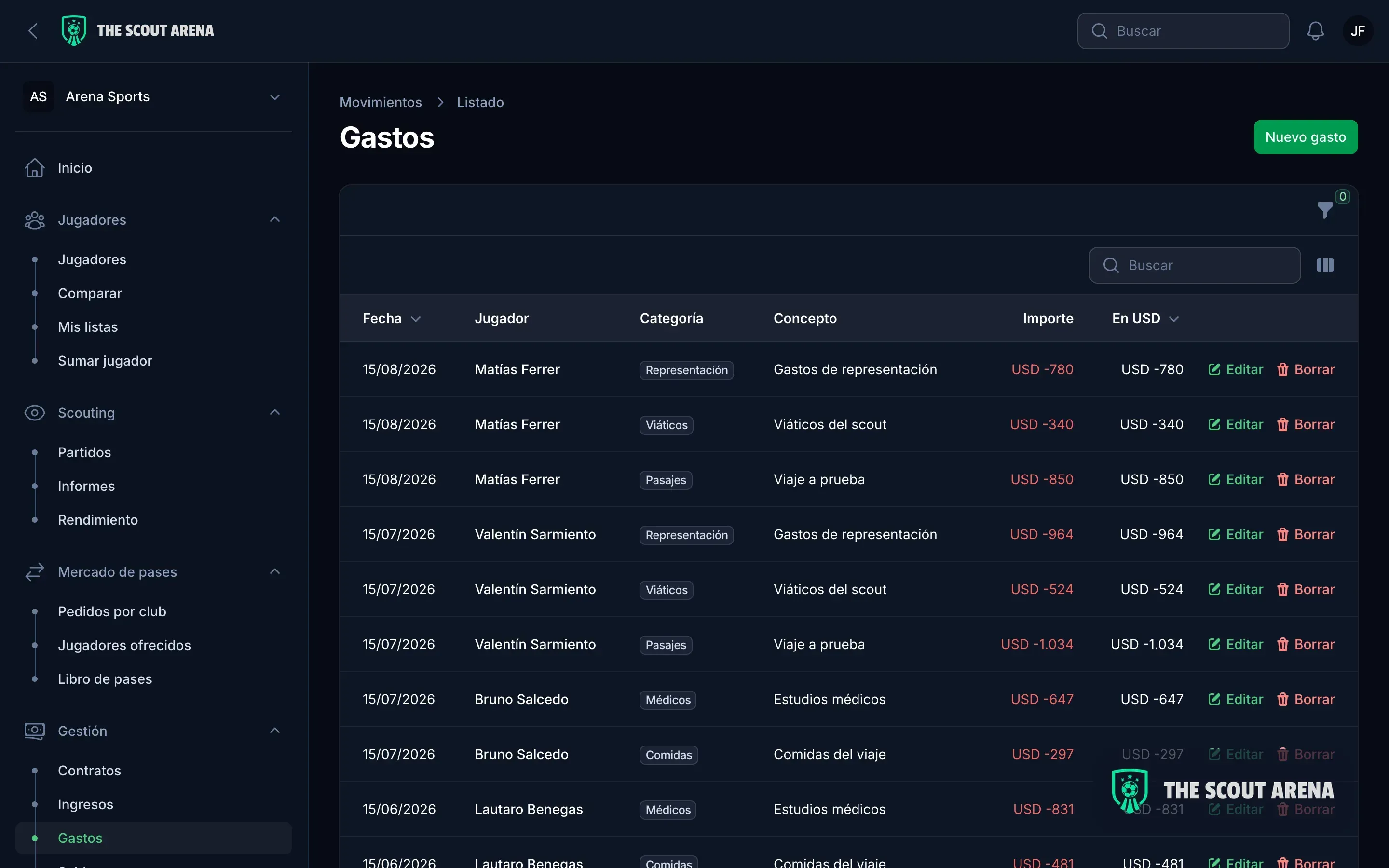
Define the categories once and keep them to ten or twelve: if everyone invents their own, by the end of the year you have “travel”, “flights”, “airfare” and “transport” and nobody can add anything up. An example with made-up data: “15/08 · Matías Ferrer · Flights · Trip to trial · USD 850 · paid by Julia · receipt attached.”
How should expenses in several currencies be recorded?
In the currency they were paid in, with the day’s exchange rate noted alongside. An agency with players across several countries pays flights in dollars, rent in euros and paperwork in local currency, sometimes in the same week. If everything is converted at the end of the month at that day’s rate, the figures change depending on when you do the sum, and nobody can trace where each amount came from.
The rule is simple: the original amount is never touched, the conversion into the agency’s reference currency uses the rate on the date of the expense, and totals are read in that reference currency. That way a player’s report gives the same answer today as it will in a year.
How often should an agency review its expenses?
Record them on the day. Review them once a month, at month end: no receipt missing, every expense assigned to a player or marked as an overhead, and anything a team member paid up front reimbursed. Done a little at a time, it fits in the weekly half-hour suggested in football agent daily tasks.
Once a season it is worth a longer look, player by player: how much has been invested, how much has come in through commission and what is expected to come in. That is the figure to have before sitting down to renew a representation agreement, which under the regulations lasts two years at most and never renews automatically. What else to keep an eye on for each client is in player follow-up for agents.
How The Scout Arena keeps expenses in order
A spreadsheet works while one person fills it in and there is only one currency. It stops working when the scout travels, a partner pays for a dinner and whoever runs the admin has to guess which player each item belongs to. This is how The Scout Arena handles it (the screens come from a demo agency with made-up data):
- Every expense with its player, date and category. The categories are the agency’s own, not a fixed list, and you can see how much has been invested in each player.
- Several currencies with the day’s exchange rate, and the agency’s consolidated balance.
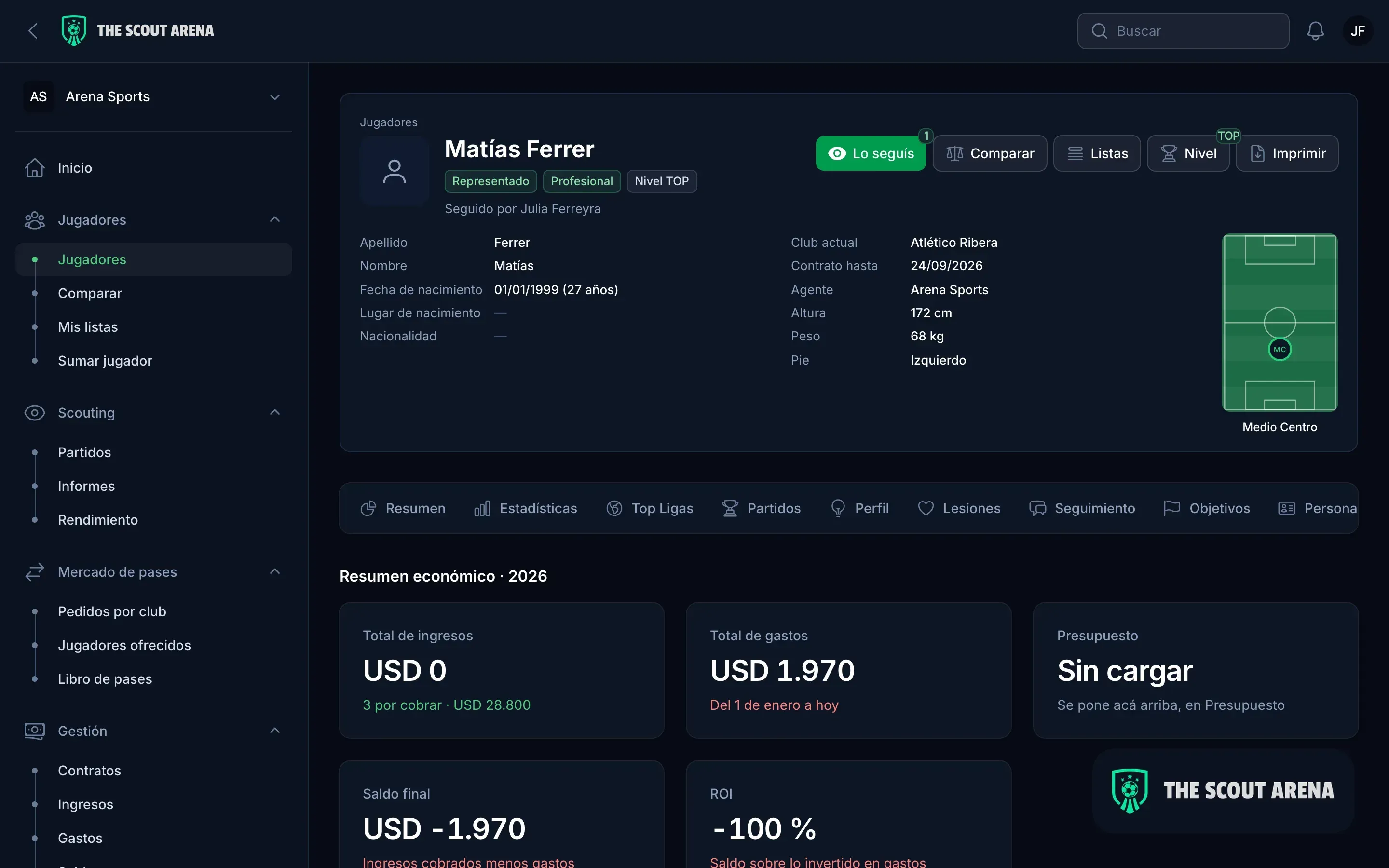
- The money inside the player profile: commission received, expenses and balance, on the same screen as their contract and reports. See contracts and commissions.
- An expenses report by player and by item, exported to Excel for the accountant and to PDF for the partners, or for the player who asks for the breakdown.
- Expenses from your phone. The WhatsApp assistant logs an expense with the amount, currency and player from a message, and asks for confirmation before saving it. You enter it at the airport rather than at the end of the month.
- Each role sees its own part. Whoever handles the admin sees expenses and balances; a scout files reports and follow-up but does not see the agency’s finances.
How this fits with contracts, expiry alerts and the rest of an agency’s work is on the page for football agents.
In short
Football agency expenses are kept in order by separating player expenses from overheads, recording each one on the day with its date, category, currency, exchange rate and receipt, and reviewing them once a month. That tells you how much the agency has invested in each footballer and lets you hand over the breakdown if they ask, as Article 18 of the FIFA Football Agent Regulations allows. And an expense meant to win a signature rather than to do the work may be an undue advantage, even if someone else at the agency paid it.
This article is for information only and is not legal or accounting advice. The regulatory points were checked against the FIFA editions cited at the top, as of October 2026; each national association may have its own rules on agents.
Sources
- FIFA Football Agent Regulations, in force since 1 January 2025 (PDF): Articles 11(3), 12(3), 16(3)(b) and 18(1)(e)
- FIFA Circular 1873: update on the implementation of the regulations (PDF, 30 December 2023)